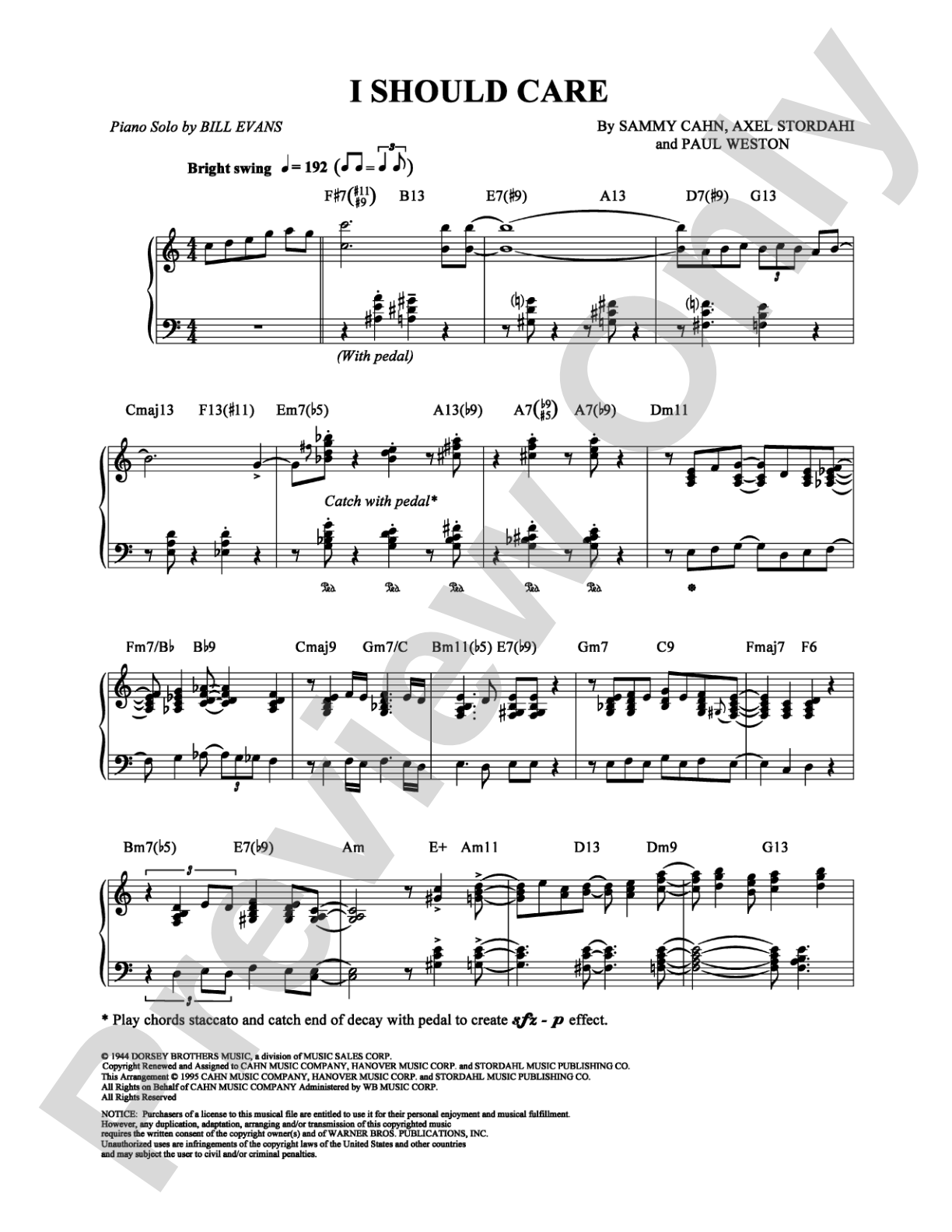
I Should Care: Piano Digital Sheet Music

I Should Care: Piano Digital Sheet Music

Sammy Cahn, Bill Evans, Axel Stordahl, Paul Weston

Item: 00-PS-0002580

Digital Download
$3.99
Description

I Should Care: Piano Digital Sheet Music isn't in MakeMusic Cloud just yet...but it could be. Let us know you'd like to see it, and you'll help shape what comes next. In the meantime, start a free trial and dive into thousands of interactive titles your students can play along with today.

Sample Audio
No sample audio found.
Sample Video
Additional Details
SKU: 00-PS-0002580

More about this title

About the Artist: Bill Evans

Bill Evans (1929-1980) stands among the most influential jazz pianists of the twentieth century. His harmonic sophistication, touch sensitivity, and ability to reimagine standards set a new standard for jazz piano and shaped how generations of musicians approach the instrument. Evans's work demonstrates that classical training and deep jazz vocabulary can coexist, making his interpretations invaluable models for pianists exploring both idioms.

Why we love this

Evans's treatment of this standard reveals why he remains essential listening for serious jazz pianists. His voicings are sophisticated yet singable, his touch is transparent, and his approach to form shows how a great player can honor a tune while making it entirely their own. This recording captures the kind of musical thinking that transcends genre boundaries.

What to expect

Thoughtful and introspective, Evans's reading unfolds with the intimacy of a private conversation about the tune's emotional content. His harmonic language transforms familiar changes into something fresh without losing the song's essential character, creating that rare balance between respect for tradition and artistic vision.

Who it's for

This is for pianists ready to study how great jazz musicians approach standards with serious harmonic knowledge and refined taste. It works equally well for classical pianists expanding into jazz or jazz students seeking a masterclass in voicing, touch, and interpretation.

How to get the most out of it

  • Study Evans's touch and dynamic control carefully. Listen for how he uses the sustain pedal to blend harmonies without muddying the texture, then apply this clarity to your own pedaling.
  • Pay attention to his comping and solo lines as separate voices. Notice where he accompanies himself and where he steps forward, using this contrast to shape phrase structure and interest.
  • Approach the harmonic reharmonization as language rather than decoration. Understand why each chord substitution works before you attempt to replicate it in your own playing.
  • Work on maintaining even time while allowing for the rubato Evans uses. His flexibility feels natural because his pulse underneath remains secure.

How to use it

Use this as a study score for jazz ensemble rehearsals or jazz history listening sessions. It pairs well with lead sheets or fake book versions of the same tune, encouraging students to compare their approaches with Evans's choices and understand how artists at this level make decisions about reharmonization and arrangement.

Skills your students will build

  • Voice leading across extended and altered chord voicings
  • Pedal technique and sustain control in jazz contexts
  • Listening for comping texture versus solo line independence
  • Harmonic reharmonization and chord substitution analysis
  • Rubato and time-feel coordination with underlying pulse

You May Also Like