I See, Satie: Piano/Vocal/Chords Digital Sheet Music

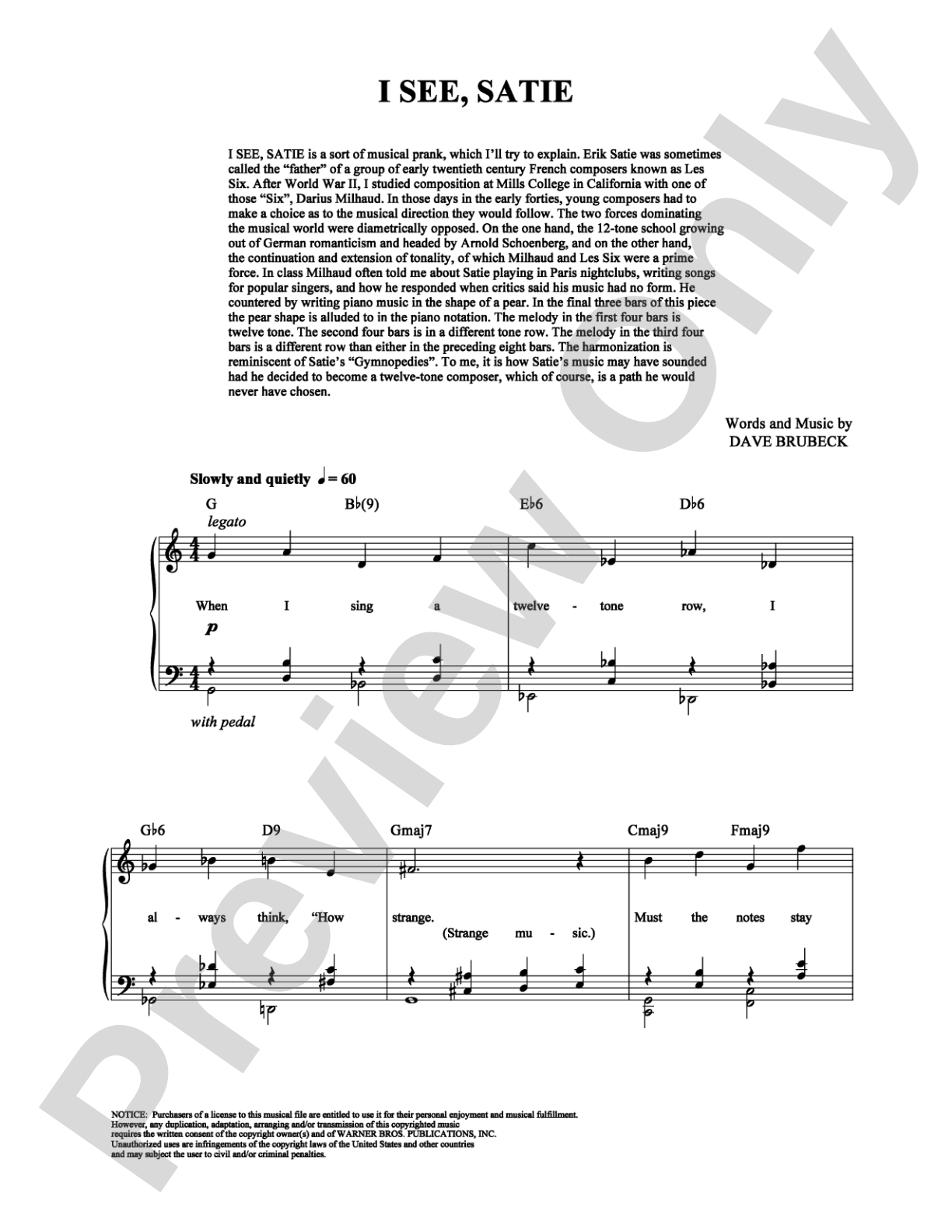
I See, Satie: Piano/Vocal/Chords Digital Sheet Music

Dave Brubeck

Item: 00-PS-0000958

Digital Download
$3.99
Description

I See, Satie: Piano/Vocal/Chords Digital Sheet Music isn't in MakeMusic Cloud just yet...but it could be. Let us know you'd like to see it, and you'll help shape what comes next. In the meantime, start a free trial and dive into thousands of interactive titles your students can play along with today.

Sample Audio
No sample audio found.
Sample Video
Additional Details
SKU: 00-PS-0000958

More about this title

About the Artist: Dave Brubeck

Dave Brubeck

Dave Brubeck earned his place in jazz history as both a virtuoso pianist and a prolific composer whose reach extended far beyond the jazz idiom. After studying with Darius Milhaud at Mills College following World War II, he synthesized classical training with jazz language, creating works across choral literature, orchestral pieces, chamber music, and solo repertoire. His 1959 album "Time Out" became the first jazz recording to sell over a million copies, anchored by the iconic "Take Five," yet his ambitions encompassed sacred music, ballet, and large-scale vocal works performed by ensembles like the London Symphony Orchestra.

Beyond his recording legacy, Brubeck used his prominence to challenge racial segregation in mid-20th century American music and performance spaces. His sacred works, including the mass "To Hope!" and oratorios such as "The Voice of the Holy Spirit," have been recorded and performed internationally from Austria to Russia. Recognition of his dual contributions came late but decisively: a Grammy Lifetime Achievement Award, the Presidential Medal of the Arts, induction into the American Classical Music Hall of Fame, and a lifetime achievement honor from the London Symphony Orchestra.

Why we love this

This is a chance to introduce students to Brubeck's melodic sophistication in a format they can sing and play together. The piano/vocal/chord arrangement keeps the focus on his songwriting gift while remaining accessible for rehearsal, and the digital format means you can print exactly what you need without managing full octavos.

What to expect

The song carries the thoughtful lyricism Brubeck brought to his songwriting, where jazz inflection serves melody rather than overshadowing it. There's an introspective quality here, a moment to breathe and listen rather than flash and dazzle.

Who it's for

This works for pianists accompanying vocalists in jazz or contemporary settings, singers preparing jazz standards or crossover repertoire, and ensembles exploring Brubeck's accessible melodic writing. Voice students and jazz pianists can also use this to understand how Brubeck balanced singable melody with harmonic sophistication.

How to get the most out of it

  • Let the chord symbols guide your harmonic interpretation rather than playing only what's written; jazz voicings reward subtle reharmonization that complements the vocalist's line.
  • Shape the melody with natural breath points that match the singer's phrasing, not just the written bar lines.
  • Listen for the swing feel implicit in Brubeck's rhythmic language; rhythmic precision without rigidity makes the difference between notation and music.

How to use it

Pair this with other jazz standards or American songbook selections to build a recital segment exploring twentieth-century vocal writing. It also serves as a bridge repertoire option for classical singers interested in jazz idiom or for mixed ensembles broadening their stylistic range.

Skills your students will build

  • Reading chord symbols and interpreting jazz voicings
  • Coordinating vocal phrasing with piano accompaniment
  • Understanding swing rhythm and jazz articulation
  • Balancing melody-driven arrangement with harmonic sophistication

You May Also Like