
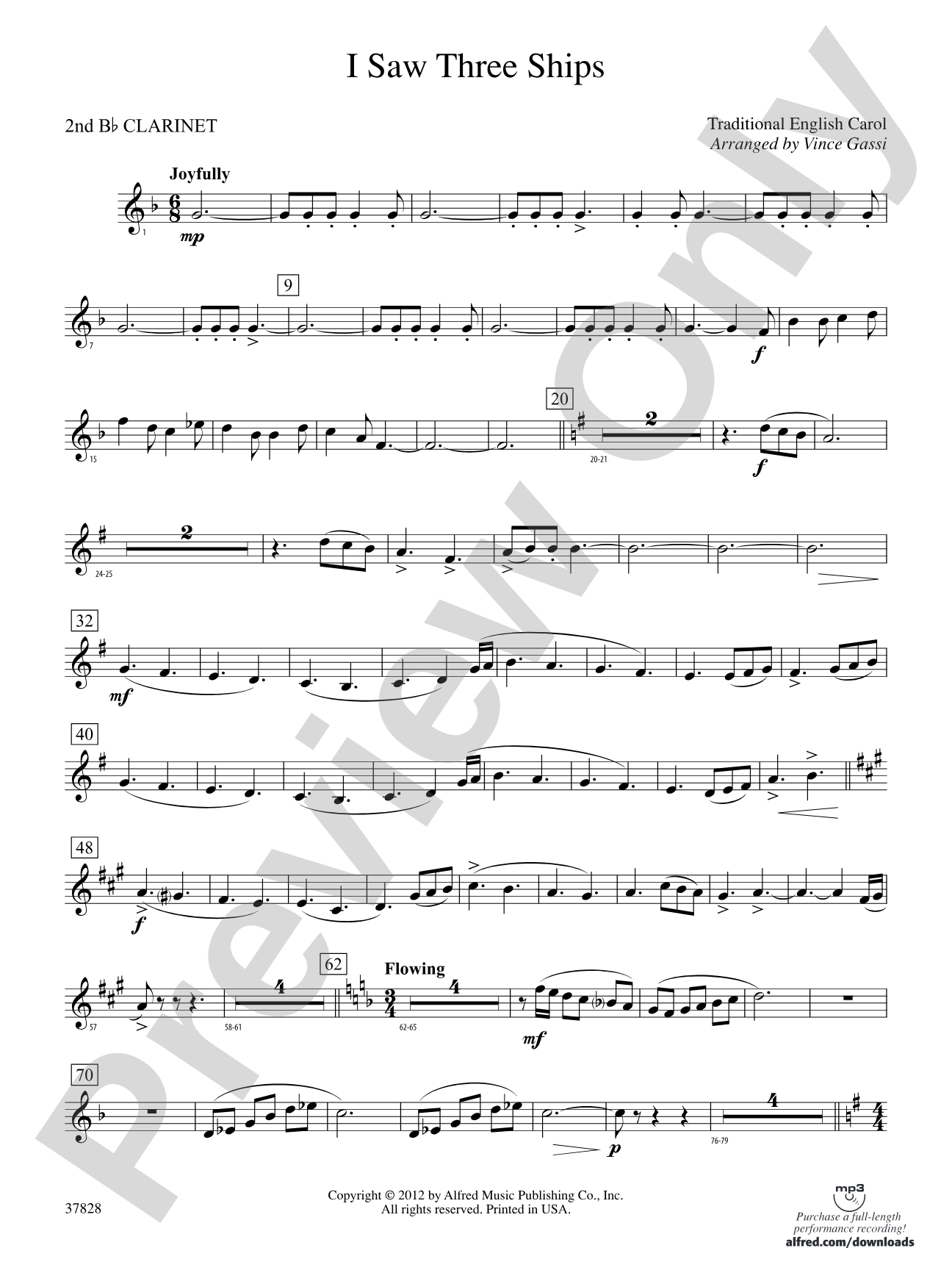

I Saw Three Ships: 2nd B-flat Clarinet
Traditional / arr. Vince Gassi
Grade: 3 (Medium)
Item: 00-PC-0015358_C2
$3.00
Pickup currently not available
Description
With skill, artistry, and a touch of sugar frosting, Vince Gassi has crafted another Christmas favorite. This lovely arrangement is based on a 17th century English carol. The melody is presented in a variety of keys and meters while a sense of joy and warmth is maintained throughout this uplifting work.


Don't just read it, hear it, play along with it, and watch your students grow with it. In MakeMusic Cloud, I Saw Three Ships: 2nd B-flat Clarinet comes alive with professional accompaniment, adjustable tempo, and built-in practice tools that turn solo practice into real progress.
Open in the Player
Jump straight in and assign it today.
Start Your Free Trial
Open this title and explore the full library in minutes.
Sample Audio
1
Audio File
--:--
0:00
0:00
Sample Video
No sample videos found.
Additional Details
Series:
Alfred Concert Band
Publisher:
Alfred Music
Page Count:
266
SKU:
00-PC-0015358_C2
More about this title
About the Arranger: Vince Gassi

Vince Gassi has spent twenty-five years teaching instrumental music at the elementary and secondary school levels while establishing himself as one of today's most prolific arrangers and composers. His catalog of over 100 published works demonstrates a gift for creating music that challenges young musicians without overwhelming them, and his arrangements consistently appear on festival and contest programs across North America, Europe, and Japan.
Gassi holds a Bachelor of Music from the University of Western Ontario and studied composition and arranging at the Dick Grove School of Music in Los Angeles before completing his Ph.D. at York University in Toronto. Beyond composing, he is a sought-after guest conductor, clinician, and adjudicator whose workshops on creative engagement and digital workflows for music directors have influenced how teachers approach rehearsal and student involvement.
Why we love this
Gassi's treatment of this 17th century carol finds fresh energy in a constantly shifting harmonic and metric landscape while never losing the warmth and simplicity that make the tune so beloved. The varying keys and meters keep student musicians engaged and attentive rather than coasting through a predictable arrangement, and the Grade 3 scoring remains accessible without sacrificing musical interest.
What to expect
Festive and luminous without sentimentality. The arrangement moves through different harmonic colors and metric signatures with an almost conversational quality, as if the carol is being told from various perspectives. There's a sense of discovery throughout; what begins as a familiar tune becomes something you hear anew.
Who it's for
Concert bands at the Grade 3 level seeking a Christmas piece that engages students musically rather than serving as filler. Directors who want their holiday programming to include a traditional melody but prefer an arrangement with harmonic and structural interest will find this especially valuable.
How to get the most out of it
- Balance the melody across different sections as it shifts between instruments; mark your score to indicate which players carry the tune in each variation so the band doesn't overwhelm the featured line.
- Maintain a steady, warm tempo despite the meter changes. The transitions feel natural when the pulse remains confident rather than hesitant.
- Shape each key area distinctly without dragging between modulations. A slight lift into each new key helps the arrangement feel developmental rather than episodic.
- Let the joy come through in the articulation and phrasing; avoid a heavy or overly cautious approach even at this accessible level.
How to use it
Pair this with a simpler carol arrangement and a more contemporary holiday work to create a balanced holiday concert that appeals to both traditional and modern tastes. The Grade 3 difficulty makes it appropriate for a mid-season holiday concert without overwhelming students still building their ensemble skills.
Skills your students will build
- Reading multiple meter signatures (maintaining pulse through time signature changes)
- Following a melody through various key areas and instrumental combinations
- Balancing transparent textures so soloists and featured sections project clearly
- Responding to harmonic color changes and maintaining style across different tonal centers