
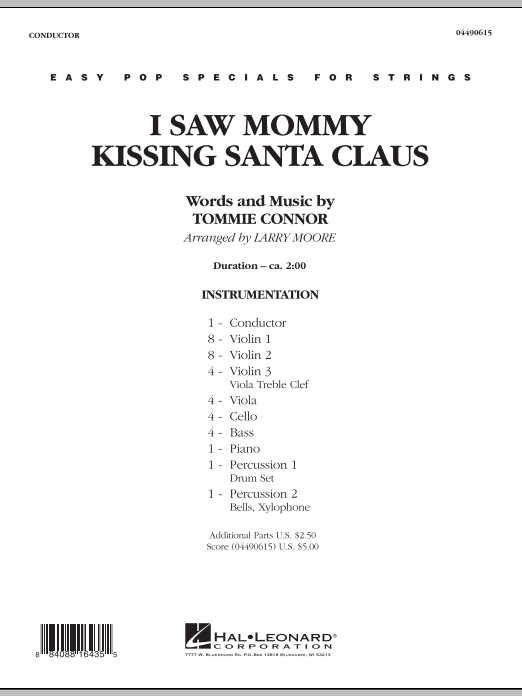

I Saw Mommy Kissing Santa Claus: String Orchestra Conductor Score & Parts
By Tommie Connor / Arranged by Larry Moore
Grade: 2-3
Item: 35-PK00096459
$40.00
Pickup currently not available
Buy Extra Parts (Digital PDF Download)
Parts Added to Cart!
Description
This lighthearted holiday favorite is arranged specifically for younger groups with careful use of syncopation, solid inner part writing, and optional festive, entertaining percussion parts. Add a frontline of softshoe dancing Santas to put this clever program number over the top at your next holiday show. Dur: 2:00


I Saw Mommy Kissing Santa Claus: String Orchestra Conductor Score & Parts isn't in MakeMusic Cloud just yet...but it could be. Let us know you'd like to see it, and you'll help shape what comes next. In the meantime, start a free trial and dive into thousands of interactive titles your students can play along with today.
Request This Title
Tell us you want it.
Start Your Free Trial
Explore everything that's ready to play right now.
Sample Audio
No sample audio found.
Sample Video
No sample videos found.
Additional Details
Publisher:
Hal Leonard
SKU:
35-PK00096459
More about this title
About the Composer: Tommie Connor
Tommie Connor wrote "I Saw Mommy Kissing Santa Claus" in 1952, and the song became an instant classic that has delighted audiences across generations. His gift for writing instantly memorable melodies with genuine warmth made him a significant figure in mid-century popular songwriting, and this particular composition remains one of his most enduring contributions to holiday music.
Why we love this
Larry Moore's arrangement captures the playful mischief at the heart of this tune while keeping the technical demands reasonable for developing players. The syncopated figures feel fresh without overwhelming younger groups, and the optional percussion parts give you genuine flexibility in how elaborate your staging can become. When you pair this with even simple choreography, you've got a show-stopper that audiences genuinely love.
What to expect
There's infectious joy in this arrangement, a kind of conspiratorial wink that makes performers and audiences alike smile knowingly. The syncopation gives it contemporary snap while the melodic simplicity ensures that listeners recognize the beloved tune instantly, creating that comfortable blend of familiar and clever that makes holiday performances so satisfying.
Who it's for
This arrangement serves younger string orchestras and developing ensembles that want a crowd-pleasing holiday showpiece without overreaching technically. It works equally well for groups looking to add theatrical staging to their concerts or for those prioritizing solid fundamentals with enjoyable repertoire.
How to get the most out of it
- Shape the syncopation with light articulation in the rhythm section; let the staccato figures breathe rather than crisp them into rigidity, which will keep the playfulness intact.
- Balance the melody carefully between your first violins and any featured instruments so the tune remains instantly recognizable even when inner parts become busier.
- Coordinate with your dancers early by running through the accompaniment separately first, then layering in the movement in rehearsals once your ensemble has secure rhythmic control.
- Treat the optional percussion as an enhancement rather than a necessity; the piece works beautifully with or without it, so use those parts only if your students are genuinely comfortable with the added complexity.
How to use it
Position this as your finale or as a strategic palate cleanser between heavier seasonal works; two minutes of pure entertainment gives audiences a genuine lift. The theatrical potential makes it ideal for a full holiday concert where you can fully embrace the staging possibilities, or use it as a standalone opener for a shorter winter celebration where you want to establish an immediate festive mood.
Skills your students will build
- Reading and executing syncopated rhythmic figures
- Maintaining rhythmic precision while executing coordinated choreography
- Balancing melody and inner harmony in a homophonic texture
- Responding to conductor cues during rhythmically active passages