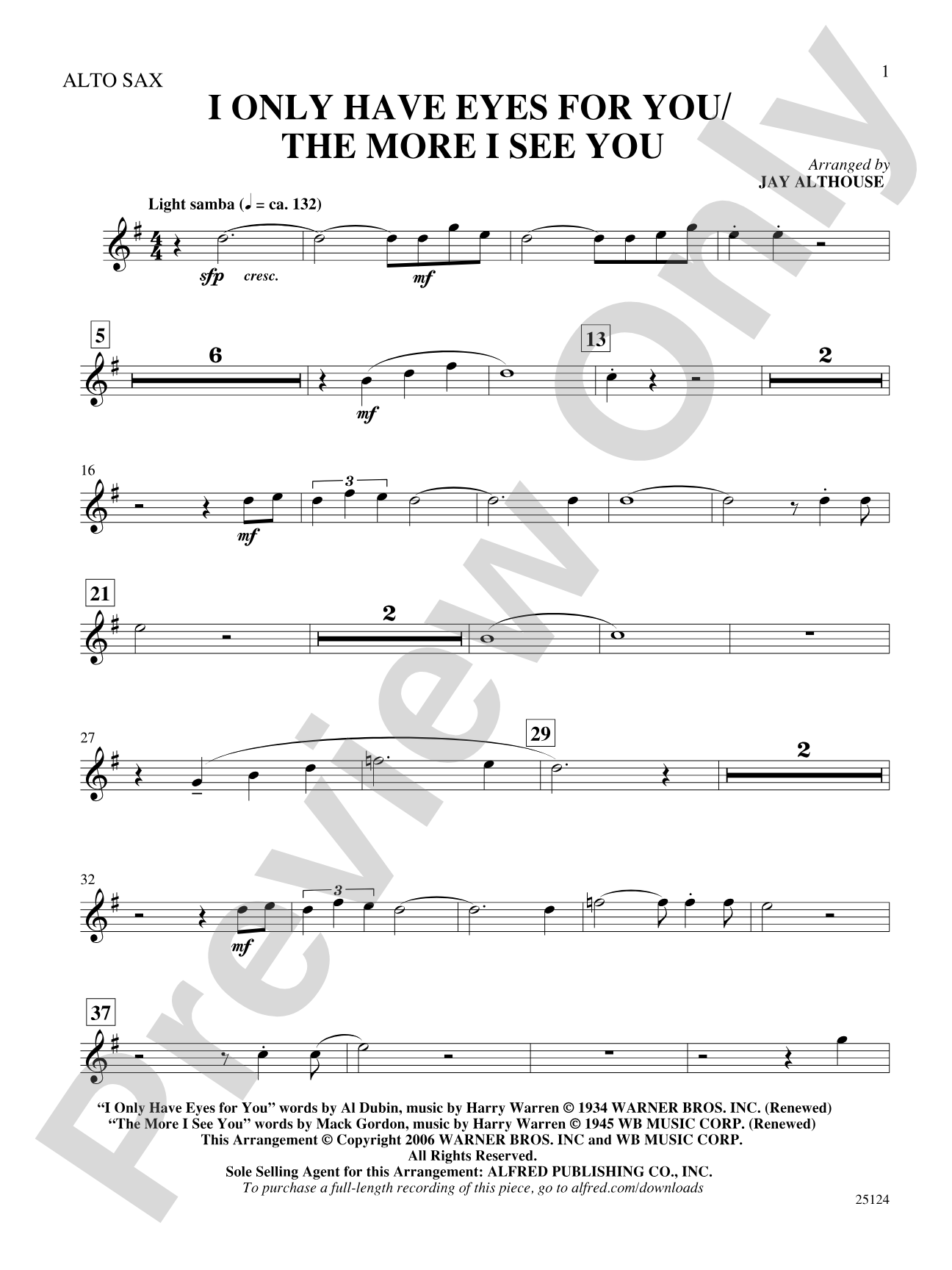
I Only Have Eyes for You / The More I See You: E-flat Alto Saxophone Sheet Music Preview

I Only Have Eyes for You / The More I See You: E-flat Alto Saxophone: Choral SoundPax

By Al Dubin, Mack Gordon, and Harry Warren / arr. Jay Althouse

Item: 00-PC-0015663_AX1

Digital Download
$4.00
Description
Parts included are: a. sax., t. sax., tpt., tbn., rhy.

Don't just read it, hear it, play along with it, and watch your students grow with it. In MakeMusic Cloud, I Only Have Eyes for You / The More I See You: E-flat Alto Saxophone: Choral SoundPax comes alive with professional accompaniment, adjustable tempo, and built-in practice tools that turn solo practice into real progress.

Sample Audio
0:00
0:00
Sample Video
Additional Details
Series: Alfred Pop Choral Series
Publisher: Alfred Music
Page Count: 28
SKU: 00-PC-0015663_AX1
Instrumentation: a. sax., t. sax., tpt., tbn., rhy.

More about this title

About the Composer: Al Dubin

Al Dubin (1891-1945) was a lyricist whose career spanned the transition from vaudeville to film musicals in Hollywood's golden age. He collaborated with composer Harry Warren on some of the era's most enduring standards, crafting lyrics that balanced sophistication with accessibility. Dubin's work defined the sound of 1930s popular song and remains a cornerstone of the Great American Songbook.

Why we love this

Jay Althouse's arrangement captures the elegance of these two standards while keeping the choral writing singable and engaging across mixed ability levels. The addition of a small jazz ensemble (saxophones, trumpet, trombone, and rhythm section) lifts the piece beyond a traditional choral setting, giving singers genuine ensemble partners to blend with and learn from. This is exactly the kind of sophisticated-but-achievable repertoire that reminds choirs why these songs have lasted nearly a century.

What to expect

Sophisticated yet approachable, with the warmth of classic songwriting and the rhythmic ease of swing. The instrumental parts add color and authenticity without overwhelming the voices, creating a sound that feels like stepping into a mid-century supper club where the singers are the real attraction.

Who it's for

This arrangement serves choirs that want to venture into jazz and popular repertoire without abandoning choral craft. It works equally well for high school ensembles seeking accessible Great American Songbook material and community or church choirs looking to expand beyond traditional choral fare.

How to get the most out of it

  • Balance the choir's dynamics to complement rather than overpower the instrumental parts, especially the sax solos. The ensemble should support the arrangement's conversational quality rather than dominate it.
  • Work the transition between the two songs deliberately. Establish clear phrase shapes in each so the shift feels intentional rather than abrupt.
  • Use the recorded accompaniment to lock ensemble rhythms, particularly in sections where the rhythm section sits behind the voices. This trains singers to listen horizontally and maintain independence.

How to use it

Use this as a palate cleanser in concerts featuring more classical or sacred work, or program it alongside other pop standards to build a full set. It also serves as an excellent introduction to jazz interpretation for choirs transitioning into that idiom.

Skills your students will build

  • Jazz phrasing and swing rhythms
  • Balancing voices with small ensemble accompaniment
  • Reading notation with syncopated rhythmic patterns
  • Interpretive choices in popular song (rubato, dynamics, articulation)
  • Blend and intonation in a stylistically different context

You May Also Like