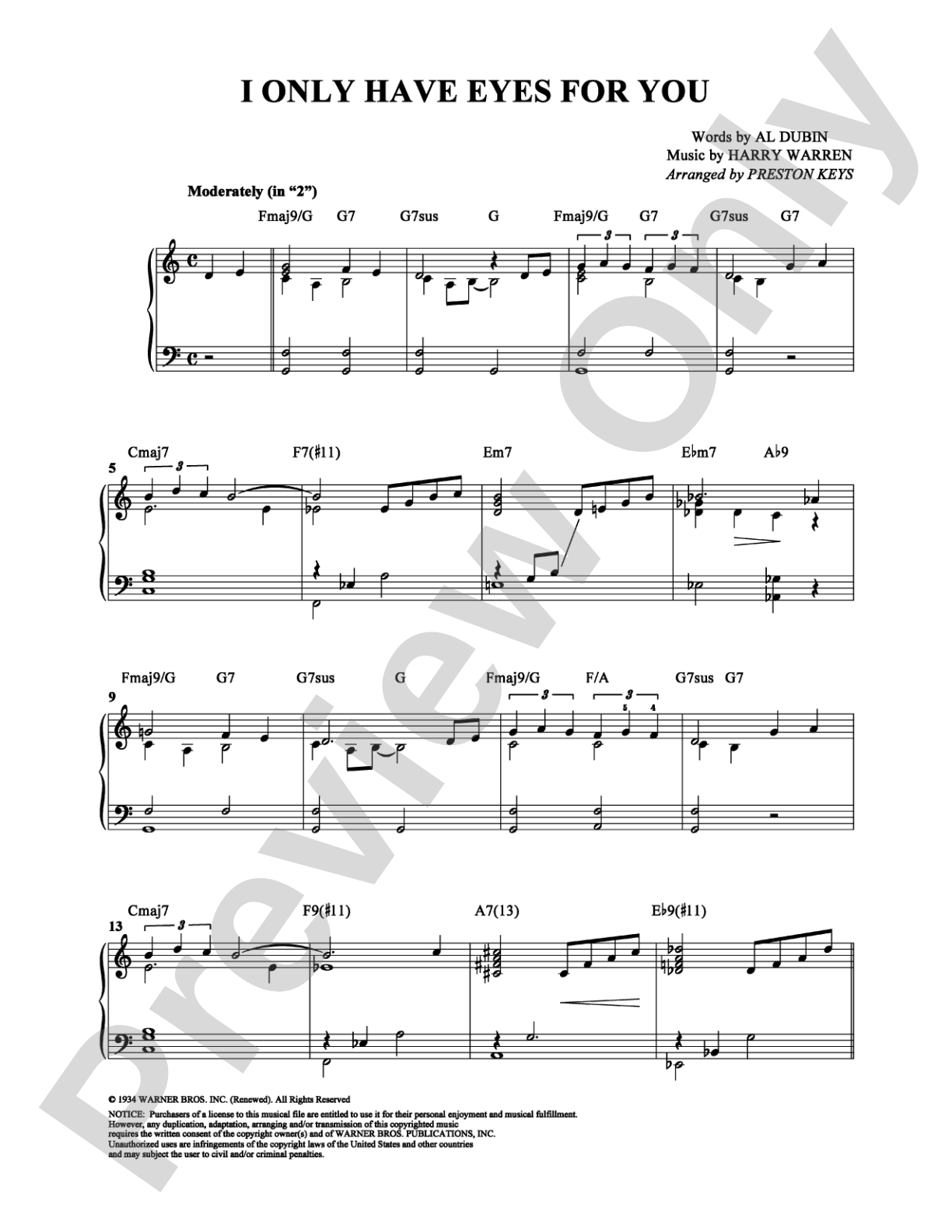
I Only Have Eyes For You: Piano Digital Sheet Music

I Only Have Eyes For You: Piano Digital Sheet Music

Harry Warren

Item: 00-PS-0008499

Digital Download
$3.99
Description

I Only Have Eyes For You: Piano Digital Sheet Music isn't in MakeMusic Cloud just yet...but it could be. Let us know you'd like to see it, and you'll help shape what comes next. In the meantime, start a free trial and dive into thousands of interactive titles your students can play along with today.

Sample Audio
No sample audio found.
Sample Video
Additional Details
SKU: 00-PS-0008499

More about this title

Why we love this

This standard sits perfectly in the sweet spot between accessibility and sophistication. The melody is instantly singable, but the harmonic movement gives pianists real interpretive choices about touch, pedaling, and rubato.

What to expect

Warm and intimate, with the kind of nostalgia that comes from 1930s songwriting. The melody has a gentle insistence to it, moving with unhurried grace while the harmonies suggest both romance and mild melancholy.

Who it's for

Piano students comfortable with lead sheet interpretation and jazz-inflected harmony; pianists preparing for recitals, casual performance settings, or exploring the Great American Songbook. Teachers looking for a standard that engages intermediate players without requiring extensive classical training.

How to get the most out of it

  • Shape the melody with your right hand while keeping the accompaniment conversational; resist playing it as background music.
  • Experiment with pedal changes at harmonic shifts rather than holding the sustain pedal throughout entire phrases.
  • Lean into the natural rubato this ballad invites, especially on the song's quieter moments.

How to use it

Pair this with other jazz standards or contemporary pop arrangements on a recital to show stylistic range. It also works well as a warm-up or opening number at community events, where its familiarity puts audiences at ease.

Skills your students will build

  • Interpreting lead sheets and realizing implied harmonies
  • Balancing melody projection with sensitive accompaniment textures
  • Using pedal intentionally rather than automatically
  • Applying rubato and phrase shaping in non-classical contexts

You May Also Like