I'm So in Love with You: Piano/Vocal/Chords Digital Sheet Music

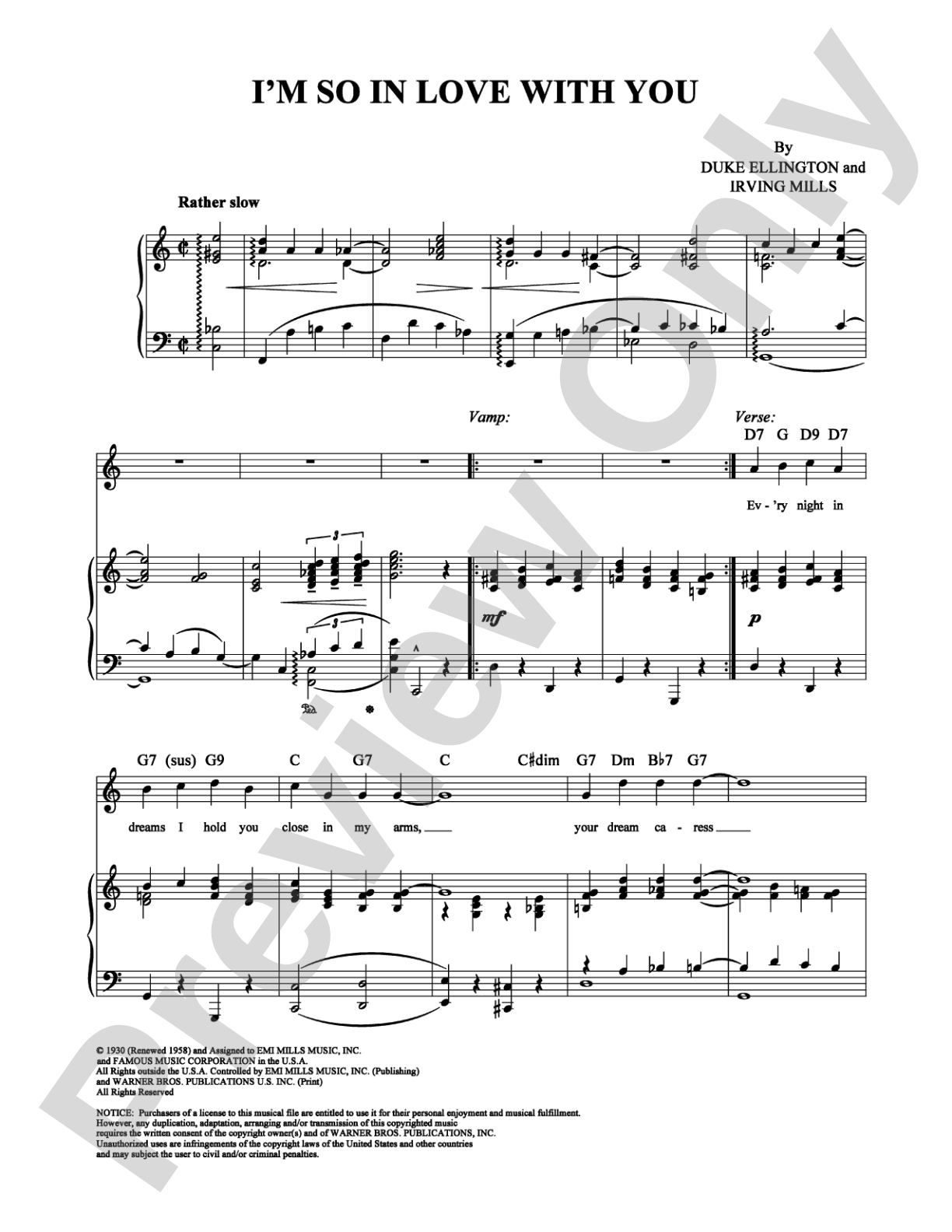
I'm So in Love with You: Piano/Vocal/Chords Digital Sheet Music

Duke Ellington, Irving Mills

Item: 00-PS-0007551

Digital Download
$3.99
Description

I'm So in Love with You: Piano/Vocal/Chords Digital Sheet Music isn't in MakeMusic Cloud just yet...but it could be. Let us know you'd like to see it, and you'll help shape what comes next. In the meantime, start a free trial and dive into thousands of interactive titles your students can play along with today.

Sample Audio
No sample audio found.
Sample Video
Additional Details
SKU: 00-PS-0007551

More about this title

About the Artist: Duke Ellington

Duke Ellington (1899-1974) stands among the most consequential composers in American music history. His prolific output ranged from extended concert works to intimate jazz standards, and he maintained creative control over both composition and arrangement throughout a career spanning five decades.

Ellington's harmonic sophistication and orchestral imagination shaped modern jazz itself. His influence on music education extends far beyond jazz programs; his works appear across classical, contemporary, and educational curricula because they demonstrate how disciplined compositional craft operates within improvisational frameworks.

Why we love this

Ellington's melodic gift ensures this standard sits gracefully for singers of varying levels, while the chord changes reward pianists who want to explore reharmonization and jazz accompaniment techniques. The piece balances accessibility with sophistication, making it equally useful for jazz ensemble contexts and art song recitals.

What to expect

Warmth and directness define this piece. The melody unfolds with the confidence of someone who knows exactly what they want to say, and Ellington's harmonies provide elegant support without ever overshadowing the emotional clarity of the text.

Who it's for

This is for jazz singers developing their standard repertoire and pianists seeking authentic Ellington material for accompanying or solo performance. It works equally well for music students exploring jazz composition and arranging through close study of a master's harmonic language.

How to get the most out of it

  • Shape the vocal line with jazz phrasing rather than classical legato; let the rhythm section breathe around the melody instead of locking rigidly to a click.
  • Treat the piano accompaniment as a conversation partner. Listen for spaces where you can voice the chords more densely or sparsely depending on what the singer needs.
  • Pay attention to Ellington's harmonic substitutions in the changes; they reward a pianist who learns the underlying structure before improvising alterations.
  • Establish a comfortable tempo that lets the lyrics breathe without rushing sentiment; standards in this era typically favor stability over pushing the tempo for excitement.

How to use it

Pair this with other standards from Ellington's American songbook output in a jazz vocal recital, or program it as a bridge between classical and jazz contexts in a mixed-genre concert. It works particularly well in educational settings where students study how jazz composition shaped popular music.

Skills your students will build

  • Jazz phrasing and rubato within a written melody
  • Reading and interpreting chord symbols in jazz contexts
  • Harmonic analysis of jazz substitutions and voice leading
  • Collaborative listening between vocalist and pianist
  • Understanding song form and harmonic structure in standards

You May Also Like