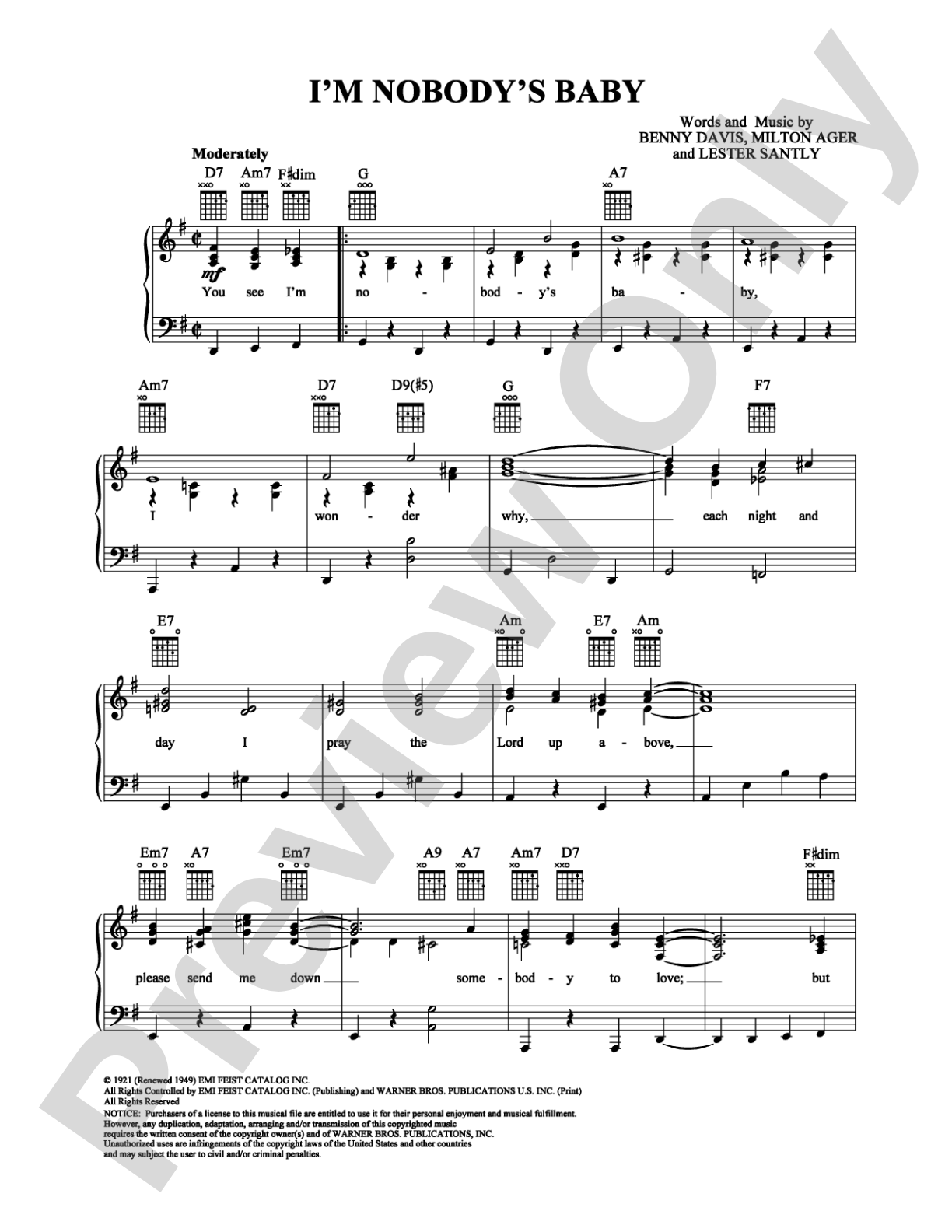
I'm Nobody's Baby: Piano/Vocal/Chords Digital Sheet Music

I'm Nobody's Baby: Piano/Vocal/Chords Digital Sheet Music

Milton Ager, Benny Davis, Lester Santly, Bobby Sherwood

Item: 00-PS-0007265

Digital Download
$3.99
Description

I'm Nobody's Baby: Piano/Vocal/Chords Digital Sheet Music isn't in MakeMusic Cloud just yet...but it could be. Let us know you'd like to see it, and you'll help shape what comes next. In the meantime, start a free trial and dive into thousands of interactive titles your students can play along with today.

Sample Audio
No sample audio found.
Sample Video
Additional Details
SKU: 00-PS-0007265

More about this title

About the Artist: Bobby Sherwood

Bobby Sherwood (1910-1980) was a jazz violinist, bandleader, and composer who bridged the swing era and early rhythm and blues. His work as both performer and recording artist made him a fixture in 1930s and 1940s popular music, and he composed several standards that became favorites of vocalists and jazz musicians alike.

Why we love this

This song captures the bittersweet yearning of 1930s popular ballads without veering into sentimentality. The chord changes are straightforward enough for students building piano/vocal fluency, yet the emotional arc rewards attention to phrasing and lyrical interpretation. It's a genuine period piece that teaches era-appropriate style.

What to expect

Wistful and gently melancholic, with the warmth of a late-night radio broadcast from another era. The melody sits in a natural range for the voice, and the harmonic language feels both familiar and slightly bittersweet, inviting performers to mine emotional nuance from simple, honest chord progressions.

Who it's for

Pianists and singers preparing period-appropriate vocal repertoire for recital or performance class will find this accessible and musically satisfying. It also works well for jazz singers exploring standards from the swing era with a clear lead sheet.

How to get the most out of it

  • Sing the melody freely within the underlying harmonic grid rather than metrically strict; the piano part should breathe with your phrasing.
  • Emphasize the contrast between the verse's introspection and any lift in the refrain by adjusting both dynamic and tempo slightly.
  • Balance the vocal line so the piano chords remain supportive but audible; these chord voicings are part of the song's nostalgic character.

How to use it

Pair this with other period standards to build a nostalgia-themed recital or showcase the evolution of American popular song. It also serves as an excellent audition or jury piece for singers and collaborative pianists working with early 20th-century vocal repertoire.

Skills your students will build

  • Sight-reading chord symbols and realizing accompaniment from lead sheets
  • Stylistic interpretation of 1930s-1940s vocal phrasing and rubato
  • Balancing vocal melody with harmonic support in piano/vocal collaboration
  • Reading and performing notation in moderate-difficulty vocal ranges

You May Also Like