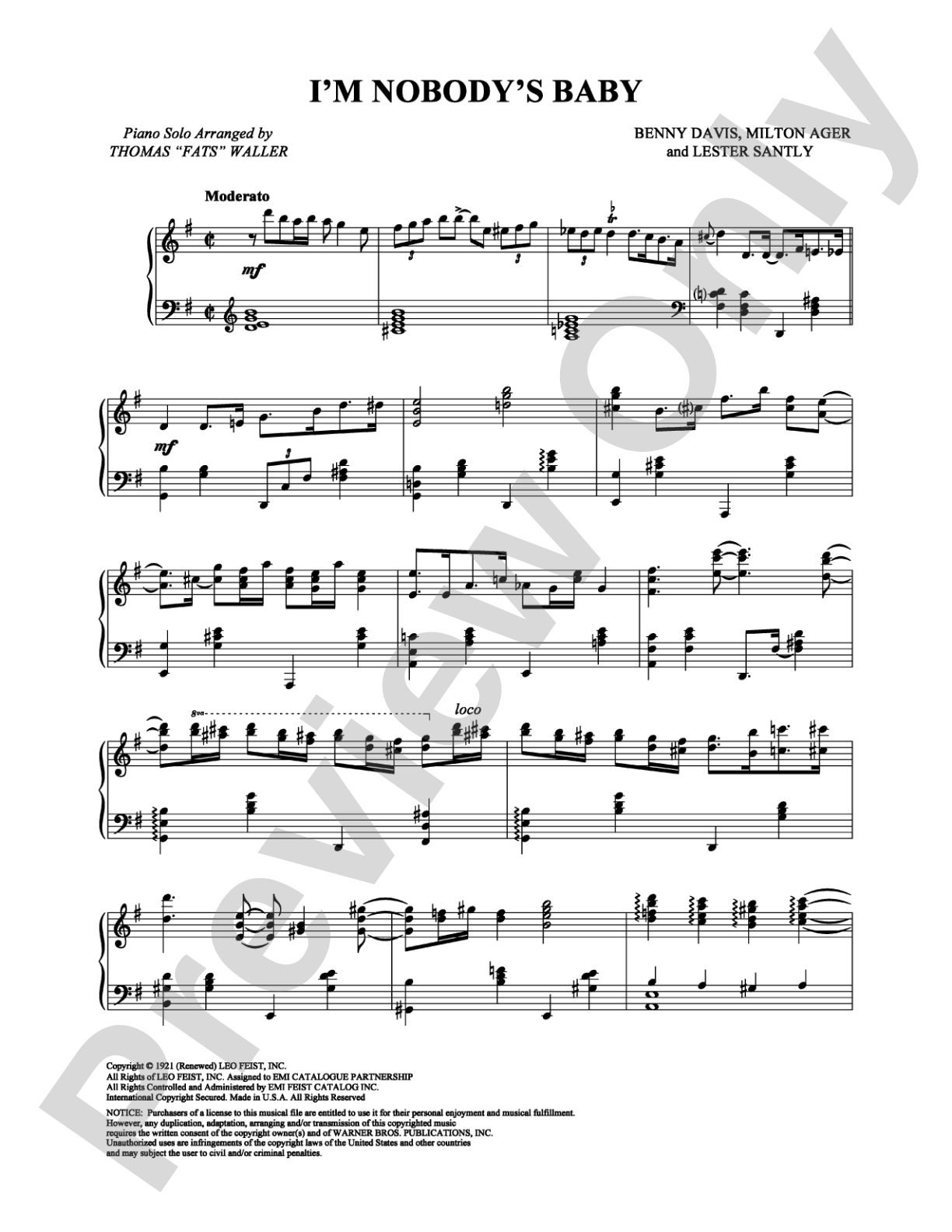
I'm Nobody's Baby: Piano Digital Sheet Music

I'm Nobody's Baby: Piano Digital Sheet Music

Milton Ager, Fats Waller, Benny Davis, Lester Santly

Item: 00-PS-0007264

Digital Download
$3.99
Description

I'm Nobody's Baby: Piano Digital Sheet Music isn't in MakeMusic Cloud just yet...but it could be. Let us know you'd like to see it, and you'll help shape what comes next. In the meantime, start a free trial and dive into thousands of interactive titles your students can play along with today.

Sample Audio
No sample audio found.
Sample Video
Additional Details
SKU: 00-PS-0007264

More about this title

About the Artist: Fats Waller

Thomas "Fats" Waller (1904-1943) was a pianist, organist, and composer who became one of jazz's most influential figures during the swing era. His harmonic sophistication, rhythmic vitality, and infectious sense of humor shaped the sound of American jazz and popular song in the 1920s and 1930s. Beyond his virtuosic keyboard work, Waller composed or co-composed hundreds of songs that remain central to jazz repertoire, including "Ain't Misbehavin'," "Black and Blue," and "Honeysuckle Rose."

Waller's legacy extends far beyond his recordings and performances. His improvisational approach to jazz piano, marked by stride technique, sophisticated comping, and melodic invention, continues to influence pianists and composers across genres. For music educators, Waller's work demonstrates how technical mastery, harmonic understanding, and personality combine to create music that endures.

Why we love this

This standard gives pianists a real taste of swing-era sophistication without requiring advanced stride technique. The harmonic movement is smart enough to deepen jazz understanding, and the melody is infectious enough to keep students engaged through multiple run-throughs. You can use it as a springboard for discussing jazz piano history or simply as a rewarding piece that sounds better the more you practice it.

What to expect

Buoyant and witty, with that unmistakable early-swing character that feels both refined and playful. The melody bounces with warmth, and the harmonic movement invites you to participate in the conversation rather than simply deliver the notes. There's a lightness here, an ease, that comes from music written by someone who loved to play.

Who it's for

Jazz pianists working on standard repertoire, from intermediate players building their jazz vocabulary to advanced students exploring swing-era interpretation. This also serves pianists who want to understand how jazz comping and melody interact, and students interested in the connection between stride tradition and modern jazz playing.

How to get the most out of it

  • Approach the rhythmic feel as essential to the piece's character. The notation gives you the skeleton, but the swing behind it is what makes it swing. Listen to Waller's original recording multiple times to internalize the pocket.
  • Let the harmonic changes dictate your comping choices. Rather than playing block chords, explore how the harmony can inform your left hand voicings, especially during the B section.
  • Shape the melody with dynamic clarity. Jazz standards live and die by phrasing, so avoid treating every note equally. Give weight to the strong beats and let the weaker ones breathe.
  • Stay grounded rhythmically when improvising on changes. If you're adding your own interpretation, remember that Waller built his solos on solid time and clear harmonic awareness, not technical flash.

How to use it

Feature this in a jazz standards recital alongside other Waller compositions or comparable swing-era pieces to show the depth of the songbook. It works equally well as a solo encore or as part of a longer program that traces jazz piano history. Consider pairing it with a more uptempo Waller tune to showcase different sides of his writing.

Skills your students will build

  • Reading and performing jazz articulation and swing rhythm
  • Comping with sophisticated jazz voicings and chord substitutions
  • Interpreting melody with phrasing and dynamics appropriate to the swing era
  • Understanding harmonic movement in standards and finding improvisational pathways
  • Balancing technical execution with groove and feel

You May Also Like