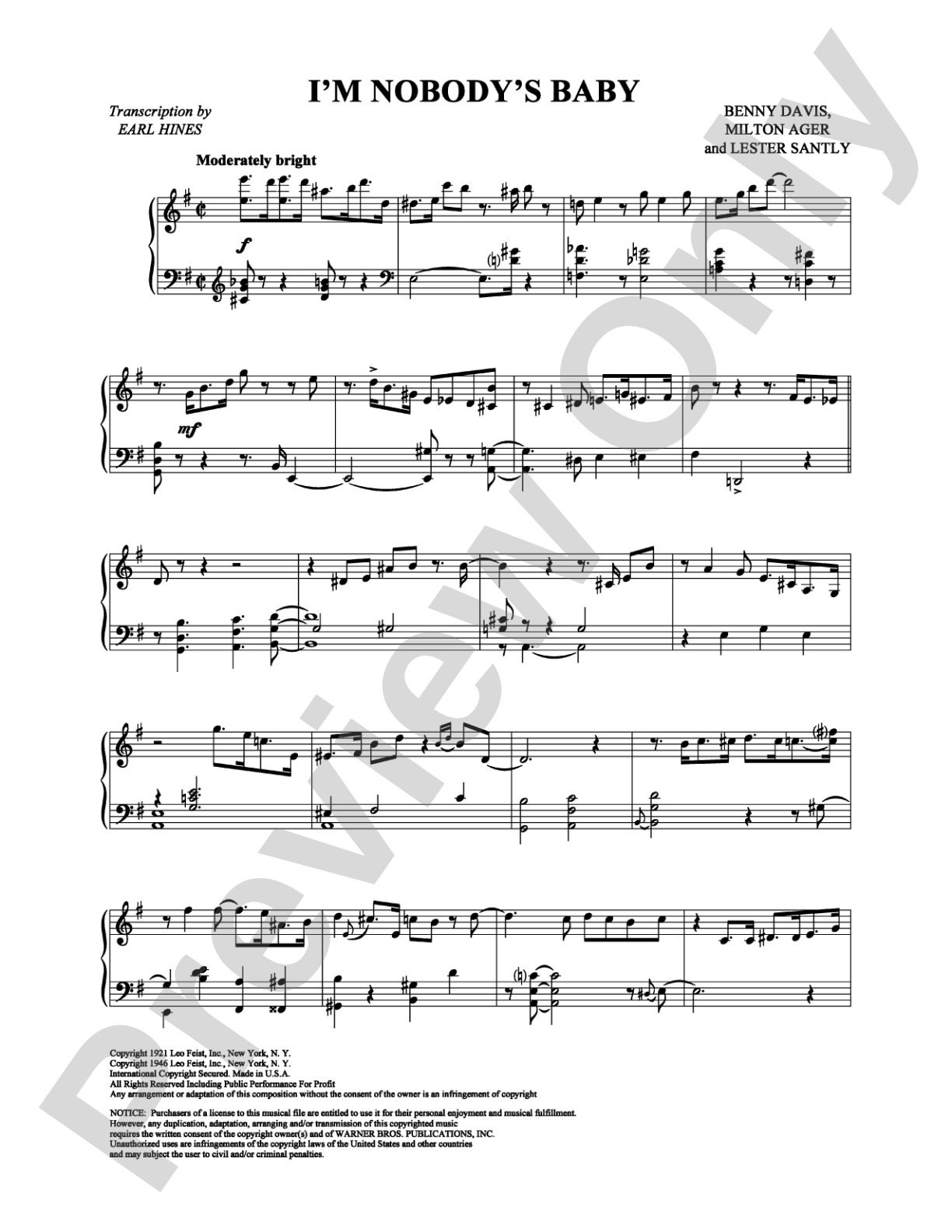
I'm Nobody's Baby: Piano Digital Sheet Music

I'm Nobody's Baby: Piano Digital Sheet Music

Milton Ager, Earl Hines, Benny Davis, Lester Santly

Item: 00-PS-0000657

Digital Download
$3.99
Description

I'm Nobody's Baby: Piano Digital Sheet Music isn't in MakeMusic Cloud just yet...but it could be. Let us know you'd like to see it, and you'll help shape what comes next. In the meantime, start a free trial and dive into thousands of interactive titles your students can play along with today.

Sample Audio
No sample audio found.
Sample Video
Additional Details
SKU: 00-PS-0000657

More about this title

About the Artist: Earl Hines

Earl Hines (1903-1983) was a pianist and bandleader whose innovative stride technique and harmonic sophistication fundamentally shaped jazz piano. His left-hand independence and right-hand fluidity became touchstones for generations of jazz pianists, influencing everyone from Art Tatum to Thelonious Monk. Hines led his own big band for over a decade and remained a vital force in jazz until his death, recording prolifically and mentoring younger musicians throughout his career.

For educators, Hines matters because his playing demonstrates how classical training (he studied formally as a child) can merge seamlessly with jazz vocabulary. His interpretations reward close listening and analysis; students can hear exactly how a master musician phrases, voices chords, and reimagines a tune.

Why we love this

This is Earl Hines at his most swinging, with a stride foundation that never overwhelms the melody. The voicings and reharmonization choices are sophisticated enough to challenge serious piano students, yet the tune itself remains accessible and playable at multiple levels of advancement. It's exactly the kind of arrangement that shows jazz pianists how to balance technical display with musical storytelling.

What to expect

Playful and warm, with a stride foundation that feels both rooted and bouncy. The melody floats above the harmonic foundation with conversational ease, and there's an underlying wink to the lyric that colors every phrase. It swings hard without ever sounding strained.

Who it's for

Jazz pianists at the intermediate to advanced level who want to study how a master musician interprets standard material. Students ready to move beyond lead sheet playing into the territory of sophisticated chord voicings and improvisation will find plenty to unpack here. Educators can use this as a listening and analysis assignment or as a model for how to arrange a familiar tune.

How to get the most out of it

  • Listen to Hines's original recording repeatedly before diving into the score; his phrasing and touch are inseparable from the composition itself.
  • Work the left-hand stride pattern slowly and separately until it becomes automatic, then gradually layer in the right-hand melody and improvisation.
  • Pay attention to Hines's use of space and silence; he doesn't fill every beat, and that restraint is what makes the playful moments land.
  • Let the reharmonized chords breathe; this isn't a piece where rhythmic precision matters more than harmonic clarity and voice leading.

How to use it

Feature this in a jazz recital or as a solo feature within a jazz combo set. It pairs well with other Tin Pan Alley standards rearranged by or for jazz musicians, and it works equally well as a listening and analysis assignment in music history or jazz appreciation courses. Consider programming it as a model for students learning to transcribe and understand jazz voicing and reharmonization.

Skills your students will build

  • Jazz stride technique with independent left hand and right-hand melody
  • Reading and executing sophisticated jazz voicings and reharmonization
  • Phrasing and articulation in a conversational jazz style
  • Listening and transcription skills through analysis of Hines's interpretive choices
  • Improvisation within a jazz standard framework

You May Also Like