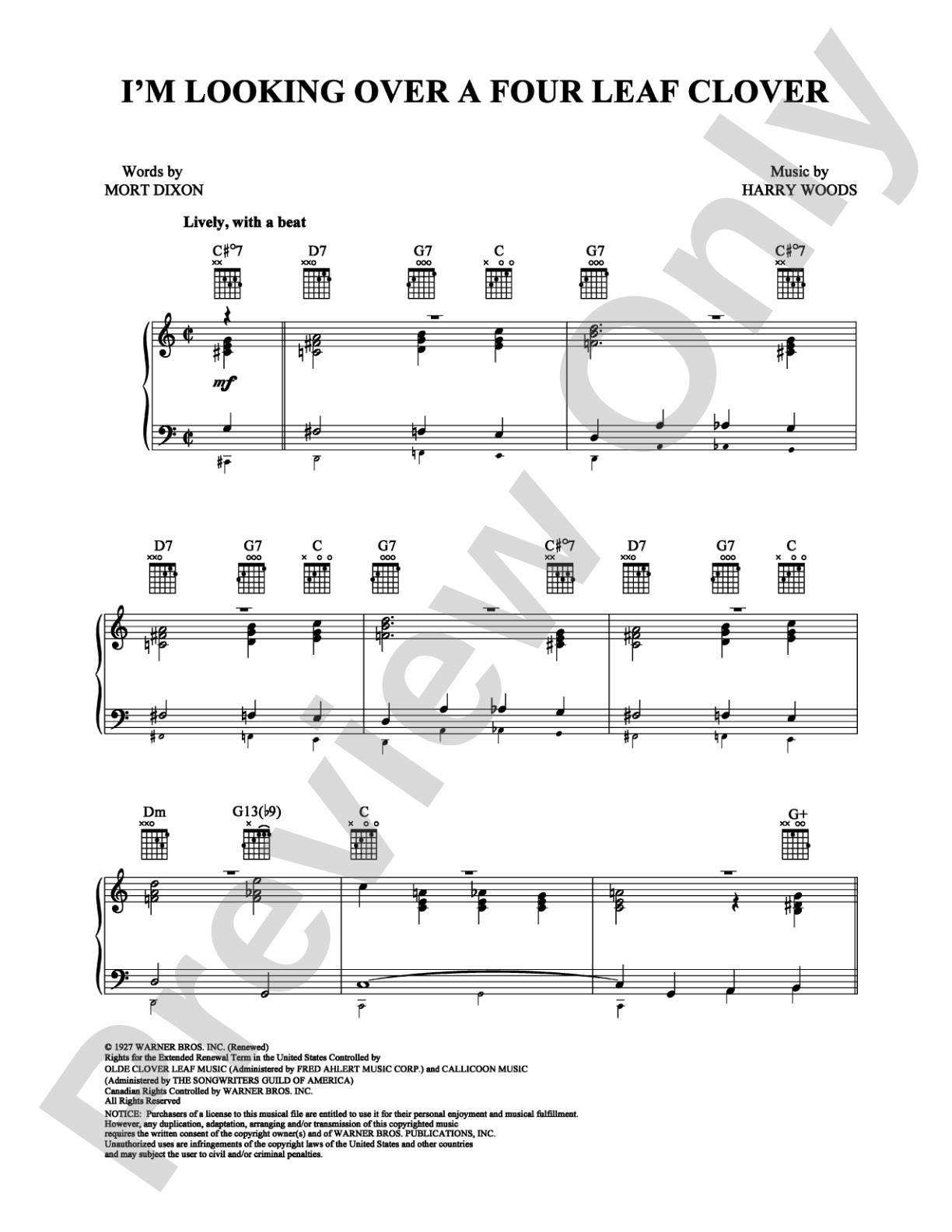
I'm Looking Over a Four-Leaf Clover: Piano/Vocal/Chords Digital Sheet Music

I'm Looking Over a Four-Leaf Clover: Piano/Vocal/Chords Digital Sheet Music

Harry Woods, Art Mooney

Item: 00-PS-0008486

Digital Download
$3.99
Description

I'm Looking Over a Four-Leaf Clover: Piano/Vocal/Chords Digital Sheet Music isn't in MakeMusic Cloud just yet...but it could be. Let us know you'd like to see it, and you'll help shape what comes next. In the meantime, start a free trial and dive into thousands of interactive titles your students can play along with today.

Sample Audio
No sample audio found.
Sample Video
Additional Details
SKU: 00-PS-0008486

More about this title

About the Artist: Art Mooney

Art Mooney was a bandleader and accordionist who rose to prominence in the 1950s, bringing a polished, accessible sound to popular music of the era. His recordings became staples of mid-century radio and dance halls, and his interpretations of standards helped define the sound of post-war American entertainment.

Why we love this

This arrangement captures the charm of a jazz-age standard in a format that works beautifully for collaborative performance. The piano part sits comfortably for players who read accompaniment fluently, while the vocal line sits in a singable tessitura that doesn't require extensive range.

What to expect

Warmth and optimism pulse through every measure. The melody floats with a lyrical lightness that feels both earnest and gently whimsical, evoking a simpler era while maintaining genuine musicality.

Who it's for

This piece works well for vocalists preparing nostalgic or vintage-themed recitals, and for pianists who accompany singers regularly. It's also an excellent choice for community performances, weddings, or programs celebrating American popular music standards.

How to get the most out of it

  • Treat the accompaniment as conversational; the piano need not dominate. Let the voice lead while maintaining a steady, supportive harmonic foundation.
  • Pay attention to chord voicings in the accompaniment. The notation will guide your hand position and voice leading; respect those choices as they reflect the era's arranging style.
  • Lean into the rhythmic bounce without rushing. The swing feel sits between strict time and rubato; let the groove breathe naturally.
  • Balance dynamics so the vocalist can be heard clearly. Nostalgic repertoire often rewards clarity of text and melody over thick pianistic textures.

How to use it

Pair this with other standards from the 1920s-1950s to create a cohesive nostalgic set, or use it as a lighter moment within a recital that spans multiple styles. It works particularly well for community concerts, senior programs, or vintage-themed benefit performances.

Skills your students will build

  • Reading and interpreting chord symbols in jazz/popular music notation
  • Accompanying a vocalist while maintaining independence in the piano part
  • Balancing melodic and harmonic interest in a digital score
  • Capturing the rhythmic and stylistic character of early-to-mid 20th century popular music

You May Also Like