I'm In The Mood For Love (from Every Night At Eight) Sheet Music Preview

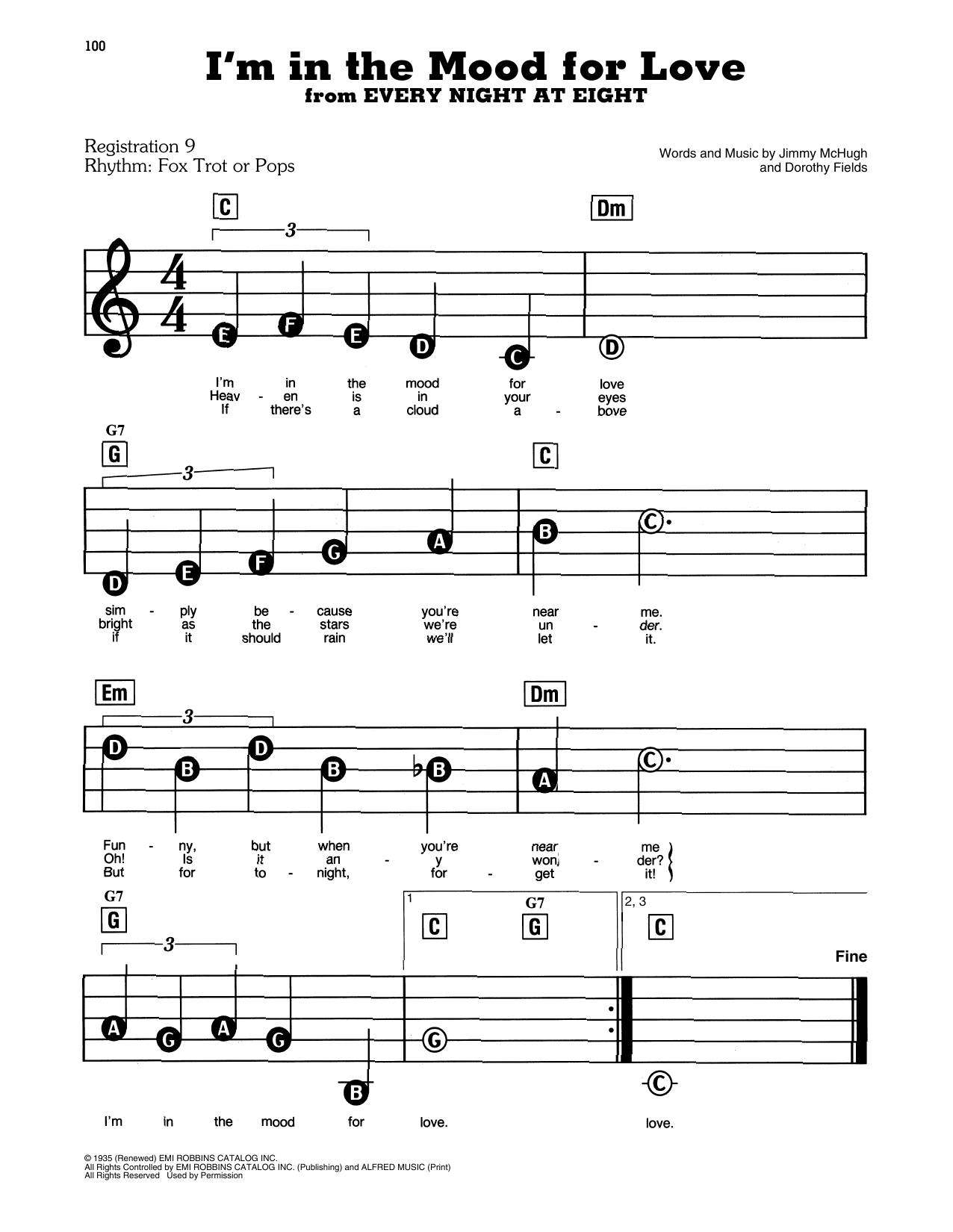
I'm In The Mood For Love (from Every Night At Eight): E-Z Play Today

As performed by Frances Langford

Item: 35-DS00456379

Digital Download
$4.99
Description

I'm In The Mood For Love (from Every Night At Eight): E-Z Play Today isn't in MakeMusic Cloud just yet...but it could be. Let us know you'd like to see it, and you'll help shape what comes next. In the meantime, start a free trial and dive into thousands of interactive titles your students can play along with today.

Sample Audio
No sample audio found.
Sample Video
Additional Details
Publisher: Hal Leonard
Page Count: 2
SKU: 35-DS00456379

More about this title

About the Artist: Frances Langford

Frances Langford (1913-2005) was an American singer and actress who became a household name during the Golden Age of radio and Hollywood musicals. Known for her warm contralto voice and sophisticated phrasing, she recorded extensively throughout the 1930s and 1940s, performing standards that showcased her ability to shape a lyric with genuine emotion and musical intelligence.

Langford's interpretations of jazz standards became teaching models for singers and pianists alike. Her work demonstrates how to balance technical precision with interpretive freedom, a quality that makes her recordings invaluable references for musicians studying the American songbook.

Why we love this

This is a swingable standard that sits perfectly for pianists building their jazz repertoire without overwhelming technical demands. The tune's melody is memorable enough to let the harmonic palette shine, giving students real access to jazz voicings and comping patterns that actually matter in performance settings.

What to expect

Warm, slightly wistful, and breezy. The tune radiates the unhurried confidence of a singer who knows exactly what she's saying and isn't rushing to get there. It invites a relaxed swing feel that settles into the listener's ear like a comfortable conversation.

Who it's for

This arrangement serves pianists at the intermediate level who want to add a genuine jazz standard to their sight-reading and performance repertoire. It's equally useful for vocalists needing an accessible accompaniment that still demonstrates solid jazz harmony knowledge.

How to get the most out of it

  • Lean into the straightforward rhythmic feel. The swing eighth-note pulse should feel conversational, not metronomic; let the natural relaxation of the tempo carry the phrasing.
  • Shape the melody with the harmonic rhythm rather than fighting it. Notice where chord changes land within phrases, and use those moments to breathe and reset the listener's ear.
  • If accompanying a vocalist or instrumentalist, keep your left hand supportive and sparse enough to leave room for the other voice. The song's strength lies in its simplicity.
  • Study how the original recording approaches dynamics. Langford's restraint in volume makes the emotional peaks land harder.

How to use it

Pair this with other standards from the same era to create a "classics of the songbook" segment in a jazz or cabaret concert. It also works beautifully as an interlude between more energetic pieces, giving both audience and performers a moment to breathe while maintaining musical sophistication.

Skills your students will build

  • Reading swing eighth-note notation and feeling the pulse
  • Interpreting jazz chord symbols and implied harmonies
  • Balancing melody and accompaniment textures
  • Phrasing lyrical material with rhythmic accuracy

You May Also Like