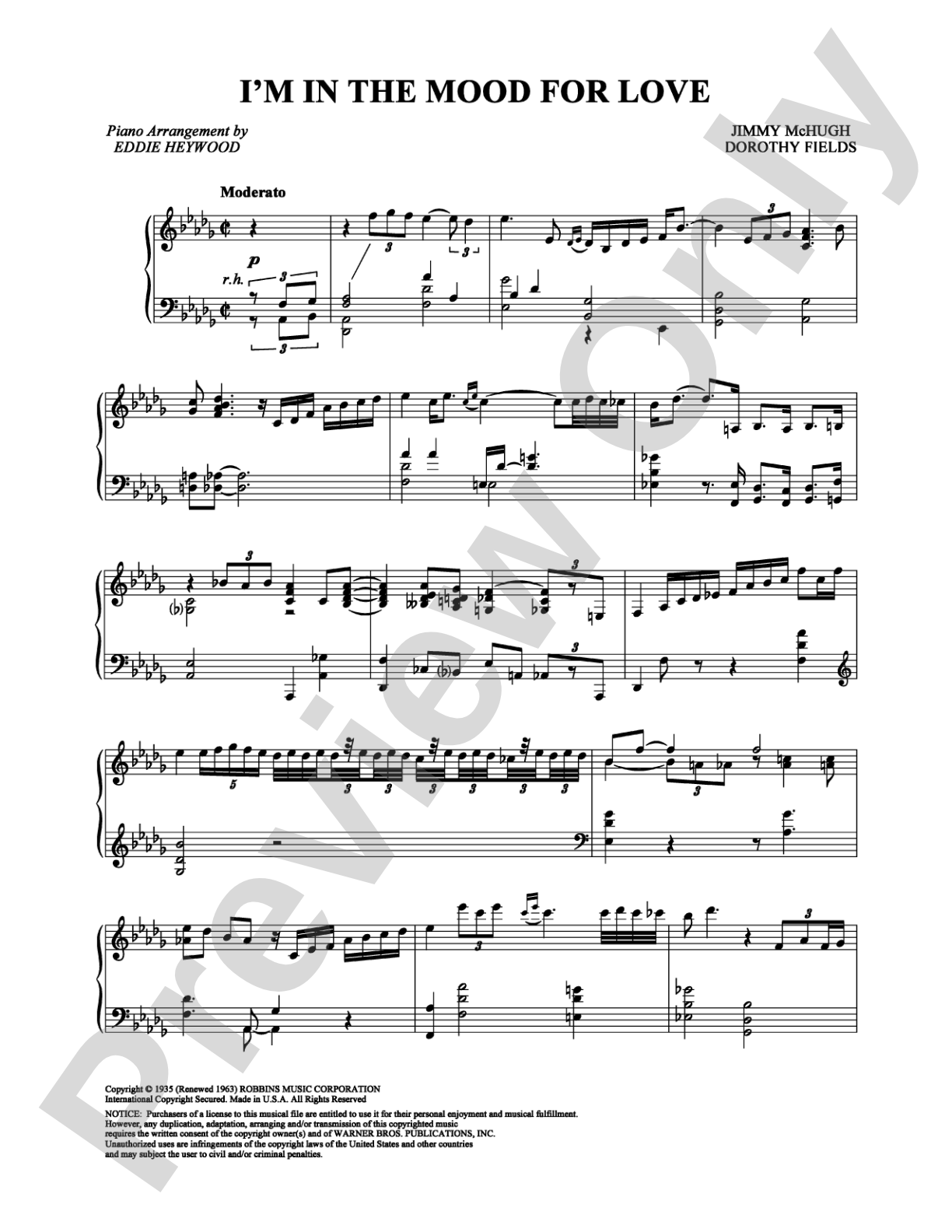
I'm in the Mood for Love: Piano Digital Sheet Music

I'm in the Mood for Love: Piano Digital Sheet Music

Jimmy McHugh, Dorothy Fields, Eddie Heywood

Item: 00-PS-0007245

Digital Download
$3.99
Description

I'm in the Mood for Love: Piano Digital Sheet Music isn't in MakeMusic Cloud just yet...but it could be. Let us know you'd like to see it, and you'll help shape what comes next. In the meantime, start a free trial and dive into thousands of interactive titles your students can play along with today.

Sample Audio
No sample audio found.
Sample Video
Additional Details
SKU: 00-PS-0007245

More about this title

About the Artist: Eddie Heywood

Eddie Heywood (1911-1989) was a pianist and composer who became a defining voice in jazz during the 1940s and 1950s. His light touch, harmonic sophistication, and ability to swing a standard made him a natural interpreter of the Great American Songbook, and he arranged and recorded extensively for both small groups and larger ensembles.

Heywood's approach to the jazz standard emphasized clarity and melodic sensibility over pyrotechnics. His recordings became touchstones for pianists learning how to navigate classic songs with taste and restraint, making his interpretations valuable references for students studying jazz repertoire.

Why we love this

This is a masterclass in how a skilled pianist handles a beloved standard. Heywood's arrangement respects the song's architecture while adding sophisticated voicings and subtle rhythmic inflections that reveal new colors in the melody. Pianists at the intermediate to advanced level will find a clear model for balancing respect for the tune with genuine jazz interpretation.

What to expect

Warm, conversational, and subtly swinging. The tune carries a genteel romanticism that Heywood never oversells; instead, he lets the harmonic movement and the pianist's touch create intimacy. It's the sound of someone playing for an intimate room rather than a crowded hall, with wit and ease in equal measure.

Who it's for

Intermediate to advanced jazz pianists who want to study how a master approaches a standard. This works equally well for music students building their jazz vocabulary, pianists preparing a recital set of standards, or anyone learning the tradition of swing-era piano style.

How to get the most out of it

  • Let the melody breathe in the first chorus. Heywood doesn't rush or overplay the opening statement; the voicings and bass line do most of the work.
  • Anchor the left hand with a steady but conversational walking bass or comping pattern. The rhythm section feel depends on your touch in the lower register.
  • Shape the phrases with dynamics rather than speed changes. The song's emotional arc comes from how you voice the changes, not from tempo fluctuations.
  • Balance transparency with swing. Keep comping light enough to hear the harmony clearly, but commit fully to the groove on the backbeat.

How to use it

Feature this in a jazz standards recital or as part of a piano workshop on interpreting the Great American Songbook. It also works beautifully as a teaching example in jazz history or piano pedagogy classes, where students can study Heywood's comping choices and voicing strategy. Solo performance contexts are ideal; the arrangement is self-contained and doesn't require accompaniment.

Skills your students will build

  • Voice leading and harmonic realization of jazz standards
  • Left-hand comping patterns and walking bass fundamentals
  • Phrasing and dynamic shaping in swing style
  • Listening and analyzing how a master pianist interprets a familiar melody

You May Also Like