
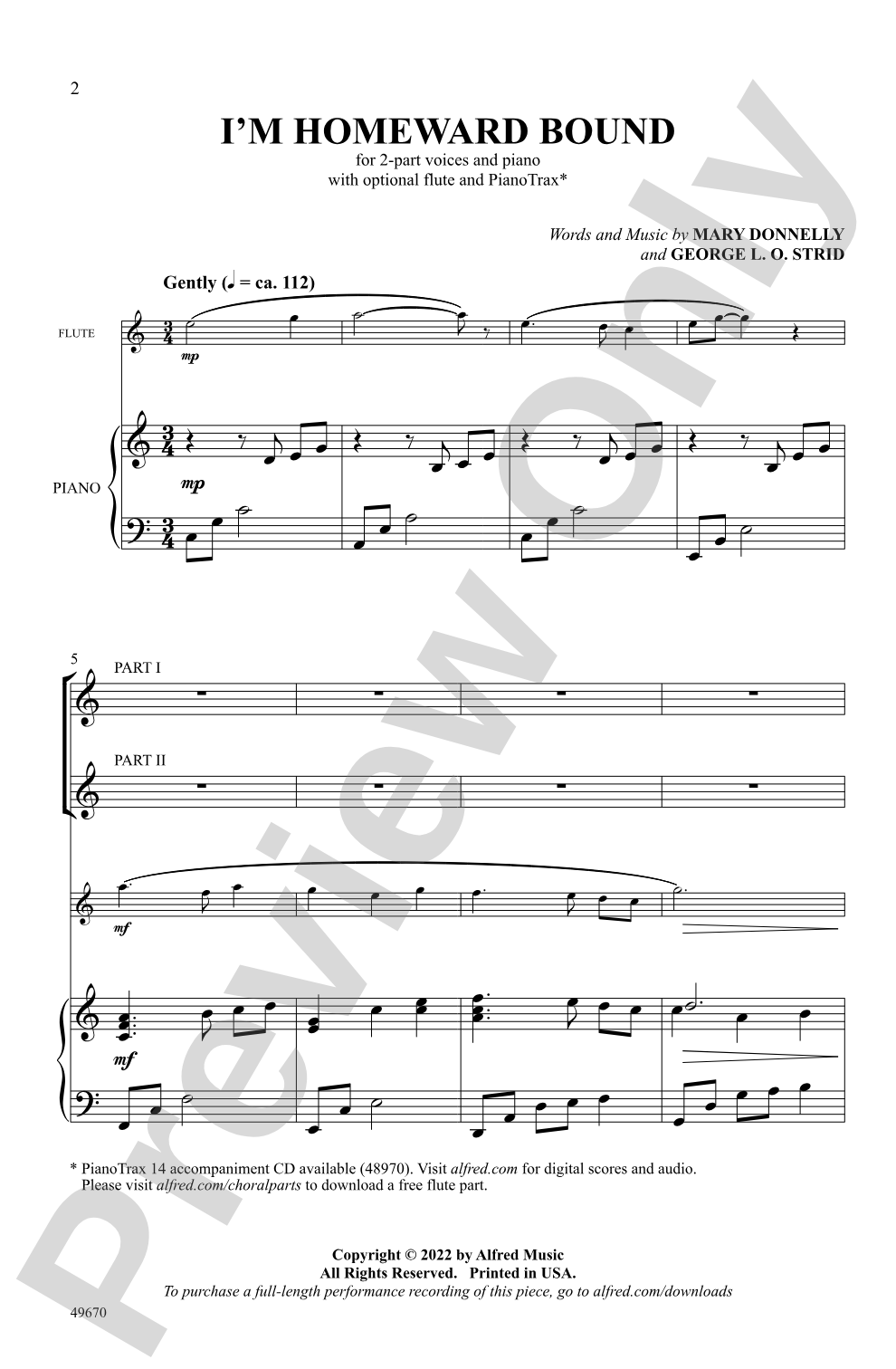
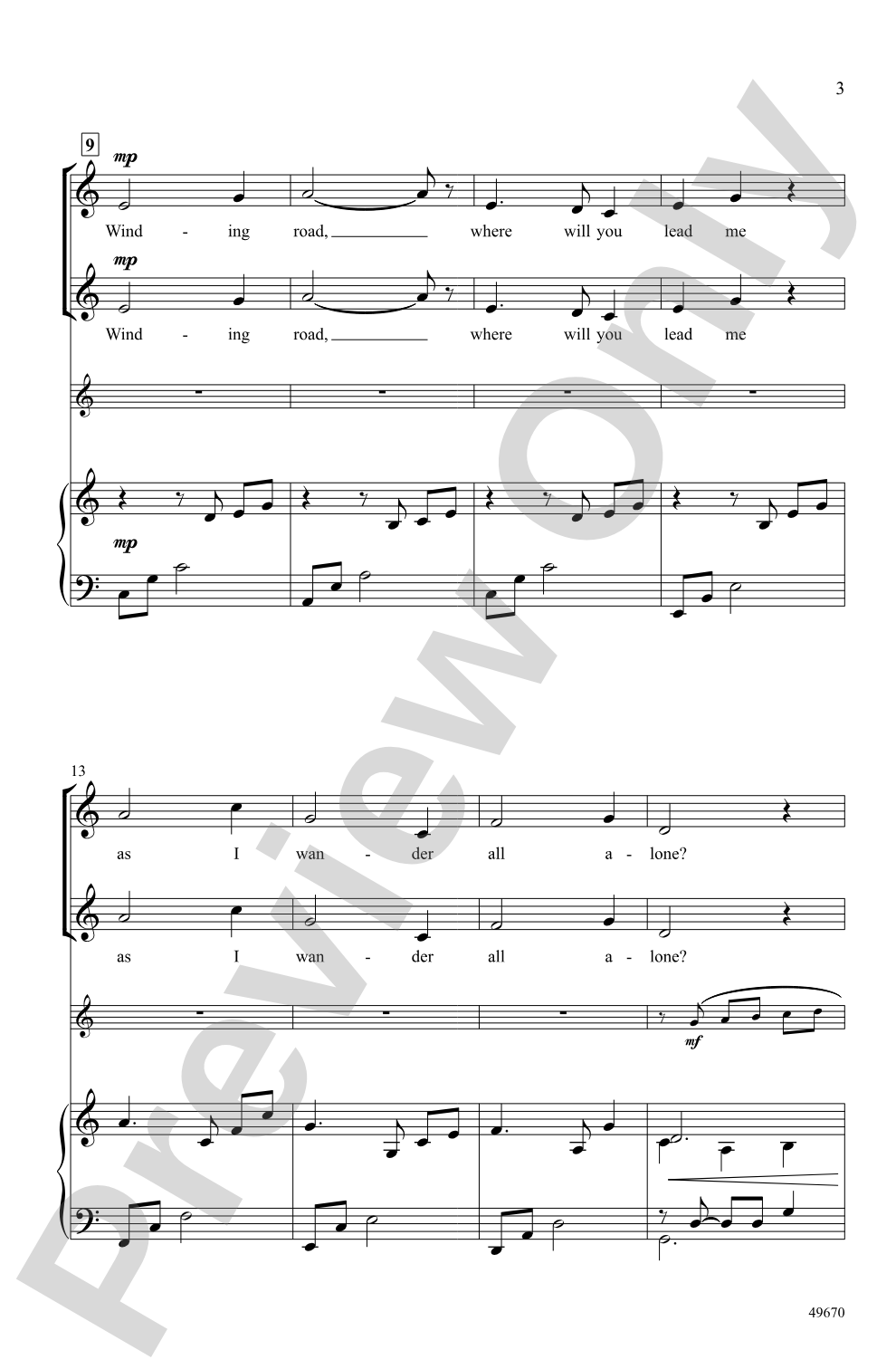

I'm Homeward Bound: 2-Part Choral Octavo
Words and music by Mary Donnelly and George L. O. Strid
Item: 00-PO-0006895
$2.05
Minimum order quantity: 20 copies
Pickup currently not available
Description
There's a place for this lyrical folk-inspired original on every program. It's a gentle ballad with traditional treble harmony, readable rhythms, and a tuneful melody sung in the most comfortable range. The optional flute part (available as a download) is as legato and flowing as the tender voices and arpeggiated piano. "Winding road, western wind, golden moon, silver stars . . . take me home."


I'm Homeward Bound: 2-Part Choral Octavo isn't in MakeMusic Cloud just yet...but it could be. Let us know you'd like to see it, and you'll help shape what comes next. In the meantime, start a free trial and dive into thousands of interactive titles your students can play along with today.
Request This Title
Tell us you want it.
Start Your Free Trial
Explore everything that's ready to play right now.
Sample Audio
1
Audio File
--:--
0:00
0:00
Sample Video
Additional Details
Series:
Alfred Choral Designs
Publisher:
Alfred Music
Page Count:
12
SKU:
00-PO-0006895
More about this title
About the Composer: Mary Donnelly
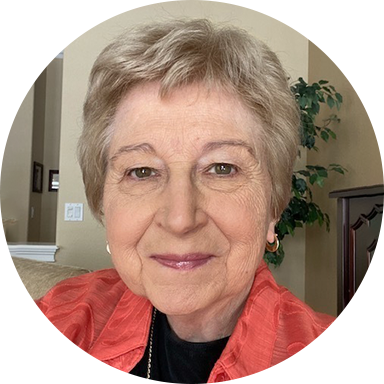
Mary Donnelly grew up in Reno, Nevada, and studied English and French at the University of Nevada before discovering her passion for music education. While still an undergraduate, she organized children's choruses and found the work so fulfilling that she pursued formal music training, earning a Master's Degree in Education from Lesley College. Her graduate coursework centered on bringing the arts into every classroom, shaping her approach to teaching music across thirty years in the Washoe County School District.
In 1985, Donnelly began a songwriting partnership with George L. O. Strid when their principal asked them to compose a musical for Reading Week. That first collaboration led to over two hundred original songs and twenty-five full musicals. An active member of ACDA, NEA, and ASCAP, Donnelly brings both classroom experience and prolific creative output to every piece she writes.
Why we love this
This original sits perfectly in the sweet spot between accessibility and artistic merit. The comfortable vocal range and straightforward rhythms make it immediately singable, while the lyrical melody and imagery give singers something genuinely moving to interpret and perform with intention.
What to expect
Intimate and grounded, like a quiet moment under starlight. The folk-inspired melody carries a sense of gentle longing and belonging, and the piano arpeggios create a flowing soundscape that feels both simple and rich.
Who it's for
This works beautifully with middle or high school treble choirs, or with mixed ensembles featuring predominantly treble voices. It's equally at home in a school concert, a festival performance, or a community choir setting.
How to get the most out of it
- Encourage singers to shape the legato line without oversinging; think of the melody as gently unfolding rather than soaring. The arpeggiated piano supports a sustained, unhurried approach.
- If you add the optional flute part, rehearse the choir and flute separately first to establish the independent character of each line, then layer them in.
- Use the imagery in the text ('winding road,' 'golden moon,' 'silver stars') as a rehearsal anchor. Ask singers what home means to them personally; that emotional connection will inform the tone.
- Balance the two-part harmony so neither voice dominates. This piece thrives when both lines sing with equal presence and warmth.
How to use it
This octavo fits naturally into programming that explores journeys, home, or introspection. Consider pairing it with other lyrical pieces for a set that moves audiences through reflection and hope, or anchor it as a calm moment in a varied concert that alternates between energetic and contemplative selections.
Skills your students will build
- Sustaining legato line across phrases
- Blending treble voices in two-part harmony
- Interpreting text through tone and phrasing
- Reading and interpreting arpeggiated accompaniment patterns
- Balancing individual line independence with harmonic unity