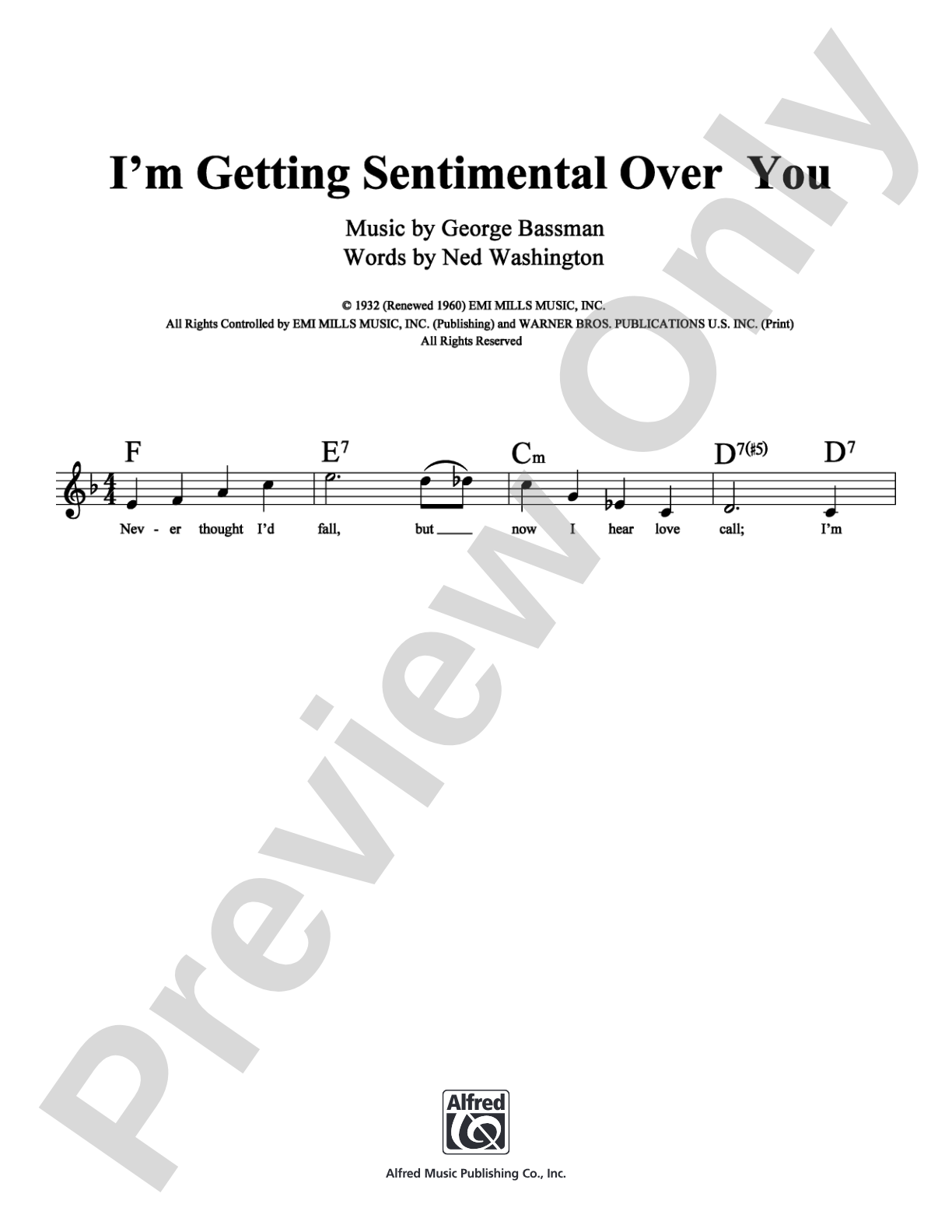
I'm Getting Sentimental Over You: Lead Sheet Digital Sheet Music

I'm Getting Sentimental Over You: Lead Sheet Digital Sheet Music

George Bassman, Tommy Dorsey

Item: 00-PS-0001047

Digital Download
$1.99
Description

I'm Getting Sentimental Over You: Lead Sheet Digital Sheet Music isn't in MakeMusic Cloud just yet...but it could be. Let us know you'd like to see it, and you'll help shape what comes next. In the meantime, start a free trial and dive into thousands of interactive titles your students can play along with today.

Sample Audio
No sample audio found.
Sample Video
Additional Details
SKU: 00-PS-0001047

More about this title

About the Artist: Tommy Dorsey

Tommy Dorsey (1905-1956) was one of the most influential bandleaders and trombonists of the swing era. His "Sentimental Gentleman of Swing" persona and silky trombone tone defined the sound of 1930s and 1940s dance bands, and his orchestra became a launching pad for vocalists including Frank Sinatra and Ella Fitzgerald. Dorsey's arranging sensibility and emphasis on melodic clarity shaped how standards were performed and recorded during jazz's golden age.

Beyond his virtuosic playing, Dorsey was a skilled businessman and recording artist whose interpretations of popular songs became definitive versions. His recordings remain essential listening for understanding swing style, big band repertoire, and the relationship between written arrangements and improvisation.

Why we love this

This lead sheet captures one of the most enduring standards in the Great American Songbook, and Dorsey's recording remains the reference performance. A lead sheet gives singers, pianists, and jazz combos room to develop their own interpretations while staying rooted in melody and harmonic changes that have proven their worth across decades of performance.

What to expect

Nostalgia wrapped in resignation. The melody dips and sways with the vulnerability of someone openly admitting an emotional truth, while the harmonic movement supports both the wistfulness and the acceptance underneath. This is a ballad that refuses to indulge self-pity; instead it finds dignity in honest reflection.

Who it's for

This lead sheet works for jazz singers preparing a vocal recital or cabaret set, pianists building a standards repertoire for restaurant or cocktail performance, and small jazz ensembles wanting to add a touchstone of swing-era repertoire. It's equally valuable for music students studying the structure and harmonic language of American songbook standards.

How to get the most out of it

  • Study Dorsey's original recording to absorb the phrasing and rubato typical of this standard; the notation alone won't convey the subtle timing that makes the sentiment land.
  • Shape the melody with dynamic restraint in the opening phrase; this tune trades in vulnerability rather than volume, so let intimacy draw the listener in.
  • Plan your harmonic reharmonization or improvisation during the bridge section, where jazz performers have traditionally taken the most creative liberties while maintaining the song's emotional core.
  • Coordinate any horn or instrumental countermelody with the lead if you're using this in a small ensemble; the dialogue between melody and accompaniment defines the standard's sophistication.

How to use it

Place this as a set piece in a jazz recital or as part of a standards showcase that spans multiple decades of American songwriting. It pairs naturally with other Dorsey-era material or with contemporary interpretations of the same tune, offering students a chance to hear how the same composition transforms across different arrangements and musical contexts.

Skills your students will build

  • Reading and interpreting lead sheet notation (melody, chord symbols, and form)
  • Phrasing and rubato within a lyrical context
  • Harmonic analysis and reharmonization of standard changes
  • Understanding swing-era style and articulation conventions
  • Chord-tone soloing and improvisation over a fixed harmonic progression

You May Also Like