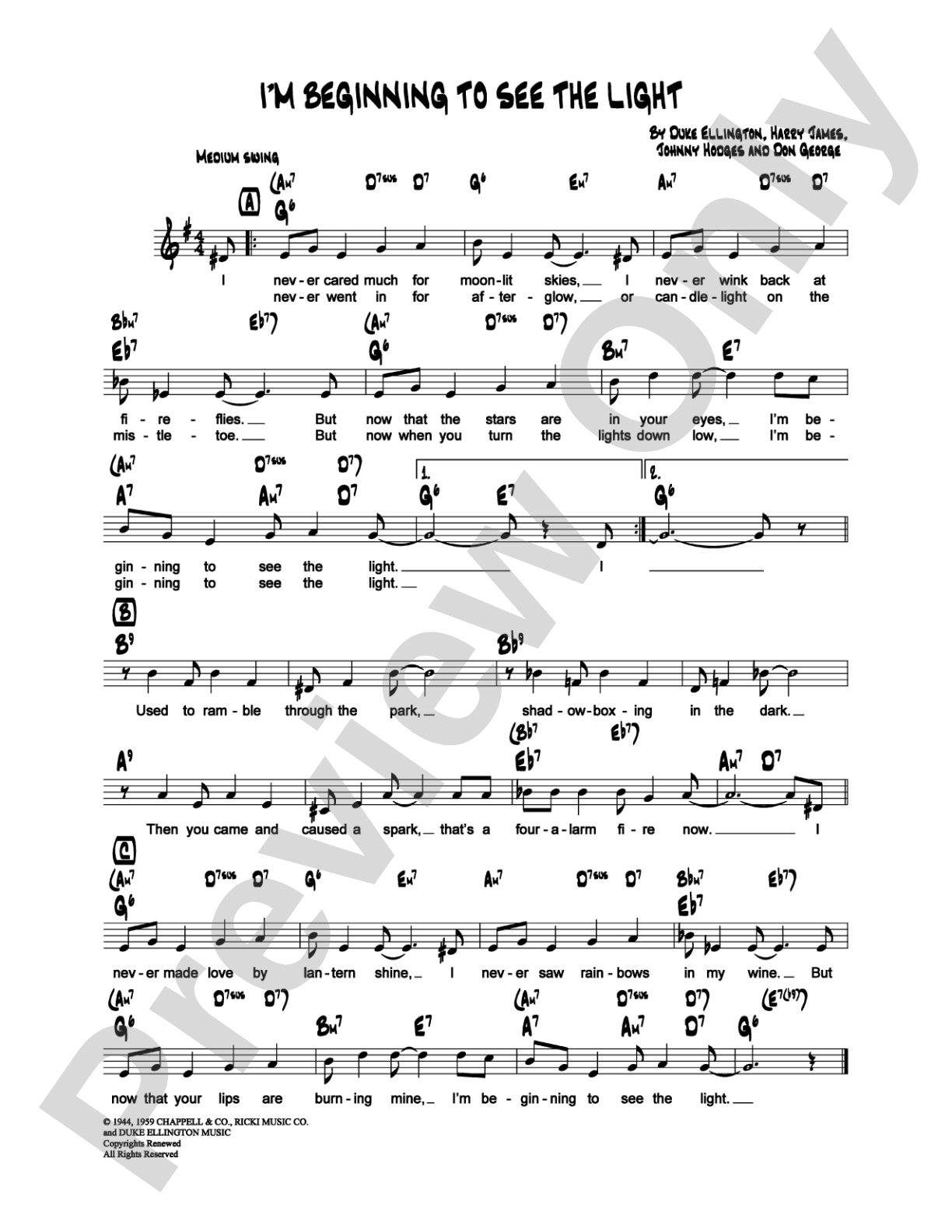
I'm Beginning to See the Light: Lead Sheet Digital Sheet Music

I'm Beginning to See the Light: Lead Sheet Digital Sheet Music

Johnny Hodges, Duke Ellington, Don George, Harry James, Ella Fitzgerald

Item: 00-PS-0001600

Digital Download
$1.99
Description

I'm Beginning to See the Light: Lead Sheet Digital Sheet Music isn't in MakeMusic Cloud just yet...but it could be. Let us know you'd like to see it, and you'll help shape what comes next. In the meantime, start a free trial and dive into thousands of interactive titles your students can play along with today.

Sample Audio
No sample audio found.
Sample Video
Additional Details
SKU: 00-PS-0001600

More about this title

About the Artist: Ella Fitzgerald

Ella Fitzgerald (1917-1996) remains the gold standard for jazz vocal artistry. Her impeccable intonation, rhythmic precision, and ability to swing with absolute conviction made her an essential figure in American music; she won 13 Grammy Awards and performed everywhere from Carnegie Hall to the Newport Jazz Festival.

As an educator's reference point, Fitzgerald's approach to a standard offers a masterclass in phrasing and interpretive choice. Her recordings demonstrate how a vocalist can honor a song's melody while making it entirely their own through subtle timing adjustments, dynamic shaping, and harmonic awareness. For jazz ensemble directors and jazz studies instructors, her interpretations serve as invaluable models of swing vocabulary and lyrical storytelling.

Why we love this

This lead sheet captures one of the most buoyant standards in the jazz repertoire, and Ella's recording remains the definitive interpretation that students aspire to. The melody sits naturally in many ranges, making it equally accessible for trumpet, saxophone, or voice in your jazz ensemble. Its straightforward harmonic progression and moderate tempo create an ideal vehicle for working on swing articulation, note anticipation, and call-and-response phrasing without overwhelming younger improvisers.

What to expect

Sunshine and optimism. The melody floats with easy grace over a gentle swing groove, never demanding or aggressive. There's a conversational warmth in the phrasing, as if the tune is telling a simple story about noticing beauty in the everyday. The harmony supports without cluttering, leaving room for the melody to breathe and the soloist to speak.

Who it's for

Jazz ensemble directors teaching swing vocabulary and tune interpretation; jazz studies students learning to balance melodic accuracy with interpretive freedom; vocalists and instrumentalists preparing solos for jazz combos or recitals. This lead sheet works equally well in a classroom listening context as a reference recording or as a working chart for ensemble arrangement.

How to get the most out of it

  • Anchor your interpretation in the eighth-note swing feel; the groove should feel lazy and behind the beat rather than driving or syncopated.
  • Listen carefully to where Ella delays phrase entries and shortens breath time. These micro-timing choices are what make the melody swing, not the tempo itself.
  • Treat the lyric as narrative. Each phrase has emotional intention, and that intention shapes how you approach dynamics and articulation.
  • When improvising over the changes, maintain harmonic awareness by outlining the underlying chords rather than running scalar passages; this will anchor your solo and keep the tune's character intact.

How to use it

Pair this with other standards in a jazz standards unit to show students how different artists interpret the same song. It also works beautifully as a warm-up in ensemble rehearsal before tackling more demanding charts. For a jazz recital or concert, this tune bridges formal and casual contexts equally well, and audiences respond immediately to its accessibility and genuine swing.

Skills your students will build

  • Swing articulation and feel (eighth-note placement, note timing)
  • Melody interpretation through phrasing, breath placement, and dynamic shaping
  • Harmonic analysis and chord-tone soloing
  • Listening and ear training (identifying harmonic changes, recognizing substitutions)
  • Rhythmic precision within a jazz ensemble context

You May Also Like