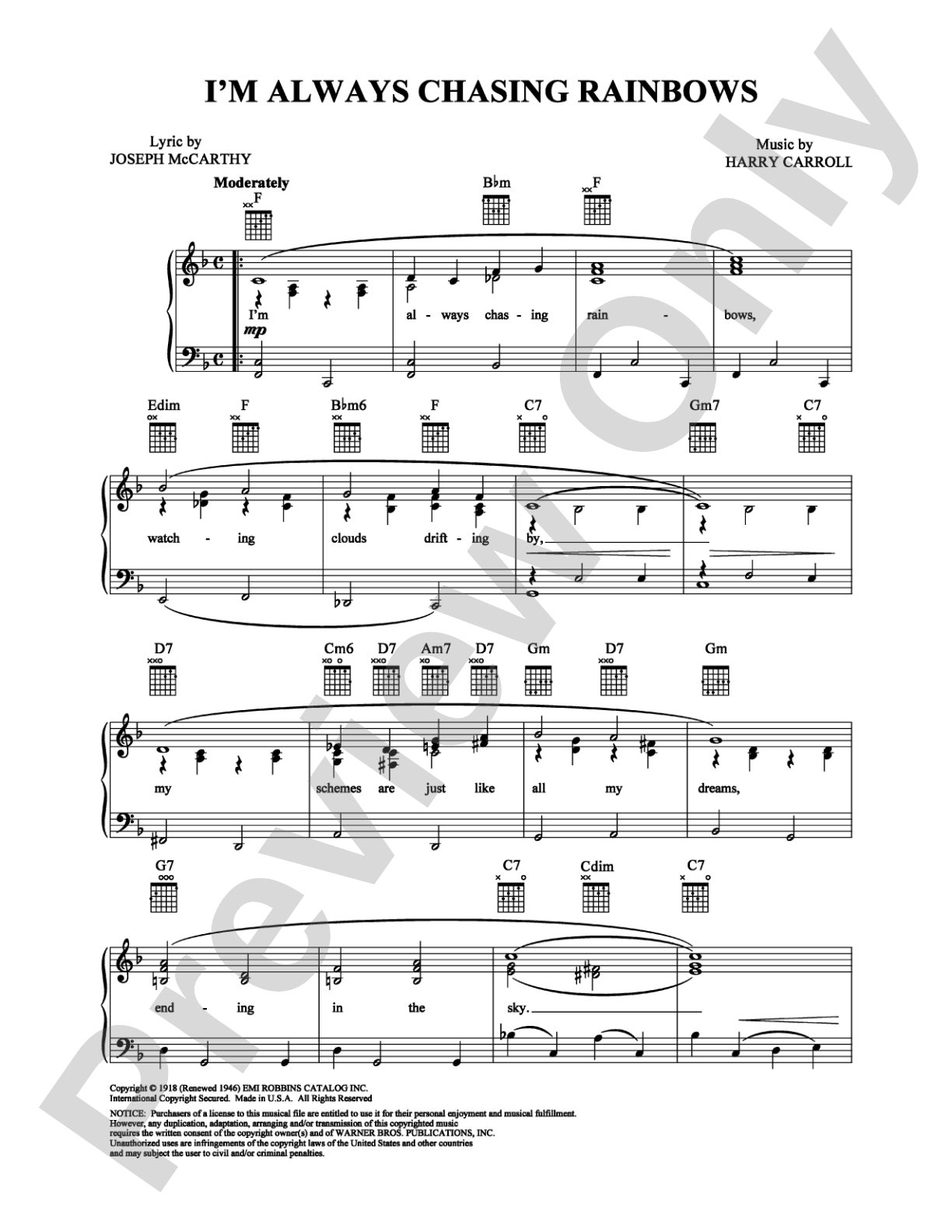
I'm Always Chasing Rainbows: Piano/Vocal/Chords Digital Sheet Music

I'm Always Chasing Rainbows: Piano/Vocal/Chords Digital Sheet Music

Harry Carroll, Judy Garland

Item: 00-PS-0007223

Digital Download
$3.99
Description

I'm Always Chasing Rainbows: Piano/Vocal/Chords Digital Sheet Music isn't in MakeMusic Cloud just yet...but it could be. Let us know you'd like to see it, and you'll help shape what comes next. In the meantime, start a free trial and dive into thousands of interactive titles your students can play along with today.

Sample Audio
No sample audio found.
Sample Video
Additional Details
SKU: 00-PS-0007223

More about this title

About the Artist: Judy Garland

Judy Garland (1922-1969) was an American singer and actress whose interpretive gifts and technical command made her one of the most influential vocalists of the twentieth century. Her performances set the standard for American popular song, combining emotional authenticity with impeccable phrasing and intonation. Garland's recordings remain essential reference material for singers studying the Great American Songbook and for pianists learning to accompany vocal standards with sensitivity and support.

Why we love this

This is a foundational standard that belongs in every jazz vocalist's book and every accompanist's library. Garland's definitive recording of this song shaped how generations of singers approach it, making her interpretation an invaluable study in phrasing, dynamics, and emotional restraint. Teaching students to sing or play from this arrangement connects them directly to a performance tradition that still influences contemporary interpretations.

What to expect

A gentle, yearning ballad that moves between hope and melancholy. The melody sits comfortably in a conversational range, inviting intimate delivery rather than belting, while the harmonic progressions create moments of unexpected depth and introspection.

Who it's for

Vocalists preparing jazz standards, pop singers studying American songbook classics, and pianists building their foundation in vocal accompaniment will find this arrangement essential. The chord symbols and melody line make it accessible for intermediate to advanced students and working musicians.

How to get the most out of it

  • Listen to Garland's recording multiple times before rehearsing, noting her tempo choices, rubato, and where she sits behind or ahead of the beat.
  • Balance the vocal line with sensitive piano voicings in the lower register; this arrangement shines when the accompaniment creates space rather than fills it.
  • Pay attention to Garland's approach to the bridge, where she shifts from hopeful to introspective. Let that emotional turn shape your interpretation of the harmonic changes.
  • Shape phrases with her rhythmic precision in mind. Her eighth-note phrasing is tight and clear, never dragging or overly leggy.

How to use it

Include this standard in a jazz or standards-focused recital alongside other songs from the 1930s-1940s era to create a cohesive program. It also works as an encore or as part of a singer's audition repertoire, offering a chance to demonstrate legit technique and storytelling ability.

Skills your students will build

  • Phrasing and breath placement in ballad tempos
  • Chord symbol reading and jazz-influenced accompaniment patterns
  • Sensitivity to lyrical content and emotional subtext in standard interpretation
  • Harmonic analysis of American Songbook progressions
  • Vocal line and accompaniment balance in duo performance

You May Also Like