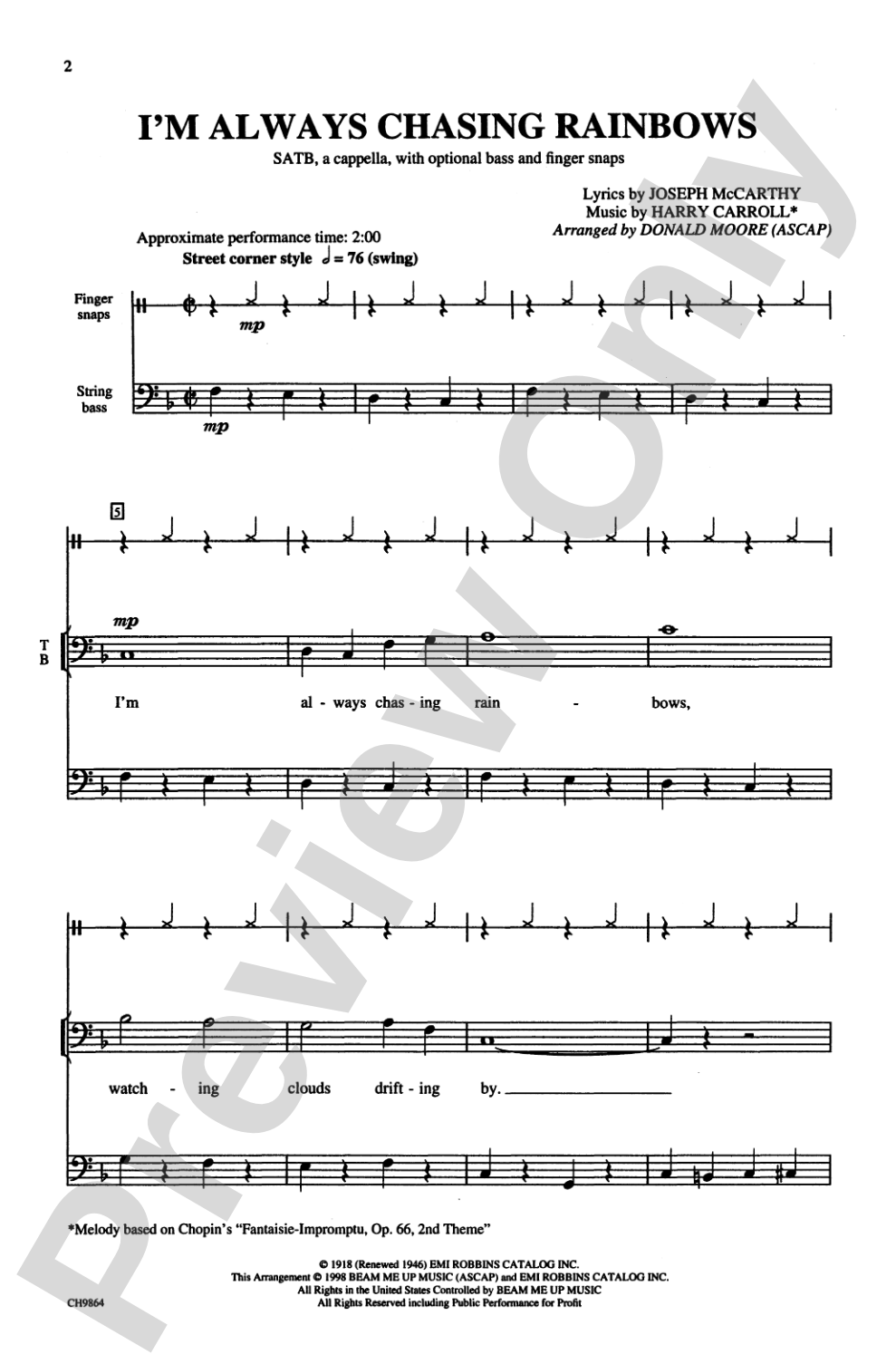
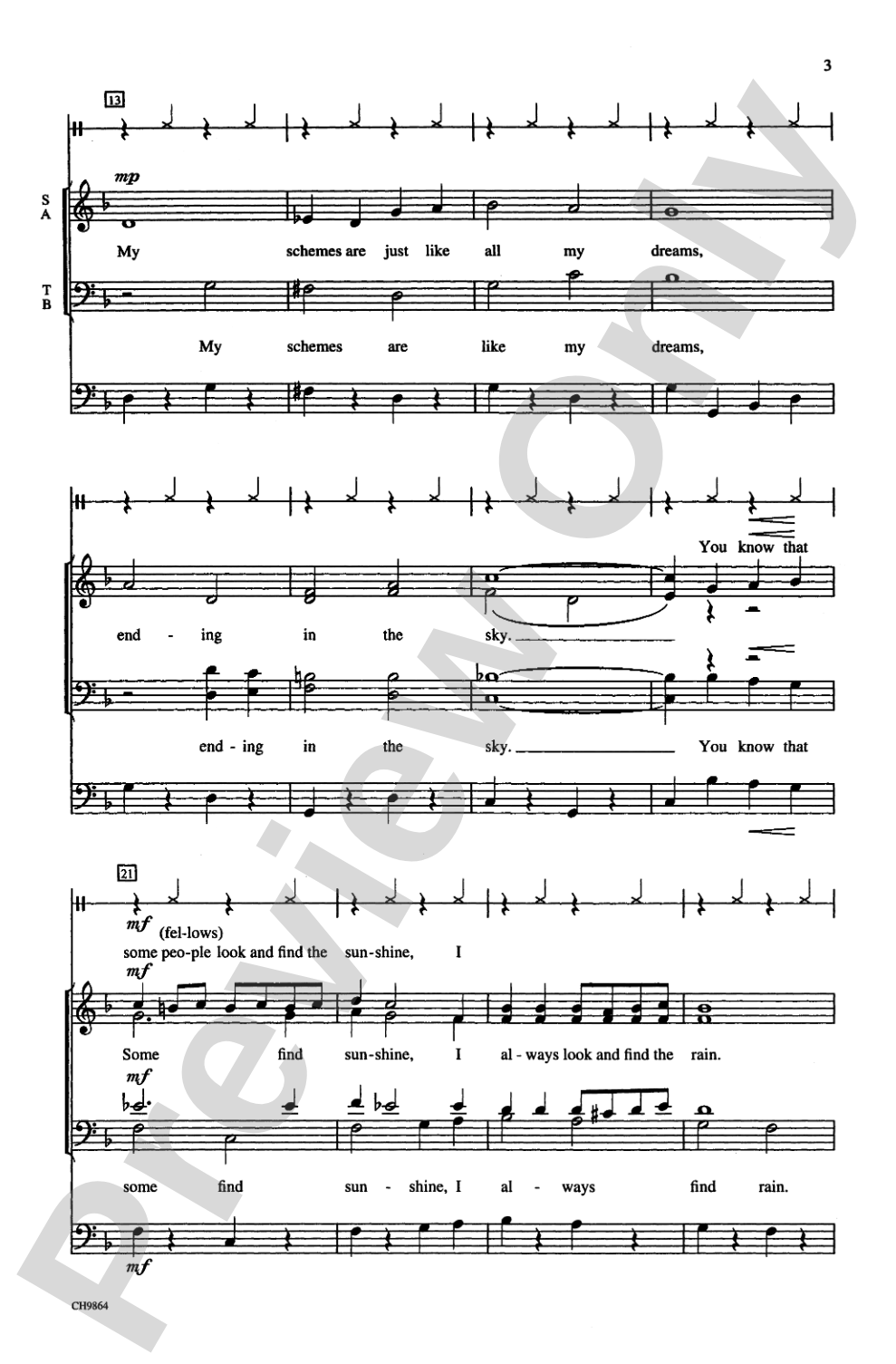
I'm Always Chasing Rainbows Sheet Music Preview

I'm Always Chasing Rainbows: SATB, a cappella Choral Octavo

Music by Harry Carroll, lyrics by Joseph McCarthy / arr. Donald Moore

Item: 00-PO-0004732

Digital Download
$2.25

Minimum order quantity: 20 copies

Description
From Don Moore comes a wonderfully fresh a cappella edition of the classic movie-music favorite. Finger snaps and the straight-ahead swing style give this arrangement that street corner doo-wop styling. Sure to be a favorite with singers and audiences!

I'm Always Chasing Rainbows: SATB, a cappella Choral Octavo isn't in MakeMusic Cloud just yet...but it could be. Let us know you'd like to see it, and you'll help shape what comes next. In the meantime, start a free trial and dive into thousands of interactive titles your students can play along with today.

Sample Audio
No sample audio found.
Sample Video
Additional Details
Series: Alfred Archive Edition: Alfred Pop Choral Series
Publisher: Alfred Music
Page Count: 8
SKU: 00-PO-0004732
Instrumentation: Opt. Bass & Finger Snaps

More about this title

About the Composer: Harry Carroll

Harry Carroll composed music during the golden age of American musical theater and film, with a catalog spanning the 1910s through 1930s. His gift for melody made him a natural fit for the emerging film industry, where his compositions became standards of the era. "I'm Always Chasing Rainbows," with lyrics by Joseph McCarthy, exemplifies Carroll's ability to craft memorable, singable lines that have endured for over a century.

Why we love this

Don Moore's arrangement captures the playful, street-level energy of doo-wop while honoring Carroll's original melodic charm. The optional finger snaps and bass parts give you flexibility to scale the production up or down depending on your ensemble's size and confidence level. This is the kind of standard that audiences genuinely love hearing from a choir, and singers respond to the straightforward swing feel and the chance to show personality.

What to expect

Nostalgic and buoyant, with a vintage Americana warmth that feels both timeless and playful. The doo-wop styling invites singers and audiences alike into a moment of unguarded joy, where straightforward four-part harmony and rhythmic snap combine into something that feels both simple and deeply satisfying.

Who it's for

SATB choirs of any age group seeking accessible yet engaging popular repertoire. This arrangement works equally well for high school show choirs, college vocal ensembles, and community choirs looking for something that blends musicality with immediate audience appeal.

How to get the most out of it

  • Lock the rhythmic pulse with the finger snaps from the start of rehearsal. Even if you don't perform with them, using them in early rehearsals establishes the swing subdivision and prevents the piece from dragging.
  • Balance the four voices so the melody sits clearly on top while the lower three parts create a cohesive harmonic bed. Test your voicing from the back of the room to ensure the sopranos cut through without shouting.
  • Bring forward the character of the doo-wop style by encouraging singers to articulate the text with a light, almost conversational tone. This isn't operatic; it's a street corner moment.
  • If using the optional bass part and finger snaps, rehearse those elements separately first, then layer them in with the voices to build confidence in the rhythmic foundation.

How to use it

Program this in the lighter half of a concert, perhaps as a palate cleanser between more serious works or as a way to showcase your ensemble's versatility and humor. It pairs well with other jazz-influenced or pop-arrangement pieces and can anchor a themed set around classic American movie music or standards.

Skills your students will build

  • Singing in swing style with appropriate articulation and feel
  • Maintaining rhythmic precision with optional finger snaps and optional bass part
  • Balancing four-part SATB voicing with clear melody and supporting harmony
  • Performing a cappella with confidence and intonation

You May Also Like