I'm A Bad, Bad Man Sheet Music Preview

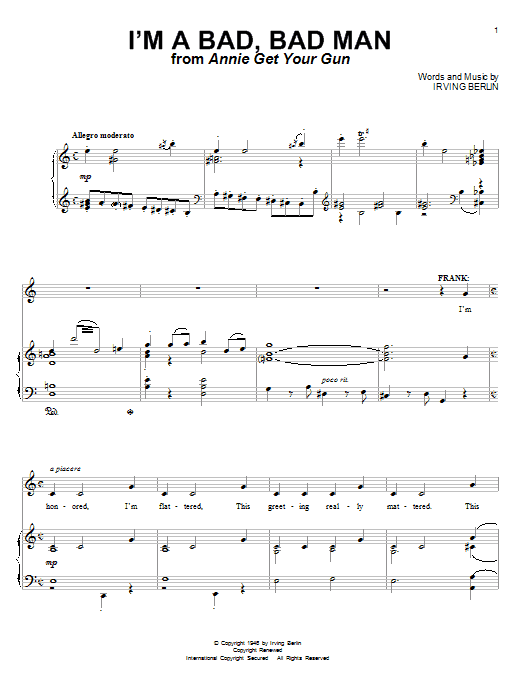
I'm A Bad, Bad Man: Piano Vocal

As performed by Irving Berlin

Item: 35-DS00024507

Digital Download
$5.99
Description

I'm A Bad, Bad Man: Piano Vocal isn't in MakeMusic Cloud just yet...but it could be. Let us know you'd like to see it, and you'll help shape what comes next. In the meantime, start a free trial and dive into thousands of interactive titles your students can play along with today.

Sample Audio
No sample audio found.
Sample Video
Additional Details
Publisher: Hal Leonard
Page Count: 5
SKU: 35-DS00024507

More about this title

About the Artist: Irving Berlin

Irving Berlin (1888-1989) composed some of the most enduring melodies in American popular music, from "Alexander's Ragtime Band" to "White Christmas." His gift lay in writing songs that felt effortless and inevitable, with melodies that embedded themselves in the national consciousness. Berlin's work defined the Great American Songbook and remains essential repertoire for singers and pianists exploring 20th-century vocal music.

Beyond his commercial success, Berlin's influence on music education is profound. His songs teach voice students about phrasing, storytelling, and the marriage of lyrics to melody. For pianists, they offer accessible yet sophisticated accompaniments that reward attention to style and rubato. Every song Berlin wrote contains a lesson in economy and craft.

Why we love this

This number captures Berlin at his most theatrical and character-driven. The song demands personality from the singer, making it rewarding for performers who thrive on comedic timing and dramatic flair. The five-page score gives students enough material to sink their teeth into without overwhelming a rehearsal schedule.

What to expect

Sassy, confident, and full of personality. The song has that classic Berlin swagger where a simple melody and witty lyric create irresistible momentum. It's the kind of number that invites the performer to wink at the audience.

Who it's for

This works well for voice students exploring the Broadway canon or pianists building their accompaniment skills with American popular standards. It suits performers comfortable with character songs and those developing confidence in theatrical expression.

How to get the most out of it

  • Nail the rhythmic precision of the accompaniment pattern. Berlin's piano writing often uses specific rhythmic figures to drive the comedy, so lock the pattern in before worrying about expression.
  • Lean into the character work. This isn't a ballad; the vocal line thrives when the singer commits to the humor and attitude of the lyric.
  • Balance the vocal melody against the piano part so the melody sits forward without drowning the accompaniment entirely. The interplay between voice and piano is part of the song's charm.

How to use it

This pairs naturally with other Berlin standards in a tribute or songbook concert, or stand alone as a comedic solo turn in a variety program. It works well mid-set when you need energy and character-driven material to shift the mood.

Skills your students will build

  • Rhythmic coordination between voice and accompaniment
  • Comic timing and dramatic storytelling through song
  • Phrasing and breath placement in a character-driven vocal line
  • Piano accompaniment texture and idiomatic Broadway style

You May Also Like