
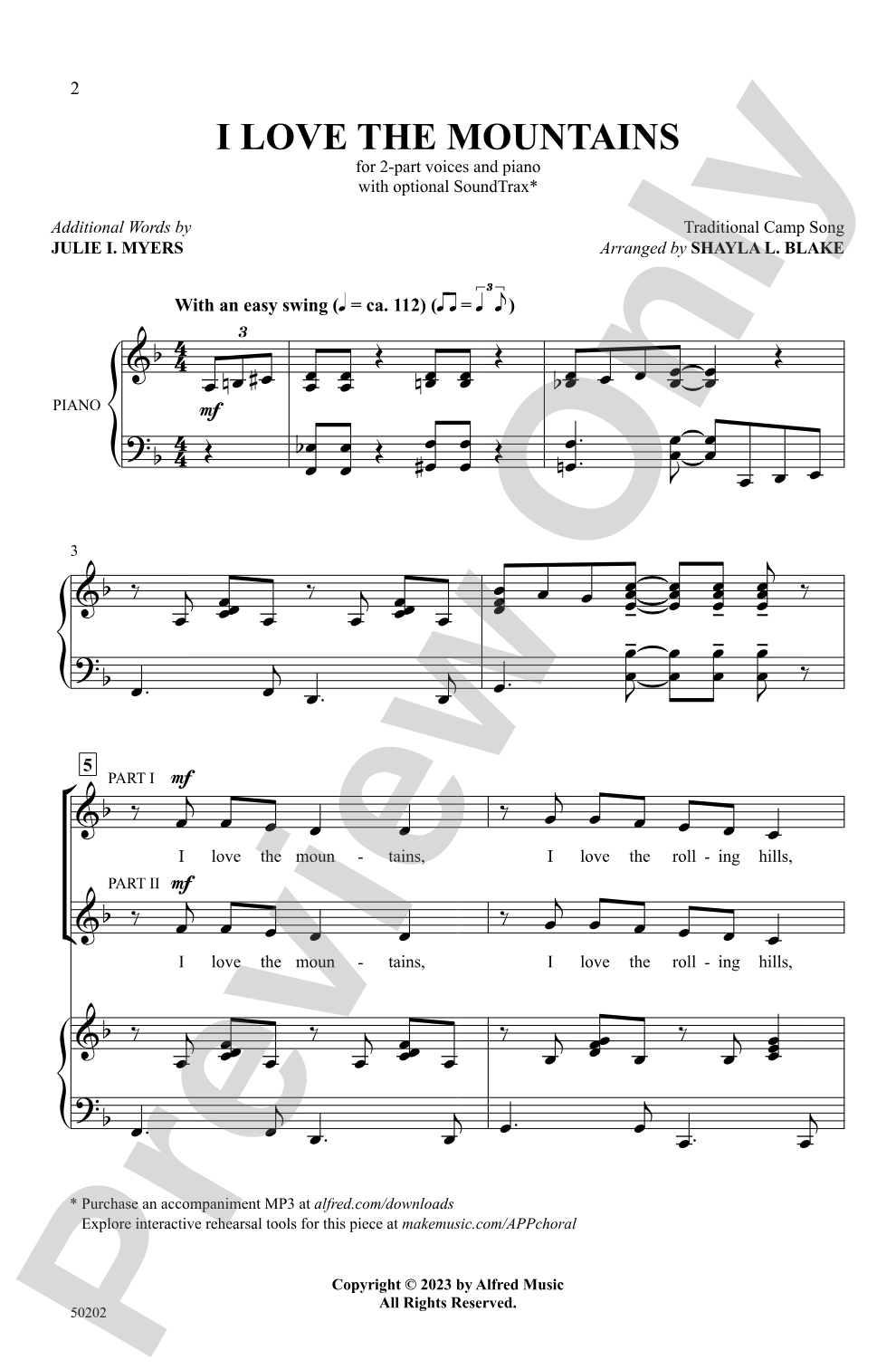

I Love the Mountains
Traditional Camp Song / additional Words by Julie I. Myers / arr. Shayla L. Blake
Item: 00-PO-0007136
$2.05
Minimum order quantity: 20 copies
Pickup currently not available
Description
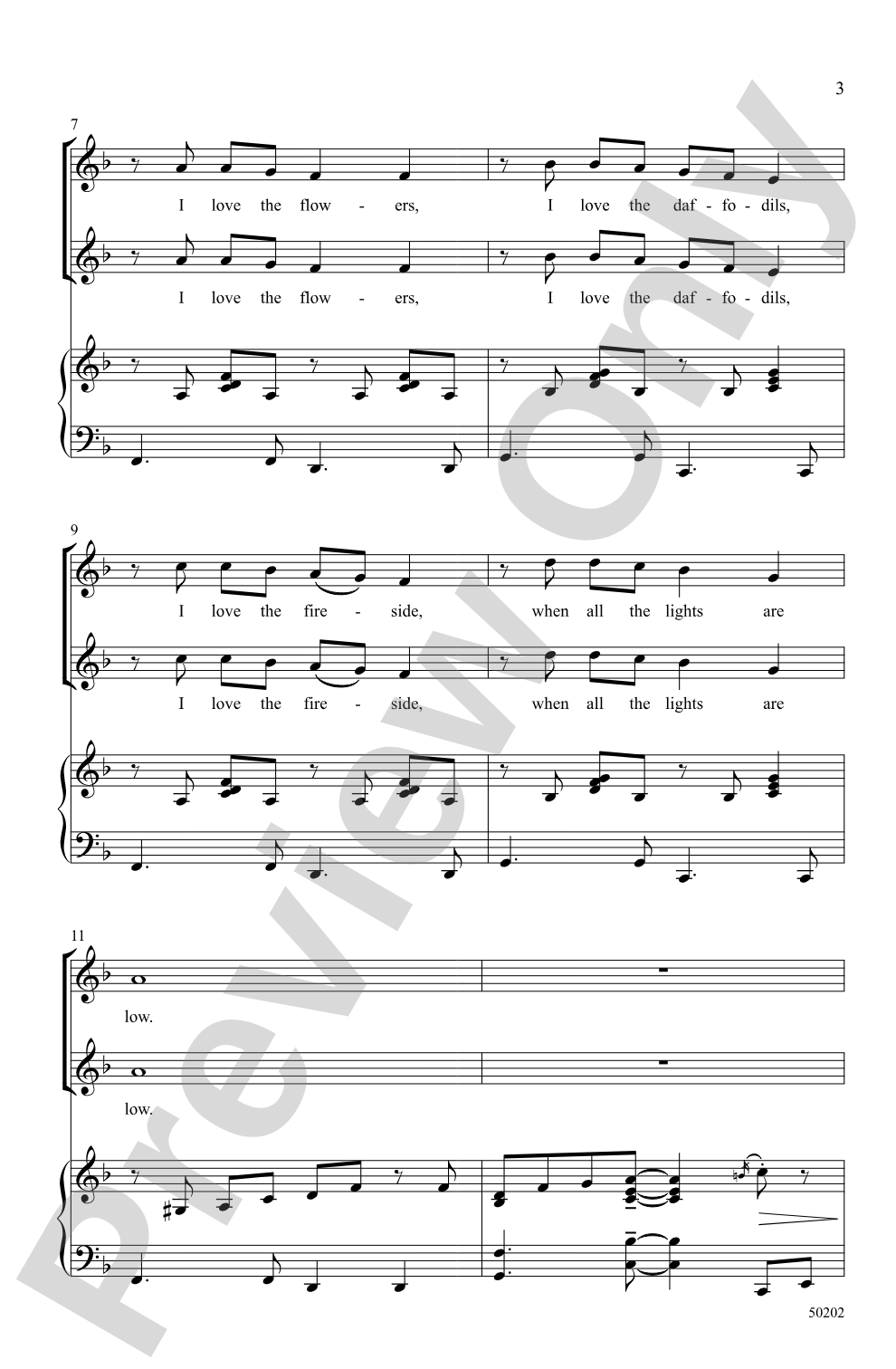
Grab your gear and let's go hiking! Everyone has a chance to sing the "boom-dee-ah-dah" ostinato in this traditional camp song of trails, sails, dragonflies, and stars. The familiar melody is passed back and forth in this engaging exploration of the wonderful things to see and do in the great outdoors. An achievable adventure for those taking their first steps on the path to singing in parts.
The PerformancePlus+ series is an innovative addition to the ever-expanding MakeMusic Cloud interactive library. These engaging selections are presented with educational resources designed to enrich the rehearsal process and create outstanding performances. Including:


The PerformancePlus+ series is an innovative addition to the ever-expanding MakeMusic Cloud interactive library. These engaging selections are presented with educational resources designed to enrich the rehearsal process and create outstanding performances. Including:
- Assignment, recording, and assessment tools within MakeMusic Cloud
- Part-predominant and accompaniment tracks
- Printable sheet music (with a standard MakeMusic Cloud subscription)
- Correlated rehearsal guides and performance notes
- Rights to perform in a live or virtual setting
I Love the Mountains isn't in MakeMusic Cloud just yet...but it could be. Let us know you'd like to see it, and you'll help shape what comes next. In the meantime, start a free trial and dive into thousands of interactive titles your students can play along with today.
Request This Title
Tell us you want it.
Start Your Free Trial
Explore everything that's ready to play right now.
Sample Audio
1
Audio File
--:--
2
Audio File
--:--
Audio File
0:00
0:00
Sample Video
Additional Details
Series:
PerformancePlus+
Page Count:
12
SKU:
00-PO-0007136
More about this title
About the Arranger: Shayla L. Blake

Shayla L. Blake holds degrees in piano performance from both Stetson University and Texas Tech University, where she studied with Geoffrey Gilbert (flute) and William Westney (piano). Her training included participation in Stetson's Summer Orchestral Institute and recognition as a finalist in Texas Tech's graduate-level concerto competition, followed by an appointment as Graduate Teaching Assistant.
At Louisiana Tech University's School of Music, Blake teaches piano, flute, songwriting, and choral arranging while serving as a collaborative pianist. Her compositions and arrangements appear with Choristers Guild, Lorenz, Shawnee Press, Hal Leonard, Alfred Music, Heritage Music, and other publishers, with performances at TMEA conferences and international venues including the Vatican. Beyond her university work, Blake maintains an active private teaching studio, directs the North Louisiana Parkinson's Chorale in partnership with Louisiana Tech's nursing program, and performs as part of a singing duo with her husband, Mack. In 2020, she completed a fellowship residency at Hambidge Center for the Arts.
Why we love this
Blake's arrangement honors the camp song tradition while creating genuine musical growth. The "boom-dee-ah-dah" ostinato gives every singer a satisfying vocal line, and the back-and-forth melody exchange builds confidence in singers transitioning to two-part singing without overwhelming them.
What to expect
Sing this and you're around a campfire under open sky. The ostinato creates a gentle, steady pulse that lets the melody soar above it, while the text paints vivid outdoor imagery. There's joy and simplicity here, with just enough harmonic texture to feel like real singing.
Who it's for
This arrangement serves singers new to part-singing, whether in middle school choirs, youth community ensembles, or camps. The accessible two-part writing and the comfort of a familiar melody make it ideal for building confidence and demonstrating that harmonizing can be engaging rather than intimidating.
How to get the most out of it
- Establish the ostinato pattern securely before layering in the melody. Have singers who aren't carrying the melody part vocalize their rhythm on neutral syllables first, then add the text once the pattern is locked in.
- Balance the melodic line so the main tune remains audible even when both parts are singing. The ostinato should support, not overshadow.
- Use the recorded accompaniment to anchor tempo and harmonic placement during early rehearsals, then gradually move toward singing without it as independence builds.
- Emphasize the outdoor imagery in the text to bring energy and character to the performance. The camp song spirit works best when singers feel the joy of trails, sails, and starlight.
How to use it
Program this early in a concert when energy and audience connection matter most, or use it as a bridge piece between more complex choral works to remind singers and listeners why singing together feels good. It works equally well in spring concerts celebrating the season or in any setting where accessible, joyful singing builds ensemble spirit.
Skills your students will build
- singing independent melodic and ostinato lines simultaneously
- maintaining a steady harmonic part while a melody moves above it
- text clarity and musical expression in a secular, contemporary arrangement
- ensemble blend and balance between two vocal lines