
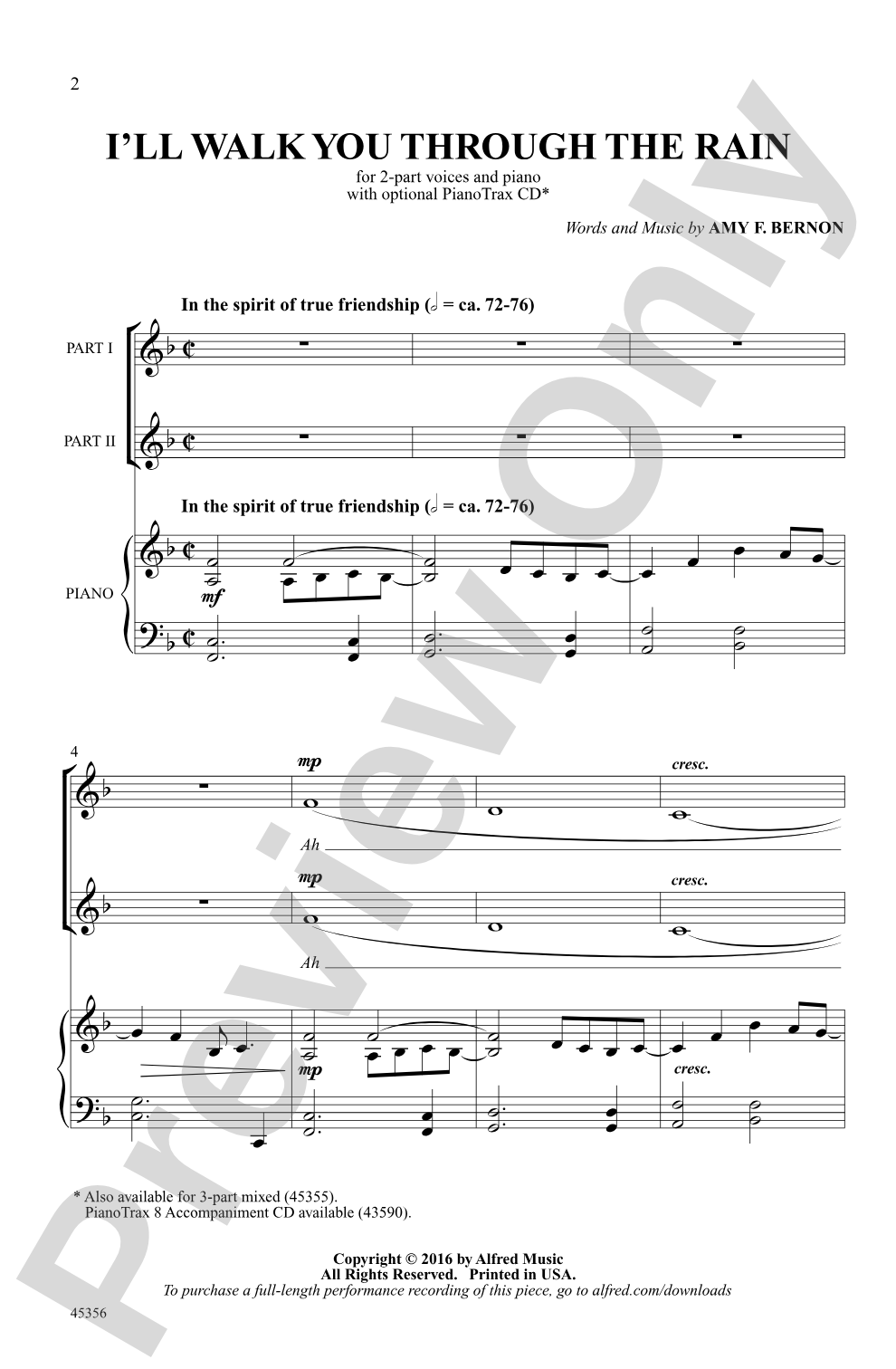
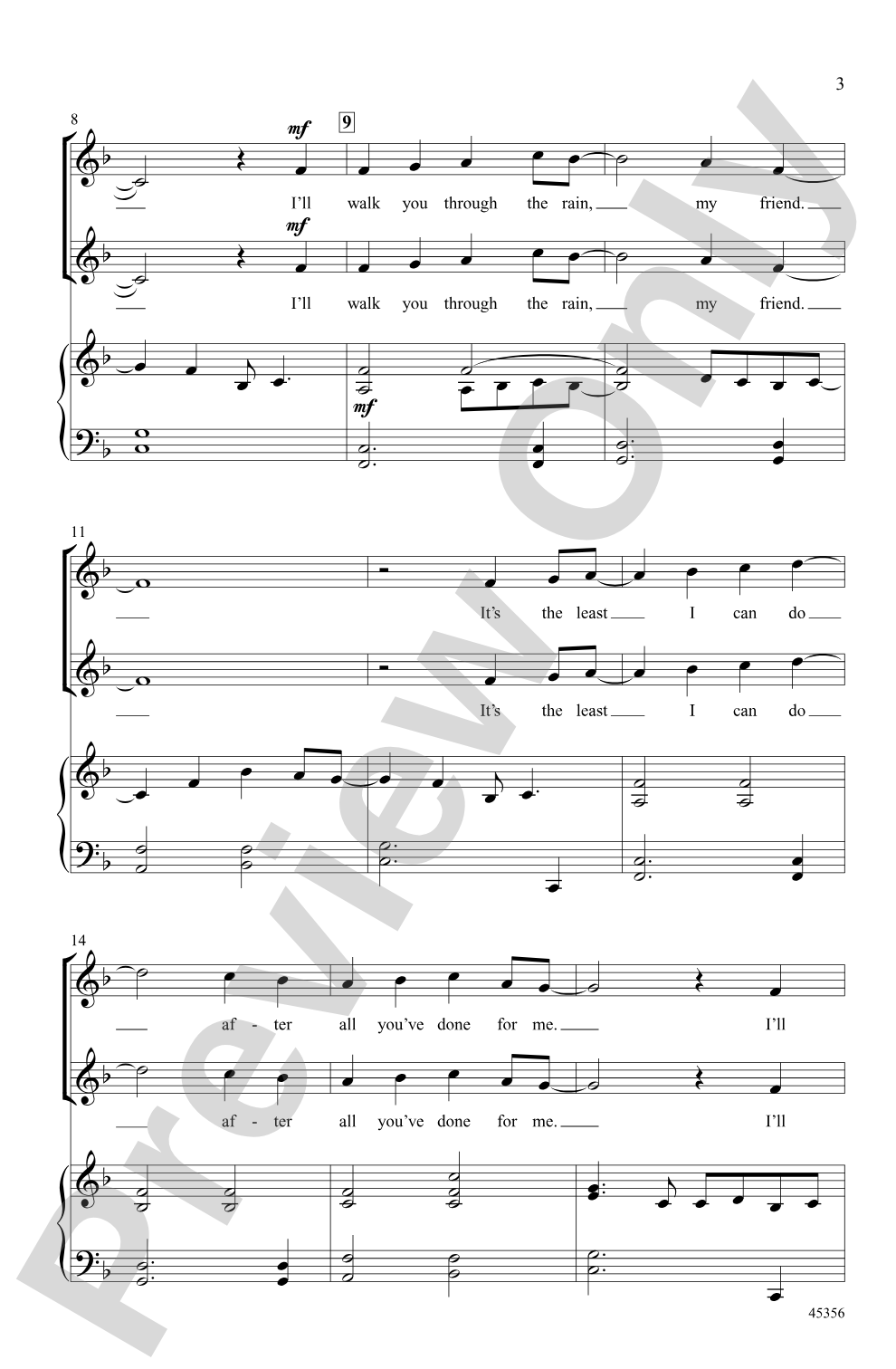
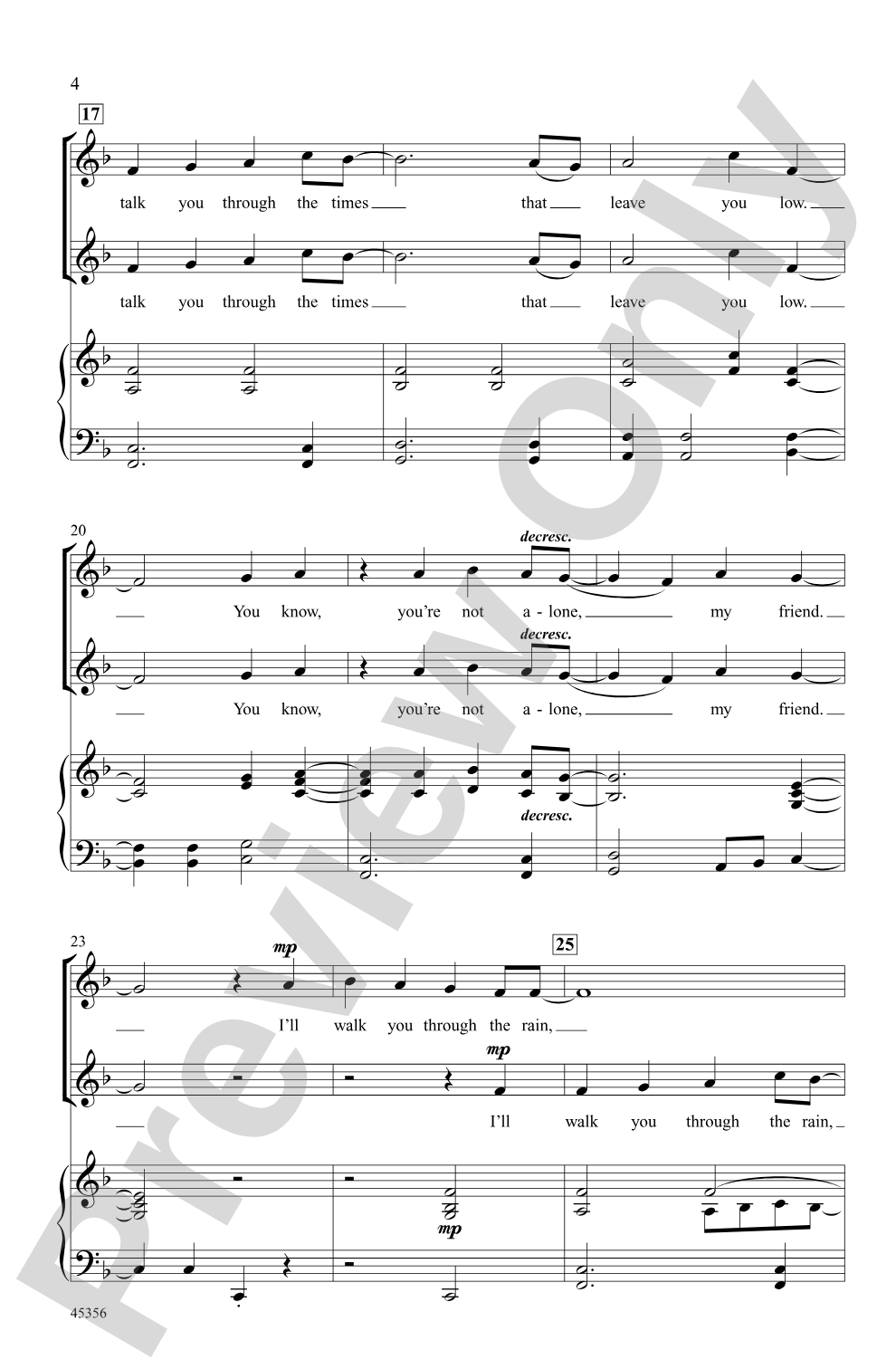

I'll Walk You Through the Rain: 2-Part Choral Octavo
Words and music by Amy F. Bernon
Item: 00-PO-0003614
$1.90
Minimum order quantity: 20 copies
Pickup currently not available
Description
A testament to the bond of friendship, Amy Bernon's tender message is conveyed beautifully through a limited-range melody, designed especially for developing choirs. Near the end, independent vocal parts weave melodic ideas together, tapering to a gentle close.


I'll Walk You Through the Rain: 2-Part Choral Octavo isn't in MakeMusic Cloud just yet...but it could be. Let us know you'd like to see it, and you'll help shape what comes next. In the meantime, start a free trial and dive into thousands of interactive titles your students can play along with today.
Request This Title
Tell us you want it.
Start Your Free Trial
Explore everything that's ready to play right now.
Sample Audio
1
Audio File
--:--
0:00
0:00
Sample Video
No sample videos found.
Additional Details
Series:
Alfred Choral Designs
Publisher:
Alfred Music
Page Count:
12
SKU:
00-PO-0003614
More about this title
About the Composer: Amy F. Bernon

Amy F. Bernon's musical foundation began in Syracuse, where winter hours at the piano evolved into songwriting and collaboration with friends. She pursued formal training at the Hartt School and Yale University School of Music, studying composition with a distinguished roster including Martin Bresnick, Robert Carl, Jacob Druckman, and Libby Larsen.
Bernon has shaped choral programs across New England, teaching and accompanying ensembles at the Taft School in Connecticut and Buckingham Browne and Nichols School in Massachusetts. She founded the Alamanda Women's Choir and directed the Litchfield County Children's Choir, and now works as a clinician at schools and conferences nationwide. Her commissions span choirs throughout the United States and internationally.
Why we love this
Bernon writes with genuine understanding of what developing choirs need: melodic lines that sit comfortably in limited ranges while remaining emotionally generous. The piece respects the learning curve without condescending, and the moment when independent vocal parts begin to interact creates a satisfying musical payoff that singers feel proud to achieve.
What to expect
The piece opens with warmth and intimacy, immediately establishing the tender subject of friendship and loyalty. As it unfolds, the melody feels conversational and genuine, free from overwrought emotion, before the final section brings a quiet complexity that feels earned and moving.
Who it's for
This piece serves developing choirs, particularly those with singers building confidence in part-singing and music literacy. It works equally well for middle school and high school ensembles where the singers are ready to handle independence but still benefit from accessible ranges and straightforward vocal writing.
How to get the most out of it
- Establish the tender character from the first phrase by avoiding excessive vibrato; clarity of tone and text will convey the intimacy more effectively than intensity.
- When the two parts weave together near the end, rehearse them separately first, then layer them slowly to ensure each voice hears and locks into the other part's line.
- Shape the gentle close by allowing a natural ritardando; resist the urge to rush the final resolution, giving the message of friendship its full emotional weight.
- Use the limited range to your advantage by encouraging singers to maintain consistent breath support throughout, preventing the melody from becoming thin or collapsing at the ends of phrases.
How to use it
Program this as a moment of sincere connection in a concert, particularly effective following more energetic selections where its gentle character provides welcome contrast. It also serves beautifully in programs celebrating friendship, community, or human connection, and its accessible difficulty makes it ideal for non-auditioned or newly formed ensembles seeking substantial yet manageable repertoire.
Skills your students will build
- Singing in two independent parts with secure melodic awareness
- Blending treble and lower voices at different pitch levels
- Phrasing and expression in limited-range writing
- Sustaining emotional connection through textual clarity
- Layering harmonic parts that create forward motion