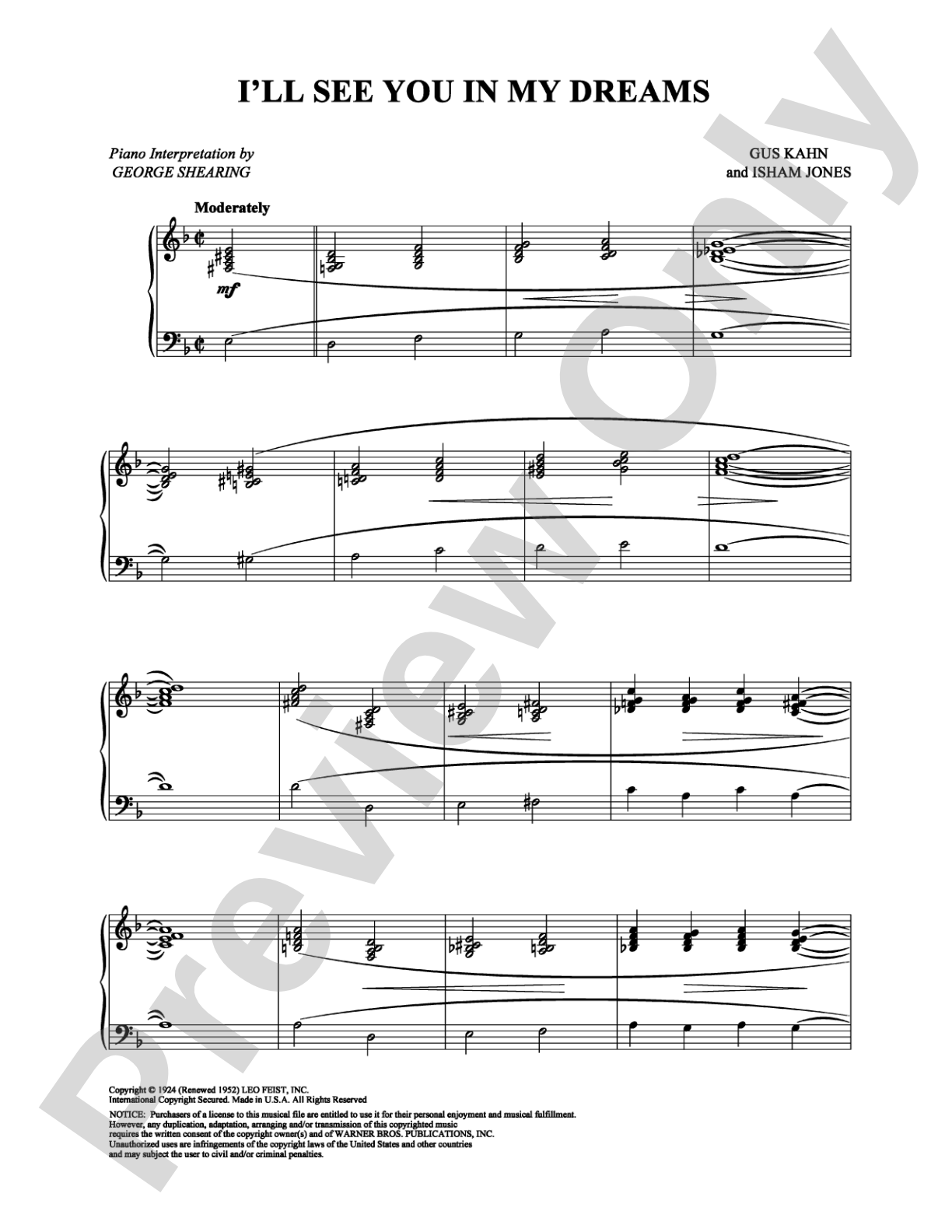
I'll See You in My Dreams: Piano Digital Sheet Music

I'll See You in My Dreams: Piano Digital Sheet Music

Isham Jones, George Shearing, Gus Kahn

Item: 00-PS-0002637

Digital Download
$3.99
Description

I'll See You in My Dreams: Piano Digital Sheet Music isn't in MakeMusic Cloud just yet...but it could be. Let us know you'd like to see it, and you'll help shape what comes next. In the meantime, start a free trial and dive into thousands of interactive titles your students can play along with today.

Sample Audio
No sample audio found.
Sample Video
Additional Details
SKU: 00-PS-0002637

More about this title

About the Artist: George Shearing

George Shearing (1919-2011) was a British jazz pianist and composer whose sophisticated harmonic approach and elegant touch shaped the sound of cool jazz and standards interpretation throughout the mid-20th century. Blind from birth, Shearing developed an instantly recognizable style built on block chord voicings and intricate left-hand work; his piano became a model for musicians seeking to balance technical brilliance with emotional restraint and clarity.

Why we love this

This recording gives pianists direct access to Shearing's refined interpretation of a timeless standard, revealing how a master of jazz harmony shapes a melody through voicing choices and rhythmic nuance. His approach to comping and single-note lines becomes a study in how taste and restraint serve the song, making this ideal for students developing their own voice in the jazz repertoire.

What to expect

Warm, sophisticated, and unhurried. Shearing's interpretation of this ballad flows with the ease of deep familiarity, each harmonic move feeling inevitable rather than clever. The intimacy of the recording draws you into the pianist's thought process, where restraint and refinement speak louder than virtuosity.

Who it's for

Jazz pianists studying standards and seeking to understand how a composer-interpreter balances technique with lyrical clarity, and educators looking for a recorded reference that demonstrates sophisticated harmony in service of melody. Piano students exploring jazz styles beyond basic voicing charts will find Shearing's recorded artistry more instructive than notation alone.

How to get the most out of it

  • Study how Shearing voices the melody against his left-hand patterns; his block chords support rather than overshadow the line, so balance is essential.
  • Notice the space in his phrasing. Resist filling every beat; the silence between phrases is part of the architecture.
  • Work the tempo and swing feel slowly at first, isolating the comping pattern separate from the melody until both feel independent and secure.
  • Listen for the way he handles dynamics across the bridge; that shift in intensity is subtle but drives the form forward without dramatic changes in volume.

How to use it

Use this as a listening and analysis component for a jazz history or standards interpretation unit, pairing it with the sheet music so students can follow Shearing's choices in real time. It works equally well as a model for a student recital piece or as a reference performance when programming jazz standards alongside classical repertoire.

Skills your students will build

  • Listening for harmonic sophistication and chord voicing choices in jazz context
  • Understanding how accompaniment patterns interact with melody in standards interpretation
  • Analyzing rubato and space as expressive tools in ballad playing
  • Recognizing the relationship between composition and performance in jazz artistry

You May Also Like