I'll See You In My Dreams: Piano Digital Sheet Music

I'll See You In My Dreams: Piano Digital Sheet Music

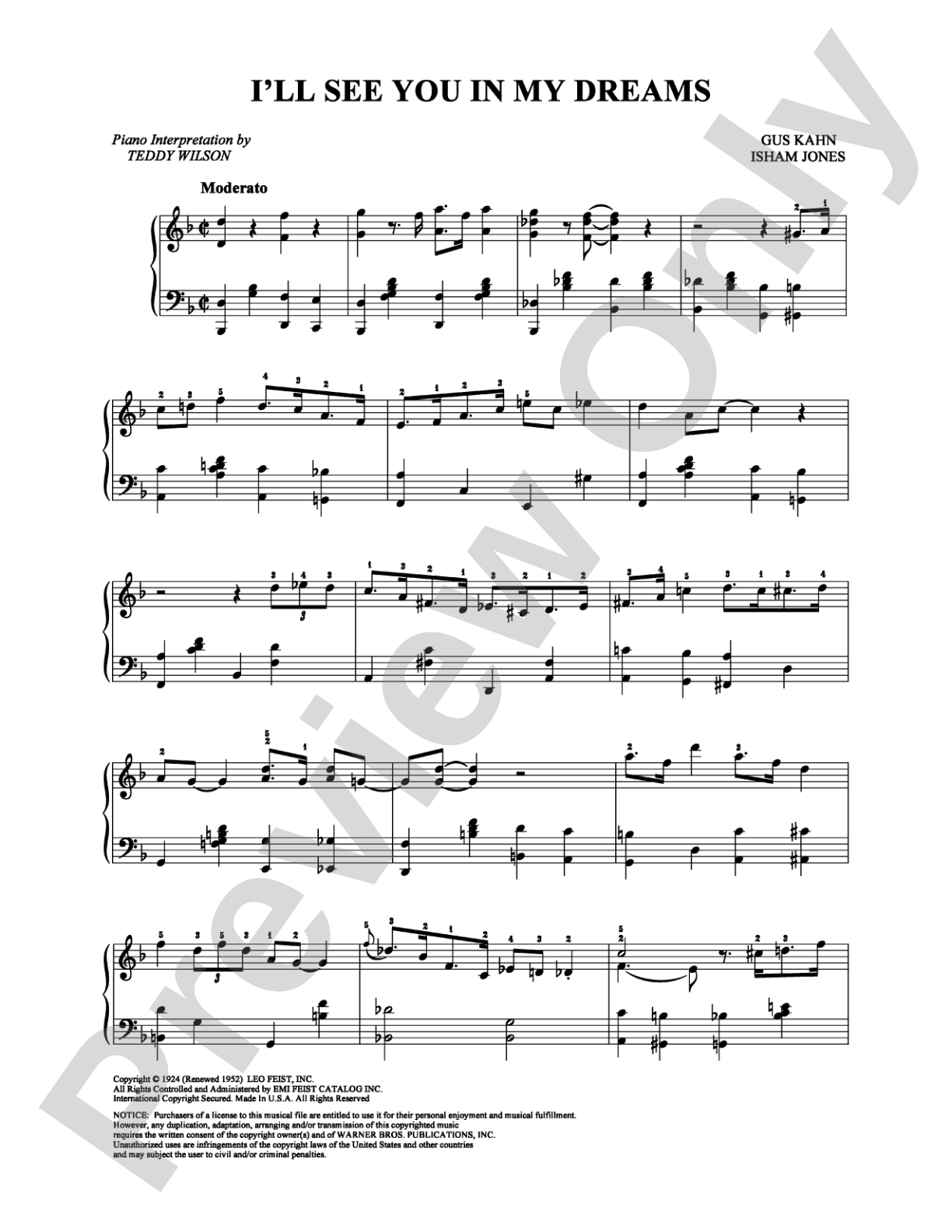
Isham Jones, Teddy Wilson

Item: 00-PS-0002633

Digital Download
$3.99
Description

I'll See You In My Dreams: Piano Digital Sheet Music isn't in MakeMusic Cloud just yet...but it could be. Let us know you'd like to see it, and you'll help shape what comes next. In the meantime, start a free trial and dive into thousands of interactive titles your students can play along with today.

Sample Audio
No sample audio found.
Sample Video
Additional Details
SKU: 00-PS-0002633

More about this title

About the Artist: Teddy Wilson

Teddy Wilson (1912-1986) was a pianist and bandleader who shaped the sound of swing jazz through his innovative approach to harmony and accompaniment. His work with Duke Ellington, Benny Goodman, and his own small groups established him as a master of economical, intelligent voicing and a model for generations of jazz pianists.

Wilson's playing combined classical training with deep blues sensibility. He demonstrated that jazz piano could be both intellectually rigorous and emotionally direct, influencing how musicians approached standards and original compositions alike.

Why we love this

Teddy Wilson's interpretation of this standard reveals how a masterful jazz pianist voices a melody: elegant, restrained, and harmonically sophisticated without ever losing the song's warmth. This digital download gives students direct access to one of swing's most influential hands, showing them how to accompany themselves with the same taste and balance that made Wilson an irreplaceable sideman.

What to expect

Nostalgic yet fresh, this arrangement wraps you in the warmth of a classic standard while the harmonies shift with unexpected grace. Wilson's touch is intimate—he's not showing off, but rather inviting you into a private moment of reflection.

Who it's for

Jazz pianists working toward a deeper understanding of swing-era harmony and accompaniment will find Wilson's voicings instructive and immediately useful. Pianists at the intermediate to advanced level can study this arrangement as a model for how to support a melody without overshadowing it.

How to get the most out of it

  • Listen to Wilson's original recording to absorb his touch and time feel; the sheet music captures his harmonic choices, but his rhythmic nuance lives in the audio
  • Voice the left hand lightly enough that the melody sings; Wilson never crowds the tune, even when harmonies grow complex
  • Approach rubato sparingly and deliberately, especially in the ballad sections; let the song's emotional arc guide slight give-and-take rather than constant pushing and pulling

How to use it

Program this as a jazz piano recital feature or as part of a standards showcase where students can hear how different eras and styles approached the same beloved material. It also works as a study score for jazz history classes examining swing-era piano technique.

Skills your students will build

  • Reading jazz voicings and reharmonization
  • Balancing melody and accompaniment texture
  • Understanding swing-era harmonic language
  • Interpreting dynamics and touch in ballad settings

You May Also Like