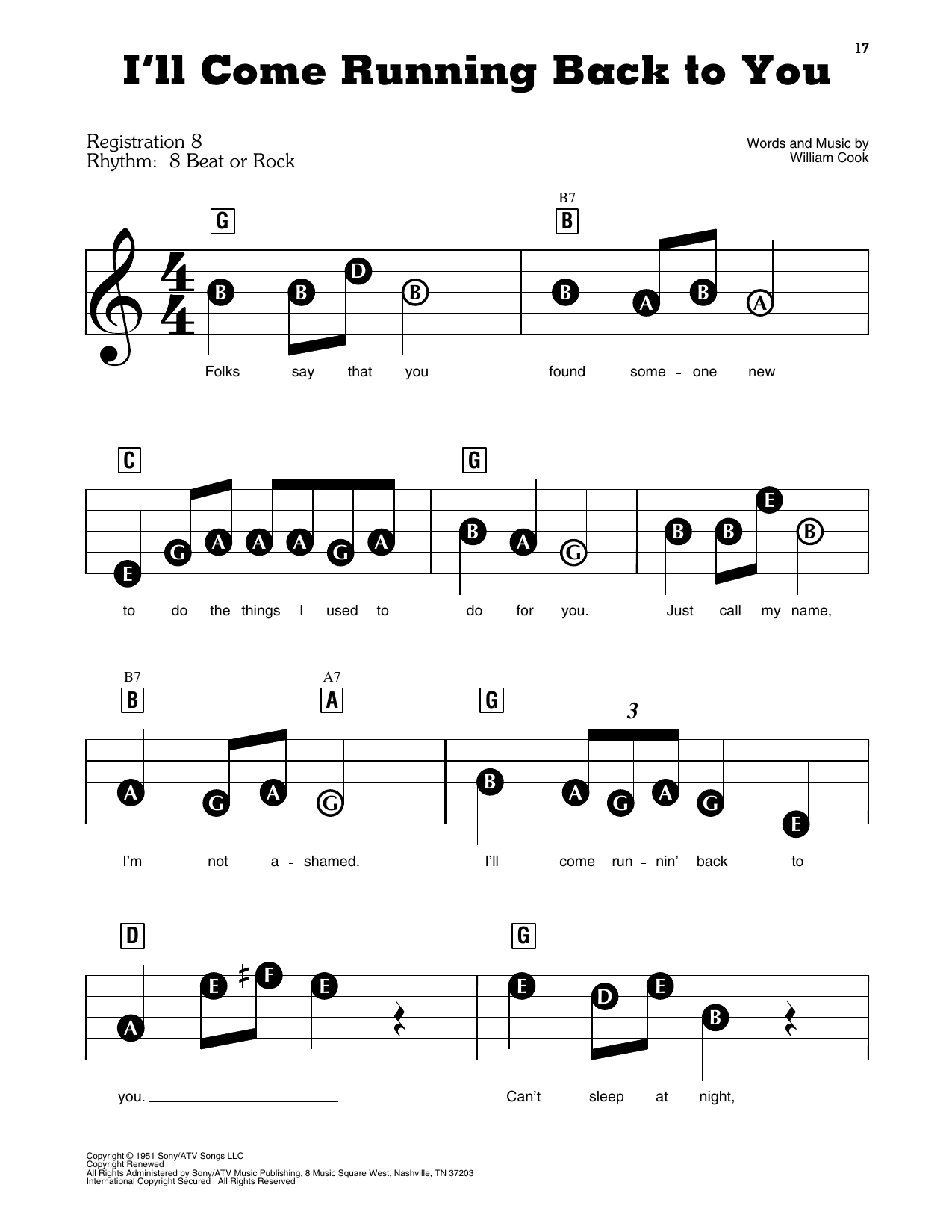
I'll Come Running Back To You Sheet Music Preview

I'll Come Running Back To You: E-Z Play Today

As performed by Sam Cooke

Item: 35-DS01888410

Digital Download
$4.99
Description

I'll Come Running Back To You: E-Z Play Today isn't in MakeMusic Cloud just yet...but it could be. Let us know you'd like to see it, and you'll help shape what comes next. In the meantime, start a free trial and dive into thousands of interactive titles your students can play along with today.

Sample Audio
No sample audio found.
Sample Video
Additional Details
Publisher: Hal Leonard
Page Count: 3
SKU: 35-DS01888410

More about this title

About the Artist: Sam Cooke

Sam Cooke was a pioneering soul and R&B artist whose smooth baritone and sophisticated songwriting shaped popular music from the 1950s through the 1960s. His ability to craft emotionally nuanced songs that bridged soul, pop, and gospel traditions made him one of the most influential vocalists and composers of his era, influencing generations of singers across multiple genres.

Why we love this

Cooke's melodic gift shines through in this arrangement, giving students a chance to explore the harmonic language of classic soul music at an accessible level. The song's emotional directness makes it rewarding to teach; students connect immediately to what they're playing rather than wrestling with complex technical demands.

What to expect

Warm, yearning, and direct. The piece captures the earnest emotional core of Cooke's original, with melodies that sit naturally under the hands and harmonies that feel both familiar and sophisticated. There's an intimacy here that draws the listener in immediately.

Who it's for

This three-page arrangement works well for intermediate pianists exploring soul and R&B repertoire, or for vocalists and ensembles needing an accessible piano reduction of Cooke's classic. It's equally useful in general music classes studying the evolution of American popular song.

How to get the most out of it

  • Balance the melody against any accompanying figures so the vocal line remains the clear focal point throughout.
  • Shape phrases by attending to where the lyric naturally breathes; the music should follow the contour of the words, not fight against it.
  • Explore subtle dynamics within phrases to create depth; soul music lives in the spaces between notes, not just in hitting the strong beats.

How to use it

Pair this with other soul standards from the era to build a program that highlights American vernacular song traditions, or use it as a solo feature in a concert celebrating influential vocalists. It also works well as a bridge piece between classical and contemporary music repertoire.

Skills your students will build

  • Reading and interpreting soul/R&B musical phrasing
  • Voice leading in jazz-influenced harmonic progressions
  • Balance between melody and accompaniment
  • Expressive dynamic control within lyrical phrases

You May Also Like