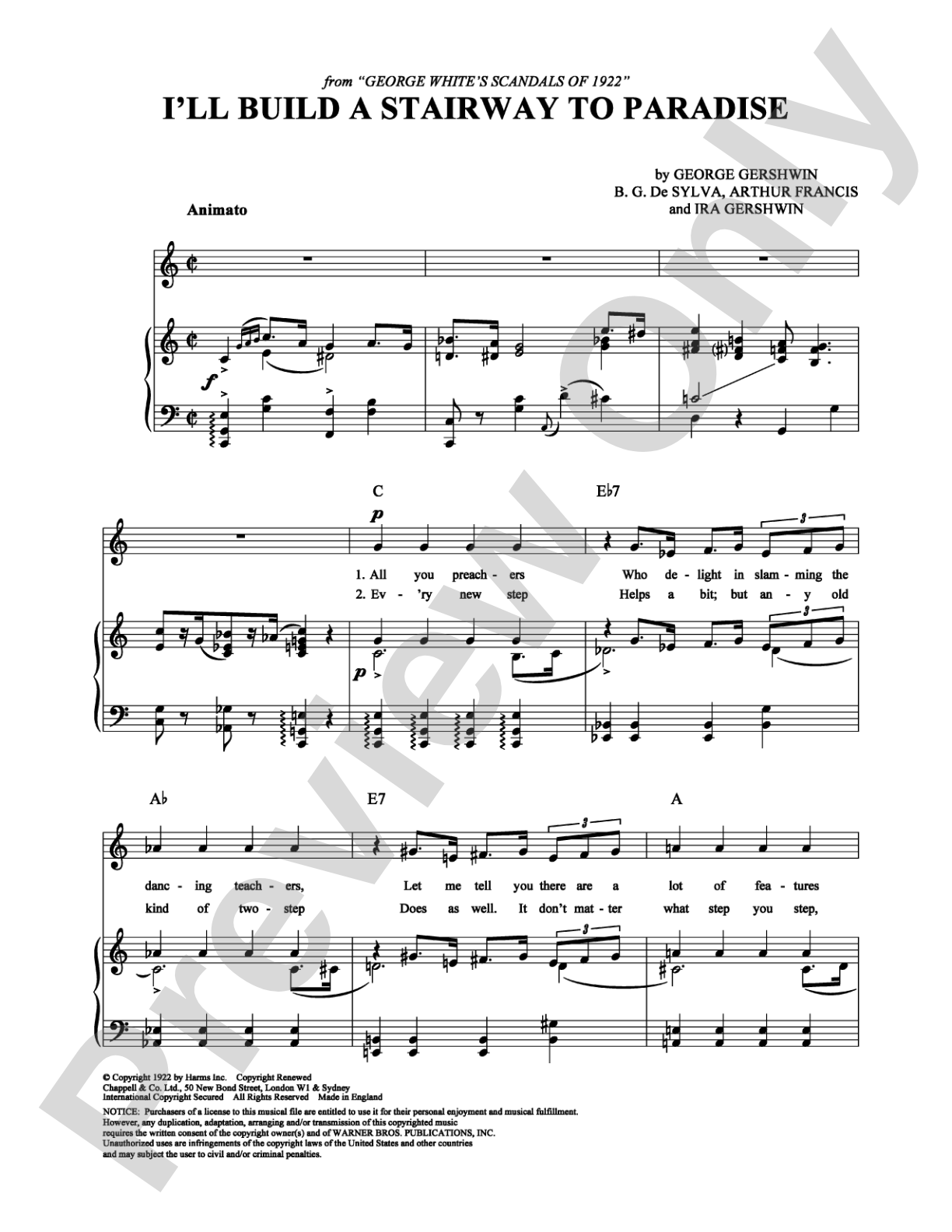
I'll Build a Stairway to Paradise: Piano/Vocal/Chords Digital Sheet Music

I'll Build a Stairway to Paradise: Piano/Vocal/Chords Digital Sheet Music

George Gershwin, Paul Whiteman

Item: 00-PS-0002174

Digital Download
$3.99
Description

I'll Build a Stairway to Paradise: Piano/Vocal/Chords Digital Sheet Music isn't in MakeMusic Cloud just yet...but it could be. Let us know you'd like to see it, and you'll help shape what comes next. In the meantime, start a free trial and dive into thousands of interactive titles your students can play along with today.

Sample Audio
No sample audio found.
Sample Video
Additional Details
SKU: 00-PS-0002174

More about this title

About the Artist: Paul Whiteman

Paul Whiteman (1890, 1967) was an orchestral leader and bandleader whose "King of Jazz" persona defined American popular music in the 1920s and 1930s. Though the title overstated the case, Whiteman's sophisticated arrangements and ability to bridge classical musicians with popular idioms made him one of the most commercially successful bandleaders of his era. His recordings and radio broadcasts reached millions, and his orchestra premiered Gershwin's Rhapsody in Blue in 1924.

Whiteman understood how to write for voices and instruments together with orchestral weight and clarity. His vocal standards, including "I'll Build a Stairway to Paradise," showcase the craft of song arrangement and the marriage of lyric, melody, and harmonic sophistication that defined American popular song at its peak.

Why we love this

This standard captures the elegance and sophistication that defined Whiteman's approach to popular song. The piano-vocal-chords format gives singers and pianists immediate access to a piece steeped in 1920s songwriting craft, with chord symbols that invite improvisation and reharmonization. It's a natural fit for jazz singers, musical theater programs, or standards-focused recitals.

What to expect

Aspirational and energetic, with the bright, forward-moving optimism of 1920s popular song. The melody ascends with a sense of purpose and progress, while the harmonies shimmer with jazz sophistication. It's a piece that radiates confidence and stylistic polish.

Who it's for

Vocalists performing jazz standards, musical theater singers exploring Great American Songbook repertoire, and pianists accompanying singers in recital or classroom settings. This works well for intermediate to advanced singers with some jazz or popular music experience.

How to get the most out of it

  • Pay attention to the chord symbols; they suggest harmonic movement that rewards subtle reharmonization and jazz voicings from the pianist.
  • Shape the vocal line with the lyrical contour rather than strict metric emphasis; these melodies breathe in long phrases.
  • Use the rhythm section flexibility that jazz standards allow; the pianist and singer should breathe together, especially at phrase endings.

How to use it

Program this in a jazz standards set or a musical theater revue that spans the American songbook. It works as a sophisticated opener or closer, and pairs well with other Gershwin-era compositions. The piece also fits naturally into a lesson sequence on jazz harmony and vocal interpretation for singers exploring the standards repertoire.

Skills your students will build

  • Reading and interpreting chord symbols in jazz and popular music context
  • Phrasing and breath control in jazz vocal style
  • Understanding harmonic movement and voice leading in 1920s-1930s popular song
  • Collaboration between vocalist and pianist with flexibility in tempo and articulation

You May Also Like