I'll Be Around: Piano Digital Sheet Music

I'll Be Around: Piano Digital Sheet Music

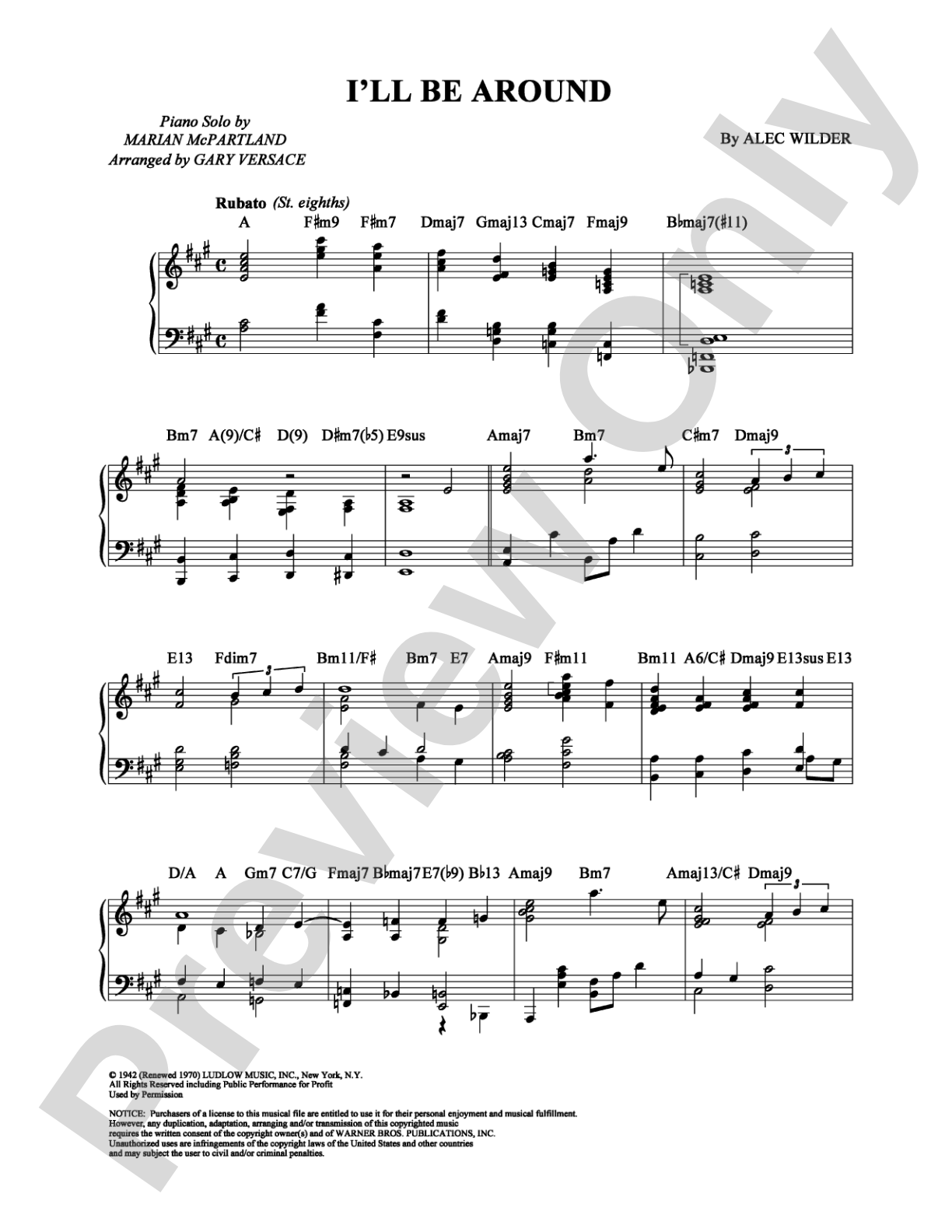
Marian McPartland, Alec Wilder

Item: 00-PS-0005925

Digital Download
$2.95
Description

I'll Be Around: Piano Digital Sheet Music isn't in MakeMusic Cloud just yet...but it could be. Let us know you'd like to see it, and you'll help shape what comes next. In the meantime, start a free trial and dive into thousands of interactive titles your students can play along with today.

Sample Audio
No sample audio found.
Sample Video
Additional Details
SKU: 00-PS-0005925

More about this title

About the Artist: Marian McPartland

Marian McPartland was a British-American jazz pianist and composer whose career spanned seven decades. Known for her sophisticated harmonic sensibility and elegant touch, she became one of the most respected pianists in jazz history, leading her own trio for decades and earning recognition as both a performer and a champion of jazz education.

Why we love this

McPartland's interpretation of this standard reveals the depth that comes from a lifetime of jazz mastery. Her voicings and phrasing offer a masterclass in how to accompany yourself with intelligence and restraint, making it an invaluable study for pianists learning to balance melody, harmony, and space.

What to expect

The piece unfolds with quiet confidence, balancing warmth and sophistication. McPartland's interpretation captures the tender reassurance of the lyric while maintaining the intellectual rigor that defines modern jazz piano.

Who it's for

This arrangement suits intermediate to advanced jazz pianists seeking to deepen their understanding of jazz standards through the lens of a master interpreter. It is also valuable for students studying jazz history, composition, or arranging who want to see how a great pianist approaches reharmonization and improvisation over familiar changes.

How to get the most out of it

  • Listen closely to the harmonic movement through the changes; McPartland's voicings often favor color over density, so let silence work for you rather than filling every beat.
  • Shape the melody with the same attention to rubato and breath that a vocalist would use; this standard was written for singers, and the best piano interpretations honor that lineage.
  • Notice how the left hand supports rather than dominates; use walking bass and chord fragments to anchor the harmonic progression without overwhelming the right-hand line.
  • Explore the space between notes as carefully as the notes themselves; jazz piano is as much about what you don't play as what you do.

How to use it

Feature this as part of a jazz recital or informal performance series where audiences appreciate piano as a solo instrument. It also works well as a study piece in a jazz ensemble workshop, where ensemble pianists can analyze McPartland's approach to comping and solo development for learning and discussion.

Skills your students will build

  • Voice leading and harmonic sophistication in jazz reharmonization
  • Stylistically authentic jazz piano touch and phrasing
  • Balancing melody, harmony, and accompaniment simultaneously
  • Developing taste in dynamic restraint and effective use of space
  • Understanding how standards accommodate both lyrical and harmonic interpretation

You May Also Like