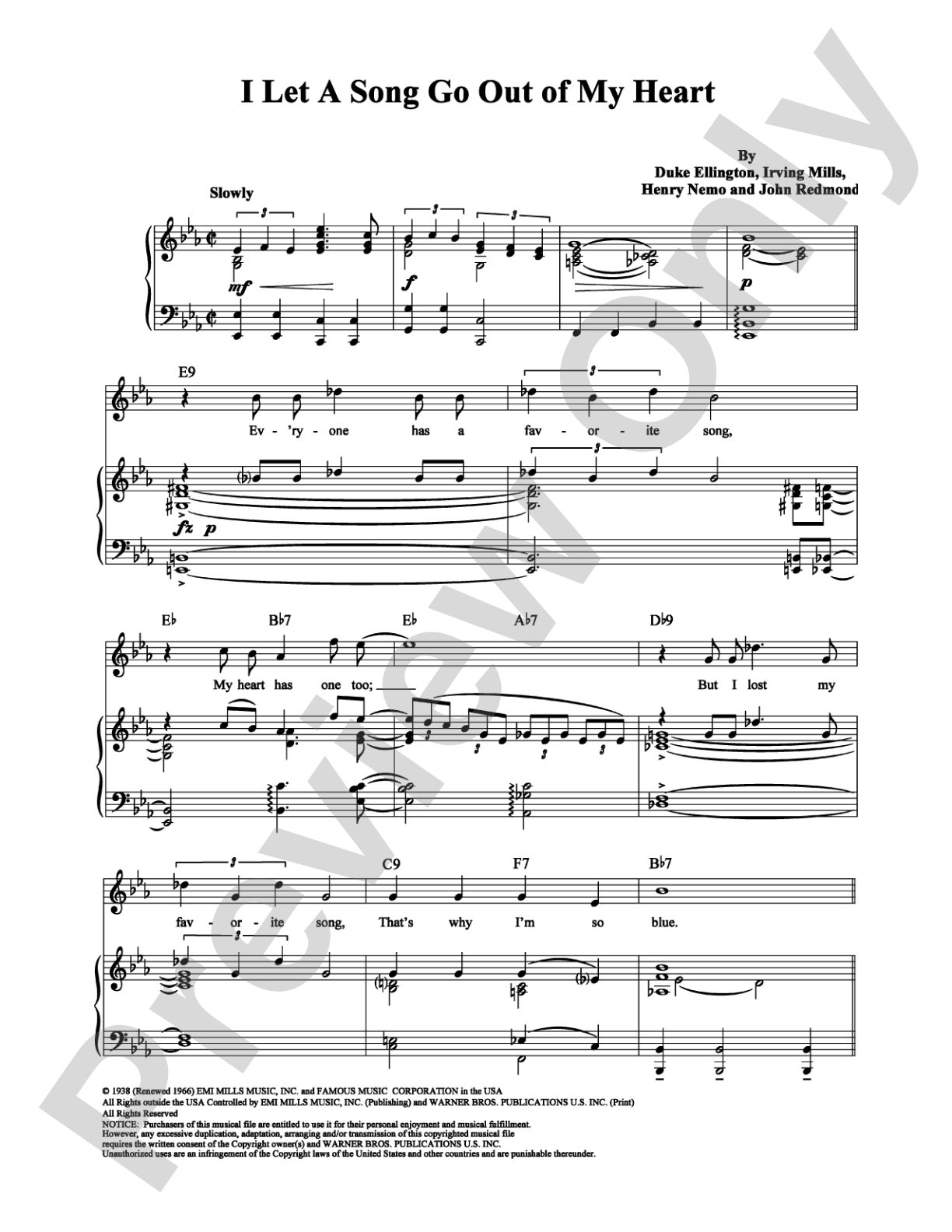
I Let A Song Go Out Of My Heart: Piano/Vocal/Chords Digital Sheet Music

I Let A Song Go Out Of My Heart: Piano/Vocal/Chords Digital Sheet Music

Duke Ellington, Irving Mills, Henry Nemo, John Redmond

Item: 00-PS-0009052

Digital Download
$3.99
Description

I Let A Song Go Out Of My Heart: Piano/Vocal/Chords Digital Sheet Music isn't in MakeMusic Cloud just yet...but it could be. Let us know you'd like to see it, and you'll help shape what comes next. In the meantime, start a free trial and dive into thousands of interactive titles your students can play along with today.

Sample Audio
No sample audio found.
Sample Video
Additional Details
SKU: 00-PS-0009052

More about this title

About the Artist: Duke Ellington

Duke Ellington (1899-1974) stands as one of the most prolific and influential composers in American music history. His sophisticated harmonic language, distinctive orchestrations, and ability to write memorable melodies established the standard for jazz composition and elevated the genre to concert hall status. Beyond his legendary big band, Ellington composed thousands of works across multiple idioms, from extended concert pieces to accessible popular standards that remain central to the jazz repertoire.

Why we love this

This standard showcases exactly why Ellington's songwriting endures in teaching studios and performance settings: the melody is elegant and singable, the harmonic movement is sophisticated without being impenetrable, and the chord changes reward close listening and harmonic awareness. Singers and pianists at the intermediate level can dive into jazz repertoire here without the rhythmic complexity of bebop, making it ideal for building jazz literacy alongside classical foundations.

What to expect

A lyrical meditation with genuine warmth. The melody moves with unhurried grace, inviting the singer to linger on phrases without demanding virtuosity. Beneath it sits harmonic sophistication that reveals itself gradually, each chord change deepening the emotional landscape without ever feeling overwrought or self-consciously complex.

Who it's for

Singers with intermediate vocal technique who are ready to explore jazz standards, and pianists seeking material that bridges classical training and jazz improvisation. This works equally well for studio instruction, jazz ensemble auditions, or recital programming where a standard sits naturally among art songs and popular repertoire.

How to get the most out of it

  • Shape the melody with dynamic variety rather than playing it straight; Ellington's standards benefit from conversational phrasing that responds to the lyric content.
  • Treat the piano part as more than accompaniment. The voicings are integral to the harmonic color, so voice them deliberately and ensure the left hand supports rather than competes with the vocal line.
  • Take time to explore the chord changes before finalizing tempos. This tune's harmonic interest lives in the substitutions and secondary dominants, not in rushing through changes.
  • Balance swing interpretation with the written notation. The lead sheet will guide you, but jazz standards expect musicians to find the pocket without losing the tune's essential shape.

How to use it

Program this alongside other jazz standards from the American songbook, or pair it with classical art songs to illustrate how melody and harmony function across genres. It works beautifully in recitals focused on twentieth-century American music, or as a bridge piece between traditional and contemporary repertoire in academic settings.

Skills your students will build

  • Reading lead sheet notation and understanding chord symbols
  • Interpreting jazz phrasing and swing articulation from a written melody
  • Analyzing extended harmony and secondary dominants
  • Balancing vocal melody with piano voicings in the jazz idiom
  • Building jazz fluency through standards-based repertoire

You May Also Like