
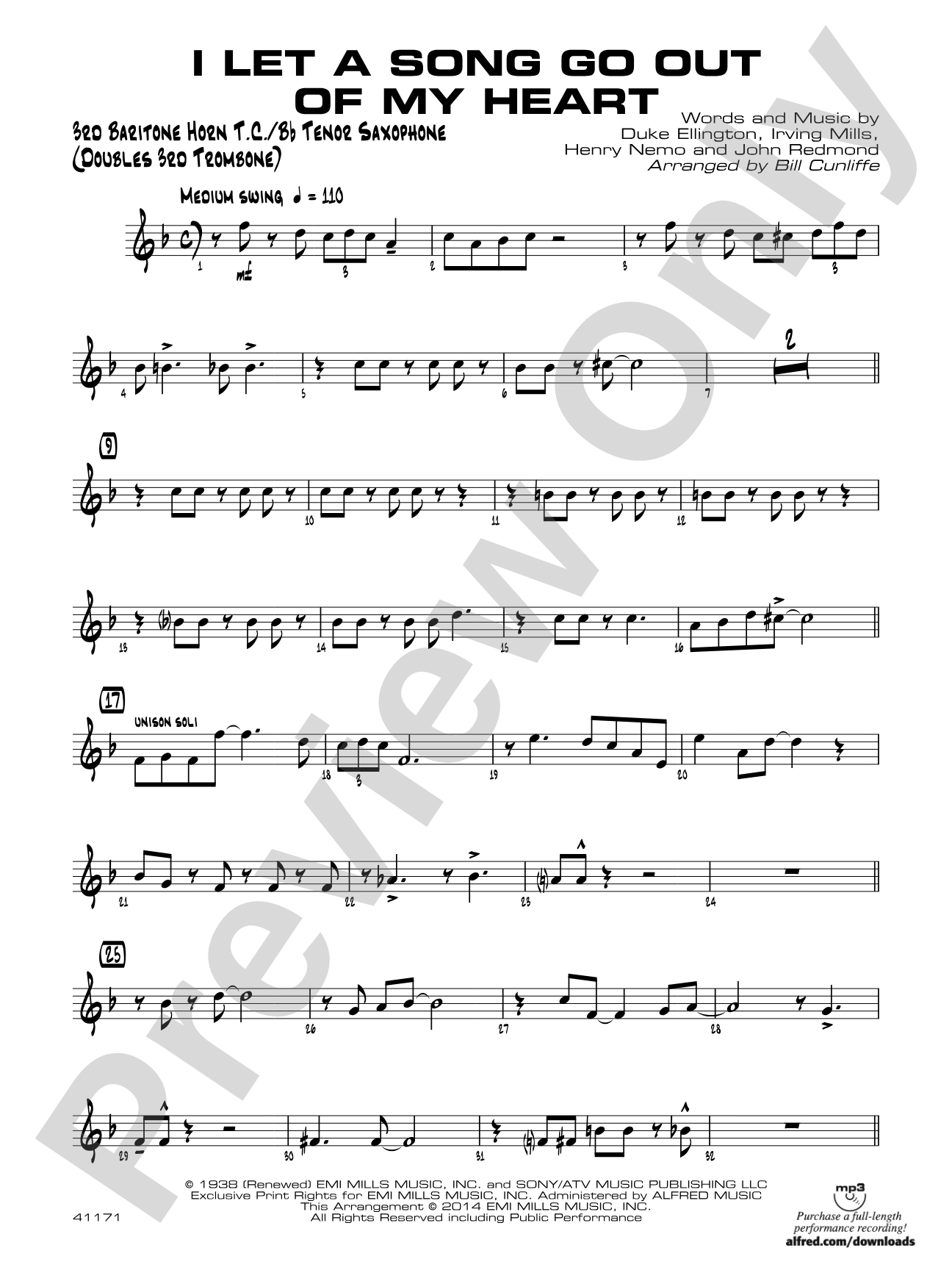

I Let a Song Go Out of My Head: 3rd Baritone T.C.
Words and music by Duke Ellington, Irving Mills, Henry Nemo, and John Redmond / arr. Bill Cunliffe
Grade: 3 (Medium)
Item: 00-PC-0016299_BTC3
$3.00
Pickup currently not available
Description
I Let a Song Go Out of My Heart arranged by Bill Culiffe, is a fine chart for a concert, festival, or dance gig. A medium swing at 114 BPM, written solos are provided for alto, trombone 1, and piano. With great dynamics, sax solis, and a sweet shout chorus, this chart swings all by itself, and you'll love its voicings, too. Optional vibes. (4:04)


Don't just read it, hear it, play along with it, and watch your students grow with it. In MakeMusic Cloud, I Let a Song Go Out of My Head: 3rd Baritone T.C. comes alive with professional accompaniment, adjustable tempo, and built-in practice tools that turn solo practice into real progress.
Open in the Player
Jump straight in and assign it today.
Start Your Free Trial
Open this title and explore the full library in minutes.
Sample Audio
1
Audio File
--:--
0:00
0:00
Sample Video
Additional Details
Series:
Jazz Band Series
Publisher:
Alfred Music
Page Count:
102
SKU:
00-PC-0016299_BTC3
More about this title
About the Composer: Duke Ellington
Duke Ellington stands as one of the most prolific composers in American music history, creating thousands of works across jazz, classical, and popular idioms during a career spanning five decades. His harmonic sophistication, orchestral arranging innovations, and gift for melody shaped the sound of jazz itself and established the big band as a vehicle for serious compositional ambition.
Ellington's music endures in education because it balances accessibility with genuine artistry. His pieces invite student musicians to engage with swing idioms, extended harmonies, and ensemble voicing in ways that feel authentic rather than didactic. Teaching from his catalog builds musicianship across technique, listening, and the history of American music simultaneously.
Why we love this
Bill Cunliffe's arrangement captures everything that makes Ellington's writing singable and playable while preserving the sophistication of the original voicings. The included solos for alto, trombone, and piano give section leaders and soloists real musical material to grow into, and the shout chorus provides the kind of moment that makes audiences lean forward. This is a chart that works equally well at a festival competition or a community dance gig.
What to expect
A medium-tempo swinger with genuine sophistication in its harmonies and section writing, yet one that never feels stiff or academic. The inclusion of vibraphone as optional adds shimmer when available, while the piece holds together beautifully as a core ensemble statement.
Who it's for
High school jazz ensembles, college jazz bands, and community big bands looking for a vehicle that swings hard while offering meaningful solo opportunities. The Grade 3 difficulty sits squarely in the working repertoire zone: challenging enough to require focused rehearsal but accessible enough to prepare in a reasonable timeline.
How to get the most out of it
- Nail the swing feel at 114 BPM by locking the rhythm section's understanding of where the backbeat lives. Once your drummer and bassist agree on the pocket, the horn sections will follow naturally.
- The written solos are starting points, not final answers. Encourage alto, trombone 1, and piano players to learn the written passage first, then develop their own voice within that harmonic and melodic framework.
- Balance the sax soli sections carefully. These moments sit at the heart of the arrangement and need clarity without overpowering the rest of the ensemble. Think transparency rather than volume.
- The shout chorus builds its power through collective energy, not force. Coach the band to think of it as conversation and response, letting each phrase land before the next enters.
How to use it
This arrangement fits naturally on a concert where you're programming a mix of jazz standards, as an opener or mid-set number that establishes ensemble swing without demanding a ballad or extended feature. It also works as a festival piece where it reads as both musically serious and genuinely enjoyable.
Skills your students will build
- Medium-tempo swing feel and articulation in both written passages and improvisation
- Voicing blend in four-part saxophone sections and section-to-section balance
- Solo construction over jazz changes, building from the provided melody
- Listening and responding to rhythm section time, particularly backbeat placement
- Phrasing and dynamics across both ensemble and individual passages