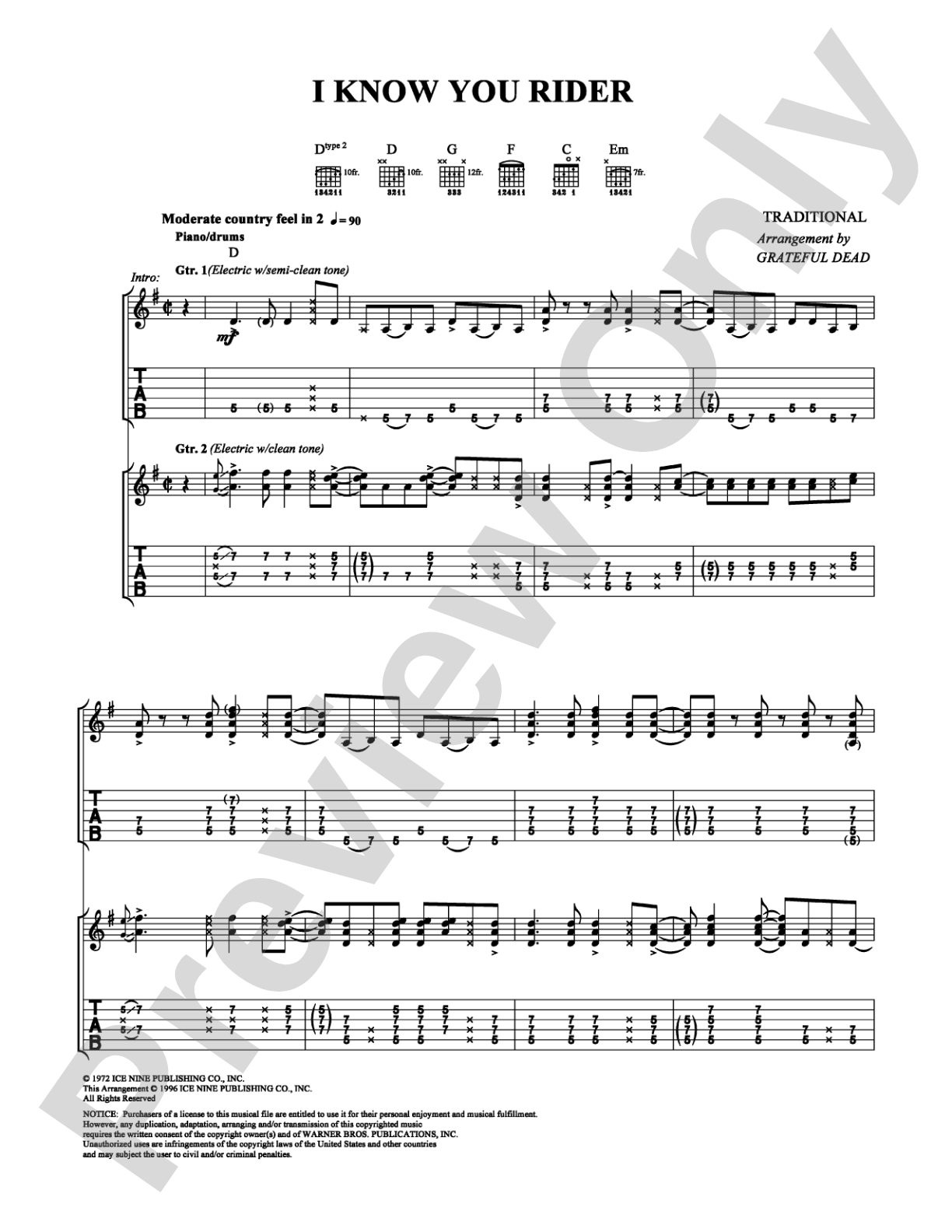
I Know You Rider: Guitar TAB Digital Sheet Music

I Know You Rider: Guitar TAB Digital Sheet Music

Traditional, Grateful Dead

Item: 00-PS-0002362

Digital Download
$2.95
Description

I Know You Rider: Guitar TAB Digital Sheet Music isn't in MakeMusic Cloud just yet...but it could be. Let us know you'd like to see it, and you'll help shape what comes next. In the meantime, start a free trial and dive into thousands of interactive titles your students can play along with today.

Sample Audio
No sample audio found.
Sample Video
Additional Details
SKU: 00-PS-0002362

More about this title

About the Artist: Grateful Dead

The Grateful Dead emerged from the San Francisco Bay Area in the mid-1960s and became one of the most influential American rock bands. Known for their improvisational live performances, intricate musicianship, and devoted fanbase, the band pioneered the jam band tradition and created a body of work that spans folk, blues, country, and psychedelic rock. Their influence on modern guitar playing and ensemble improvisation remains central to music education conversations around American popular music.

The band's catalog reflects deep roots in American musical traditions while pushing toward experimental territory. Their compositions often feature complex chord progressions, syncopated rhythms, and layered guitar work that rewards close study by developing musicians seeking to understand how rock ensembles build texture and sustain musical conversations across extended performances.

Why we love this

This track gives guitarists access to a genuine American rock standard written by and for improvisers. The TAB format lets players focus on the actual fingerings and voicings that create the song's signature sound, rather than translating notation into idiomatic guitar playing. It's a piece where learning the written arrangement opens doors to understanding how the Dead constructed their music for both accuracy and adaptability.

What to expect

The song carries the swagger and ease of a road song, with blues undertones and a storytelling quality that reflects its origins in traditional American music. The guitar work has an open, driving quality that invites you into the groove while maintaining the intricate fingerwork that makes the Grateful Dead's arrangements distinctive.

Who it's for

Guitar students who want to understand how a foundational rock song is constructed and performed. This works well for intermediate to advanced players exploring American roots in rock music, as well as ensemble guitarists looking to expand their repertoire beyond standard chord-chart material. Players interested in jam traditions and improvisational frameworks will find real value in how this arrangement balances specificity with adaptability.

How to get the most out of it

  • Pay attention to fingering efficiency in the TAB; the Dead's guitar parts were designed to be playable while leaving room for variation and improvisation in live settings
  • Lock into the rhythmic pocket rather than rushing; the groove comes from precise timing with a relaxed feel, not from racing through changes
  • Study how multiple guitar lines might interact if you're learning this as part of an ensemble; the interplay between rhythm and lead guitars is central to the arrangement
  • Experiment with dynamics and tone once you have the notes secure; the TAB gives you the roadmap, but your touch and amp settings shape the character

How to use it

This works as a bridge between classical or formal rock study and the improvisational traditions that shape modern ensemble playing. Include it in a rock repertoire concert, a summer jam session curriculum, or a deep-dive unit on American music traditions. It also serves as a gateway to exploring how the Grateful Dead influenced guitar pedagogy and ensemble musicianship across generations.

Skills your students will build

  • Reading guitar TAB notation with accuracy
  • Understanding how blues-based chord progressions support melody and improvisation
  • Executing fingering patterns that balance efficiency with idiomatic rock guitar sound
  • Recognizing rhythmic pocket and maintaining groove without rushing
  • Adapting a learned arrangement to accommodate variation and personal interpretation

You May Also Like