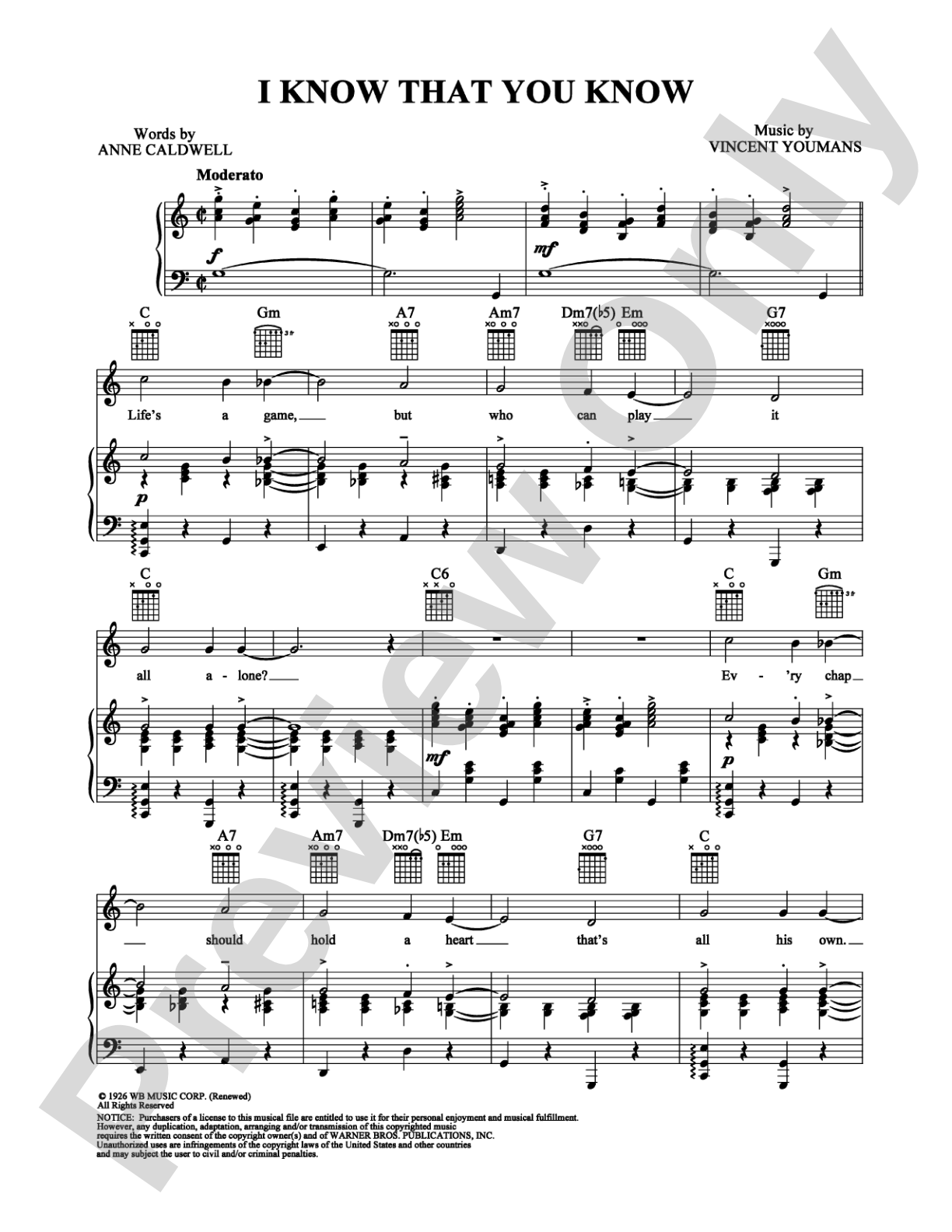
I Know That You Know: Piano/Vocal/Chords Digital Sheet Music

I Know That You Know: Piano/Vocal/Chords Digital Sheet Music

Vincent Youmans, Benny Goodman, Doris Day, Gordon MacRae

Item: 00-PS-0005262

Digital Download
$3.99
Description

I Know That You Know: Piano/Vocal/Chords Digital Sheet Music isn't in MakeMusic Cloud just yet...but it could be. Let us know you'd like to see it, and you'll help shape what comes next. In the meantime, start a free trial and dive into thousands of interactive titles your students can play along with today.

Sample Audio
No sample audio found.
Sample Video
Additional Details
SKU: 00-PS-0005262

More about this title

About the Artist: Benny Goodman

Benny Goodman (1909-1986) earned his place as the "King of Swing" through relentless musicianship and an ear for what audiences craved. A clarinetist, bandleader, and composer, Goodman shaped the swing era by commissioning arrangements, commissioning classical composers, and recording standards that became touchstones of American jazz and popular music.

Goodman's influence on music education runs deep. His commitment to ensemble sound, improvisation, and the careful balance between ensemble precision and solo expression made him a model for generations of jazz educators and band directors. His recordings remain essential listening for understanding how popular song standards can be interpreted with sophistication and swing.

Why we love this

This standard arrives with the stamp of three definitive interpreters, each bringing their own phrasing and swing sensibility to the same melody. Having multiple vocal approaches on one score gives singers permission to find their own voice rather than chase a single "correct" interpretation, while pianists benefit from seeing how the accompaniment can shift in character depending on the vocalist's approach.

What to expect

A sophisticated conversational spark between two people who already know each other well. The melody floats with ease over warm harmonic changes, inviting performers to play with rhythm and timing rather than race through the form. There's joy in the lightness of it, paired with the kind of understated elegance that defines the best American songwriting.

Who it's for

Singers and pianists working in jazz repertoire, pop standards, or crossover contexts will find this a foundational piece. It works equally well for voice students exploring legit interpretations, jazz vocalists refining their swing phrasing, or pianists building confidence with jazz comping.

How to get the most out of it

  • Anchor the rhythm section groove by feeling the swing eighth notes rather than playing them straight; the space between notes matters as much as the notes themselves.
  • Listen to each recorded version (Goodman's instrumental, Doris Day's warm ballad phrasing, Gordon MacRae's fuller legit approach) before rehearsing to absorb the range of valid interpretations.
  • Use the chord symbols to build comping vocabulary; try voicings beyond shell voicings to add sophistication without cluttering the melody line.
  • Shape phrases into the lyric's natural speech patterns rather than dividing them at bar lines; this standard rewards conversational phrasing over metronomic regularity.

How to use it

Ideal for jazz night recitals, cabaret-style revues, or standards showcase concerts where the focus is on interpretation and style. This piece sits comfortably alongside other Goodman-era standards or works as a bridge between classical vocal training and contemporary musical theatre.

Skills your students will build

  • Jazz phrasing and swing rhythm feel
  • Chord-symbol reading and jazz comping
  • Vocal microphone technique and intimate delivery
  • Stylistic flexibility across multiple interpretations of a single melody

You May Also Like