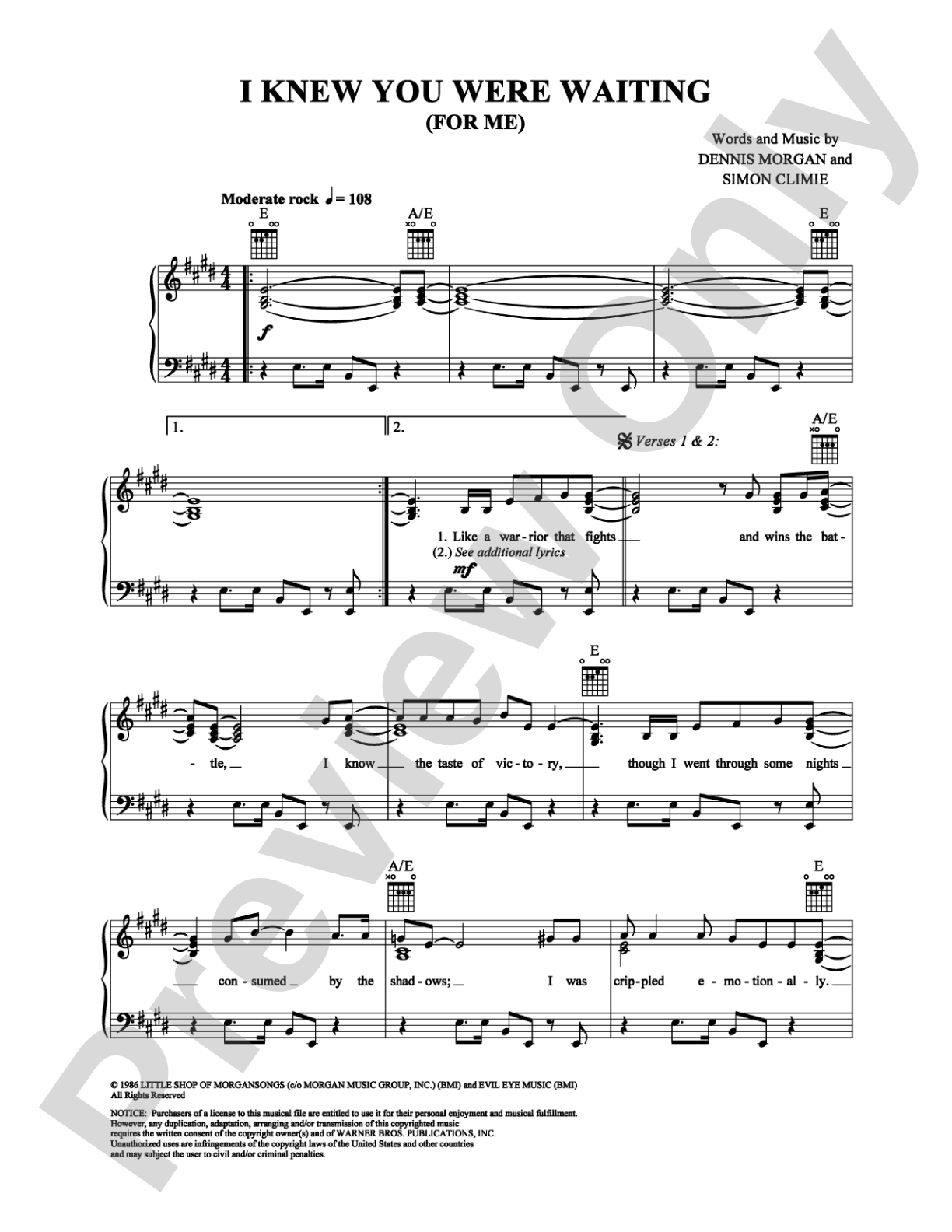
I Knew You Were Waiting (For Me): Piano/Vocal/Chords Digital Sheet Music

I Knew You Were Waiting (For Me): Piano/Vocal/Chords Digital Sheet Music

Aretha Franklin, Simon Climie, Dennis Morgan, George Michael

Item: 00-PS-0006016

Digital Download
$3.99
Description

I Knew You Were Waiting (For Me): Piano/Vocal/Chords Digital Sheet Music isn't in MakeMusic Cloud just yet...but it could be. Let us know you'd like to see it, and you'll help shape what comes next. In the meantime, start a free trial and dive into thousands of interactive titles your students can play along with today.

Sample Audio
No sample audio found.
Sample Video
Additional Details
SKU: 00-PS-0006016

More about this title

About the Artist: George Michael

George Michael emerged as one of the defining voices of 1980s pop, first as the primary songwriter and vocalist of Duran Duran's contemporary, Wham!, before launching a solo career that proved his depth as both a musician and producer. His work consistently balanced radio accessibility with genuine musicianship, crafting songs that showcased sophisticated harmonic sensibilities and emotional authenticity. This collaboration with Aretha Franklin stands as a landmark moment in pop music history, pairing two vocalists at the height of their interpretive powers.

Why we love this

This piano/vocal arrangement captures one of pop music's most electrifying vocal partnerships, giving singers and accompanists a chance to explore the interplay between two distinct vocal personalities within a single piece. The song's strong melodic anchor and emotional directness make it accessible for students while its harmonic sophistication and dynamic vocal writing reward careful musicianship. Programming this offers a bridge between contemporary pop and the soul traditions Aretha Franklin championed, expanding your students' listening and performing vocabulary.

What to expect

The opening establishes an urgent, almost conversational intimacy between the two voices, building from a place of longing and connection. As the piece develops, the harmonic movement and vocal layering create a sense of growing certainty and power, with both singers driving toward moments of genuine triumph. The arc moves from vulnerable questioning to confident declaration, with the piano arrangement supporting this emotional journey through thoughtful voice leading and dynamic shifts.

Who it's for

This arrangement works for intermediate to advanced singers with some piano accompaniment experience, as well as singers preparing for recital or concert performance who want to tackle a duet with genuine emotional stakes. Pianists at the upper intermediate level or above will find the accompaniment appropriately challenging without becoming unwieldy. It's equally valuable for musical theater singers exploring pop-influenced contemporary styles.

How to get the most out of it

  • Study both the original vocal lines separately before rehearsing them together; each artist has a distinct phrasing approach that defines the arrangement's character.
  • Balance the piano accompaniment so it supports rather than overwhelms the vocals; the chords should anchor the harmony without obscuring the lyrical content.
  • Pay close attention to the rhythmic interaction between voice and piano, especially in sections where George Michael's rhythmic phrasing differs from the notated beat.
  • Approach the dynamics with intention; this duet builds power through layering voices, so coordinate your approach to crescendos and climactic moments.

How to use it

This duet works beautifully in a concert celebrating contemporary vocal music or in a recital showcasing contrasting vocal styles and genres. You might program it alongside classical art song and musical theater selections to illustrate how contemporary pop at its best shares the same commitment to lyrical storytelling and vocal expression. It also serves well in a thematic program exploring duets or partnerships in music.

Skills your students will build

  • Balancing two independent vocal lines with distinct rhythmic and phrasing characteristics
  • Accompanying singers with sensitivity to their phrasing and emotional arc
  • Interpreting contemporary harmonic language within a pop context
  • Coordinating vocal entries, dynamics, and climactic moments in ensemble singing
  • Reading and performing piano/vocal scores with chord symbols

You May Also Like