
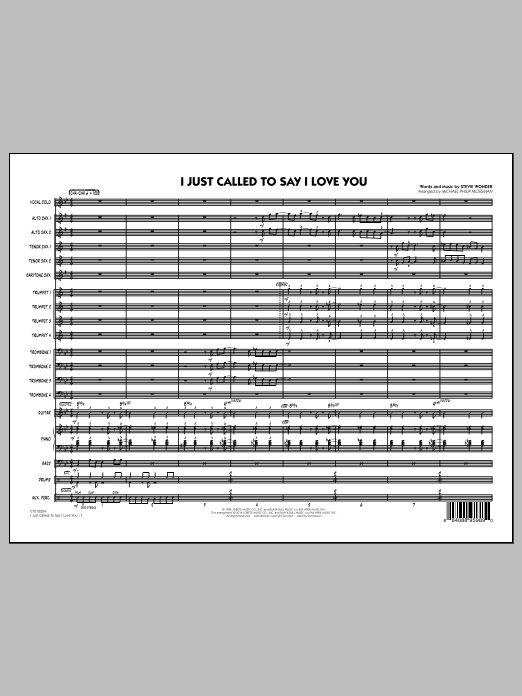

I Just Called to Say I Love You: Jazz Ensemble Conductor Score & Parts
As performed by Stevie Wonder / Arranged by Michael Philip Mossman
Grade: 5
Item: 35-PK00290575
$65.00
Pickup currently not available
Buy Extra Parts (Digital PDF Download)
Parts Added to Cart!
Description
Originally recorded in 1984 by Stevie Wonder, here is a smooth version in a cha-cha style that provides a very appealing setting for vocalist. Michael uses some harmonic twists and turns, interesting and creative background figures, and includes solo space for trumpet.


I Just Called to Say I Love You: Jazz Ensemble Conductor Score & Parts isn't in MakeMusic Cloud just yet...but it could be. Let us know you'd like to see it, and you'll help shape what comes next. In the meantime, start a free trial and dive into thousands of interactive titles your students can play along with today.
Request This Title
Tell us you want it.
Start Your Free Trial
Explore everything that's ready to play right now.
Sample Audio
No sample audio found.
Sample Video
No sample videos found.
Additional Details
Publisher:
Hal Leonard
SKU:
35-PK00290575
More about this title
About the Artist: Stevie Wonder
Stevie Wonder emerged as one of the most influential musicians of the late 20th century, blending soul, funk, jazz, and pop into a deeply personal artistic vision. His harmonic sophistication and ear for arranging made him a master of the ballad form, and his compositions reveal an instinctive understanding of how melody and chord movement can convey emotion with precision.
Why we love this
Mossman's arrangement transforms a beloved pop standard into genuine jazz repertoire without sacrificing the song's emotional core. The cha-cha setting gives the ensemble a rhythmic pocket to groove in, while the harmonic recoloring and trumpet solo space elevate it beyond a simple cover and into territory where your students will feel like they're playing real jazz.
What to expect
Warm and sophisticated. The cha-cha rhythm gives it a gentle forward motion, while Mossman's harmonic reimagining keeps listeners engaged with unexpected chord colors. There's an intimacy here, even when the full ensemble is playing, because the arrangement prioritizes space and clarity over density.
Who it's for
Jazz ensembles at the intermediate to advanced level looking for a pop standard that respects both the song's accessibility and their students' growing jazz language. Directors who want to feature a vocalist while giving the full ensemble meaningful, idiomatic jazz writing will find this well balanced across all sections.
How to get the most out of it
- Balance the vocalist's airtime carefully against ensemble passages; this arrangement thrives when the background figures support rather than compete with the melody line.
- Lock the rhythm section into the cha-cha feel early in rehearsals so the harmonic twists land cleanly and the groove stays steady through chord changes.
- Give your trumpet soloist room to breathe and explore during their featured passage; the arrangement provides scaffolding, but this is their moment to add personality.
How to use it
Reserve this for a concert where you want to include a vocalist without dropping into purely commercial territory. It works beautifully on a program that mixes jazz standards with original compositions, or as the opener for a second set where you're inviting the audience to relax into the groove.
Skills your students will build
- Comping chord changes in jazz context
- Cha-cha rhythm feel and subdivision
- Ensemble balance with featured soloist
- Harmonic reharmonization listening
- Rhythmic independence within groove-based ensemble