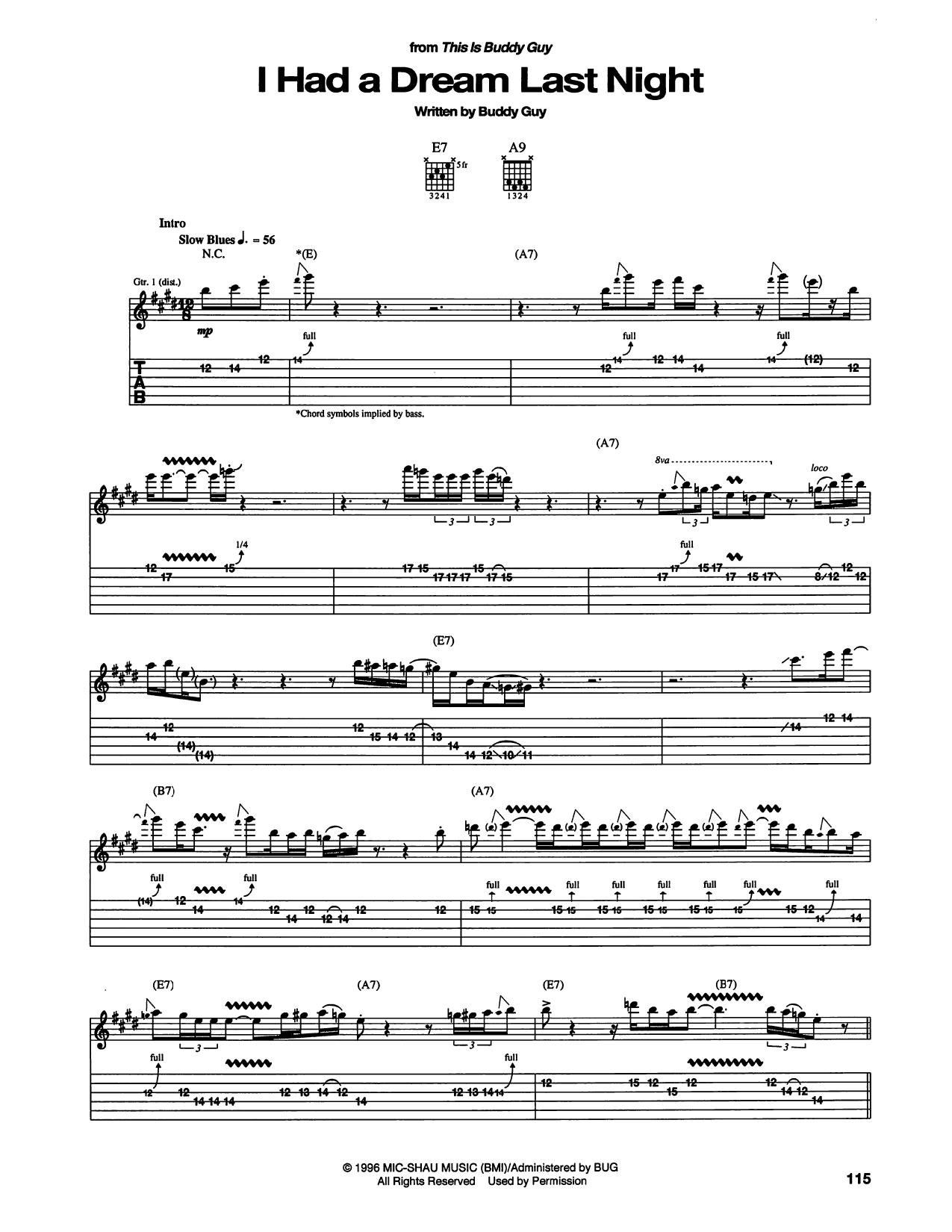
Buddy Guy stands among the most influential blues guitarists of the past seven decades, known for his explosive technique and emotional intensity. His work bridging traditional Chicago blues with rock sensibilities has shaped how guitarists approach bending, vibrato, and dynamics across genres.
Why we love this
This tab captures one of blues guitar's most recognizable voices in a format that lets students see exactly how Guy shapes tone and phrasing. The 11-page transcription rewards careful study of bending technique and rhythmic placement, offering a masterclass in how blues vocabulary translates to individual voice.
What to expect
Raw and conversational. The guitar speaks in long, singing lines punctuated by rhythmic stabs. There's swagger in the phrasing, built from bent notes that cry and scream, meeting punchy rhythmic figures that ground the melody.
Who it's for
Guitarists with solid foundational technique who want to dig into authentic blues phrasing and understand how a master bender builds vocabulary. This works well for intermediate to advanced students ready to move beyond basic pentatonic soloing into expressive, melodic blues playing.
How to get the most out of it
Nail the bend intonation before worrying about speed. Guy's bends define his sound, and half-step accuracy matters more than tempo.
Listen actively to the original recording and tab simultaneously. The notation shows you where the notes sit, but the recording teaches you the feel and swing.
Pay attention to where Guy uses string noise and muted hits. These percussive elements are written into his phrasing and shouldn't be cleaned up.
Experiment with pick angle and pressure to match the tonal variety in the transcription. Different passages ask for different attacks.
How to use it
Pair this with a unit on blues history and influential guitarists, or assign it as a solo study for students drawn to electric blues styles. It works equally well as a performance piece for a student recital or as supplementary repertoire for a guitar ensemble exploring cross-genre foundations.
Skills your students will build
Microtonal bending and intonation control
String noise and percussive articulation as musical elements
Swing feel and rhythmic displacement in blues phrasing
Reading and executing complex tab notation with stylistic inflection
Tone shaping through pick dynamics and pressure
Call-and-response phrasing and melodic conversation
You May Also Like
Scan to Complete Your Purchase
Use your phone's camera to scan the code below
You'll log in on your phone and the order will be added to your account