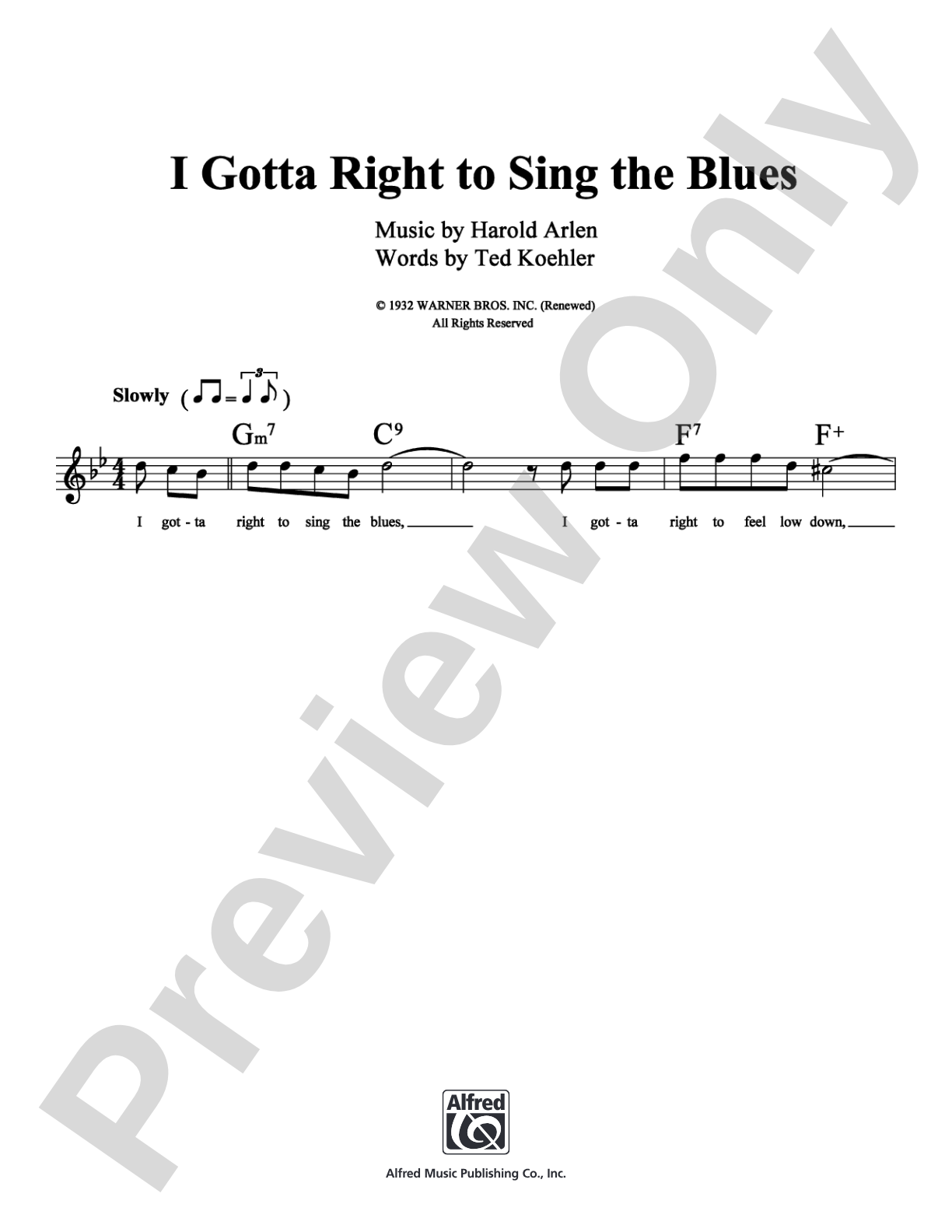
I Gotta Right to Sing the Blues: Lead Sheet Digital Sheet Music

I Gotta Right to Sing the Blues: Lead Sheet Digital Sheet Music

Harold Arlen, Cab Calloway, Benny Goodman, Louis Armstrong, Jack Teagarden

Item: 00-PS-0001974

Digital Download
$1.99
Description

I Gotta Right to Sing the Blues: Lead Sheet Digital Sheet Music isn't in MakeMusic Cloud just yet...but it could be. Let us know you'd like to see it, and you'll help shape what comes next. In the meantime, start a free trial and dive into thousands of interactive titles your students can play along with today.

Sample Audio
No sample audio found.
Sample Video
Additional Details
SKU: 00-PS-0001974

More about this title

About the Artist: Louis Armstrong

Louis Armstrong revolutionized jazz and popular music through his distinctive trumpet voice and gravelly vocals. His improvisational genius and warm stage presence made him one of the most influential musicians of the 20th century, shaping how soloists approach melody, timing, and expressive phrasing across all genres.

Why we love this

This standard gives students and performers direct access to a foundational jazz composition in its most flexible format. A lead sheet invites individual interpretation while keeping the harmonic structure intact, making it ideal for jazz ensembles, combos, and soloists who want to explore the tune's rhythmic vitality and blues sensibility without being locked into a single arrangement.

What to expect

Grounded and unpretentious, with a swinging ease that invites you to relax into the groove. The blues carries warmth and a touch of world-weary humor; the melody sits comfortably in the voice and horn, making it feel as natural as conversation.

Who it's for

Jazz musicians learning to read and interpret lead sheets, combos building their standard repertoire, students studying the blues form and its harmonic language, and performers preparing for jazz jam sessions or small-group recitals.

How to get the most out of it

  • Listen closely to Armstrong's original recording to absorb his phrasing and timing; his approach to the melody is conversational and slightly behind the beat in places, which is harder to notate than to internalize.
  • Treat the blues changes as a conversation, not a harmonic straitjacket. Leave room for call-and-response moments between melody and comping instruments.
  • Experiment with space and silence. The strength of this tune lies as much in what you don't play as in the written notes.

How to use it

Program this alongside other classic standards in a jazz history concert or small-group recital to show how the same tune lives differently in each performer's hands. It pairs naturally with other blues-based standards and works as an encore or educational performance piece that audiences recognize and enjoy.

Skills your students will build

  • Reading and interpreting lead sheet notation
  • Navigating 12-bar blues changes
  • Phrasing and rhythmic flexibility in jazz context
  • Improvisation over a fixed harmonic progression
  • Listening and transcription from recordings

You May Also Like