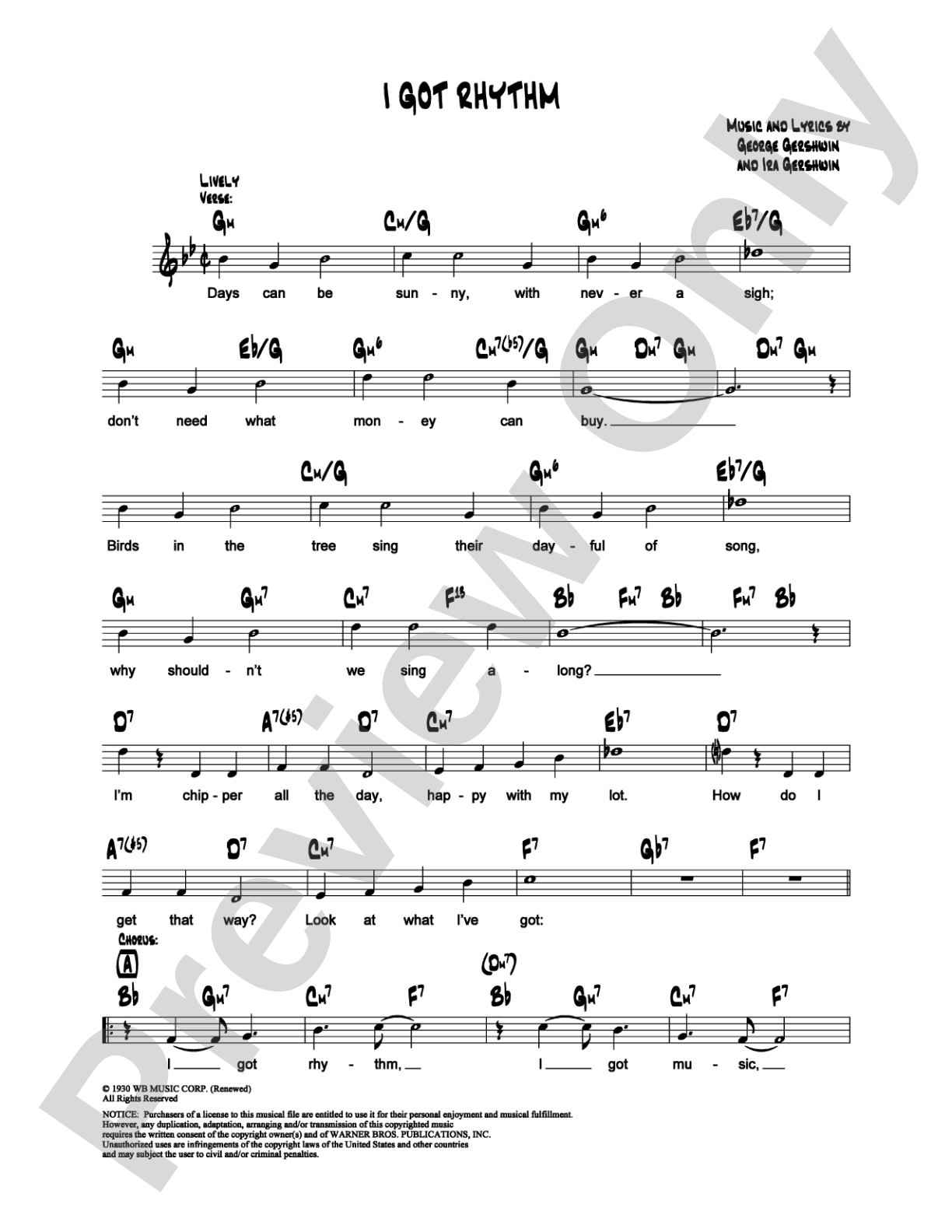
I Got Rhythm: Lead Sheet Digital Sheet Music

I Got Rhythm: Lead Sheet Digital Sheet Music

George Gershwin, Louis Armstrong, Ethel Merman, Gene Kelly

Item: 00-PS-0002100

Digital Download
$1.99
Description

I Got Rhythm: Lead Sheet Digital Sheet Music isn't in MakeMusic Cloud just yet...but it could be. Let us know you'd like to see it, and you'll help shape what comes next. In the meantime, start a free trial and dive into thousands of interactive titles your students can play along with today.

Sample Audio
No sample audio found.
Sample Video
Additional Details
SKU: 00-PS-0002100

More about this title

About the Artist: Louis Armstrong

Louis Armstrong (1901-1971) shaped modern jazz and popular music as a trumpeter, vocalist, and bandleader whose innovative approach to melody, rhythm, and improvisation became the foundation for jazz pedagogy. His recordings and performances set the standard for swing phrasing, rhythmic flexibility, and the art of accompanying oneself while soloing—concepts that remain central to jazz and popular music education.

Why we love this

This standard sits at the intersection of jazz history and accessible repertoire. The lead sheet format lets students and performers explore the tune's harmonic movement and melodic shape without being locked into a single arrangement, making it ideal for jazz combos, small ensembles, and singers looking to develop their own interpretation.

What to expect

Buoyant and instantly recognizable, 'I Got Rhythm' radiates the confidence of early jazz swing. The melody bounces with natural humor and optimism; the harmonic progression invites playfulness and musical risk-taking.

Who it's for

Jazz ensemble directors, combo leaders, jazz history students, and vocalists building a standard repertoire. This works equally well for sight-reading rehearsal or as a framework for arrangement and improvisation study.

How to get the most out of it

  • Sing or play the melody with swing articulation, placing notes slightly behind the beat to match the style Armstrong popularized.
  • Study the harmonic progression as a soloing vehicle; the changes provide natural guide tones for improvisation practice.
  • Balance rhythmic precision with rhythmic freedom; lead sheets thrive when the frontline plays with relaxed phrasing over a solid rhythm section.

How to use it

Program this in a jazz concert alongside other standards to show stylistic evolution, or use it as a teaching tool to explore how different musicians approach the same tune. It works as a warm-up for combos or as a feature that lets individual players or singers step into the spotlight.

Skills your students will build

  • Reading and interpreting lead sheet notation
  • Swing phrasing and rhythmic flexibility
  • Harmonic analysis and chord progression recognition
  • Solo improvisation over standard changes
  • Jazz interpretation and stylistic nuance

You May Also Like