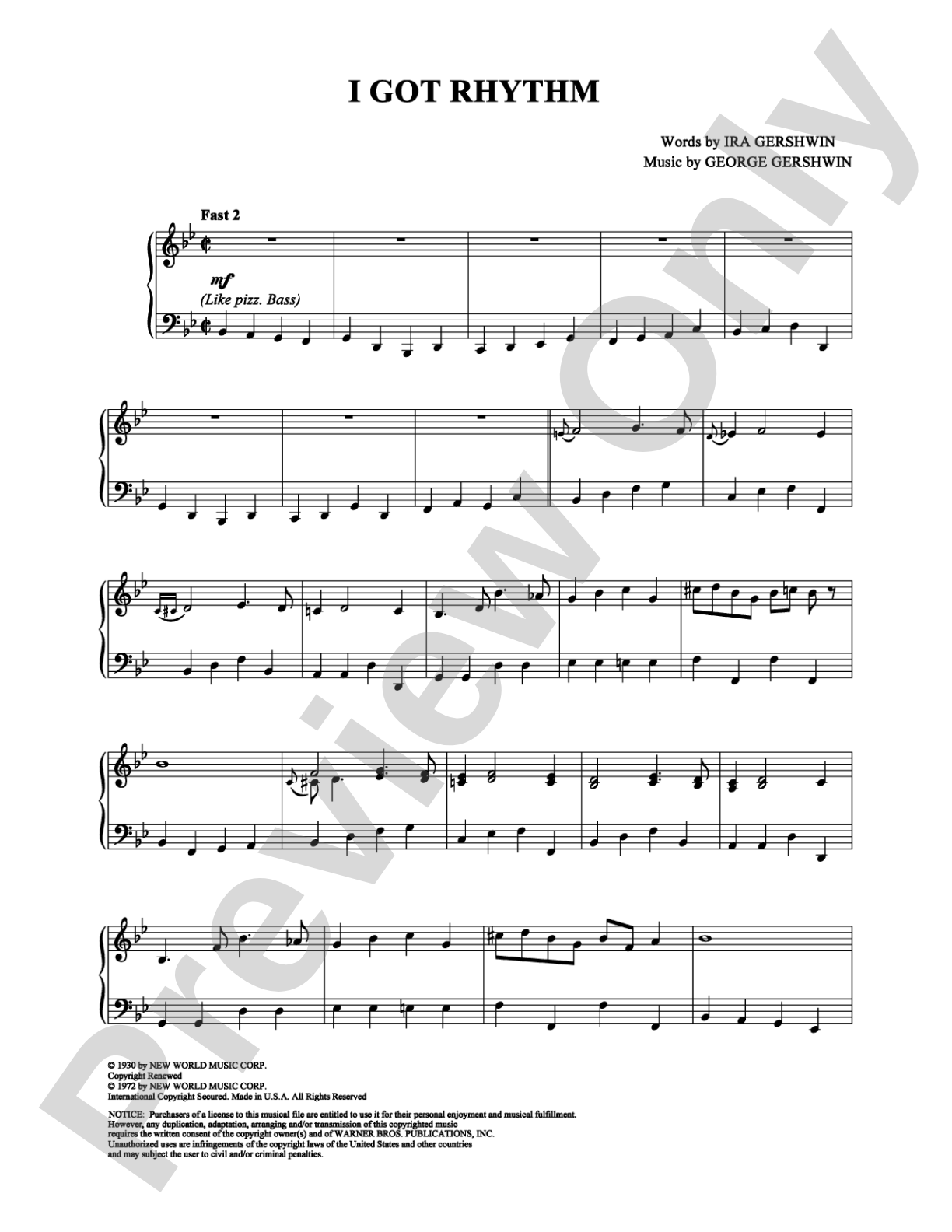
I Got Rhythm: Piano Digital Sheet Music

I Got Rhythm: Piano Digital Sheet Music

George Gershwin, Peter Nero

Item: 00-PS-0002099

Digital Download
$3.99
Description

I Got Rhythm: Piano Digital Sheet Music isn't in MakeMusic Cloud just yet...but it could be. Let us know you'd like to see it, and you'll help shape what comes next. In the meantime, start a free trial and dive into thousands of interactive titles your students can play along with today.

Sample Audio
No sample audio found.
Sample Video
Additional Details
SKU: 00-PS-0002099

More about this title

About the Artist: Peter Nero

Peter Nero is a legendary pianist and conductor known for his versatility across classical, jazz, and popular music. His recordings and performances have spanned decades, earning him recognition as a bridge between concert hall standards and accessible popular repertoire.

Why we love this

Nero's interpretation of this Gershwin standard brings both technical polish and genuine swing to a piece that can easily fall flat in less capable hands. His voicings and rhythmic sensibility make this a study in how a skilled pianist shapes a familiar melody into something fresh.

What to expect

Infectious and propulsive, with a stride-influenced foundation that gives the piece forward motion. The melody sits naturally under the hands while the accompaniment dances with rhythmic sophistication, creating the sensation of a piano confidently in command of both lightness and swing.

Who it's for

Pianists at the intermediate to advanced level who want to expand beyond classical repertoire into the jazz standards canon. Teachers seeking an authoritative arrangement of a twentieth-century essential can use this as both a performance model and a learning score.

How to get the most out of it

  • Pay attention to the rhythmic drive in the right hand; Nero's phrasing shows how syncopation lives in the spaces between notes, not just on the beat.
  • Balance transparency in the left hand accompaniment with confident support for the melody; neither part should overshadow the other.
  • Approach the tempo with forward momentum rather than dragging, letting the syncopated figures breathe naturally.
  • Explore dynamic variation across phrases to avoid monotony; subtle shading keeps the familiar melody engaging throughout.

How to use it

Include this in a recital celebrating American songbook classics or as a bridge between classical and jazz programming. It works particularly well following more formal pieces, offering audiences a moment of unbuttoned joy while maintaining musical integrity.

Skills your students will build

  • Interpreting syncopated rhythms with natural phrasing
  • Balancing melody and accompaniment in jazz-inflected voicings
  • Controlling tempo and groove in swing-based repertoire
  • Reading and executing jazz-style chord progressions

You May Also Like