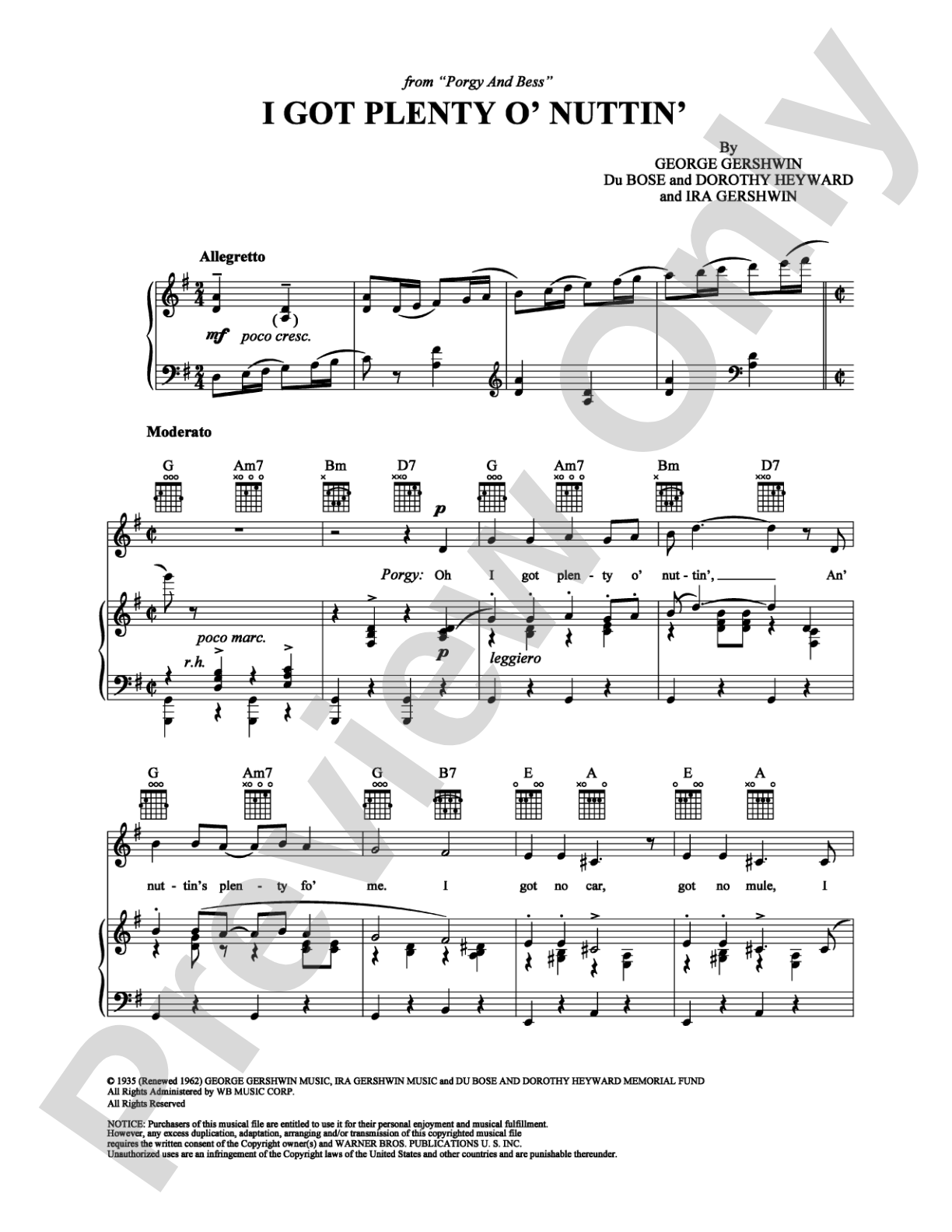
I Got Plenty o' Nuttin': Piano/Vocal/Chords Digital Sheet Music

I Got Plenty o' Nuttin': Piano/Vocal/Chords Digital Sheet Music

George Gershwin

Item: 00-PS-0001106

Digital Download
$3.99
Description

I Got Plenty o' Nuttin': Piano/Vocal/Chords Digital Sheet Music isn't in MakeMusic Cloud just yet...but it could be. Let us know you'd like to see it, and you'll help shape what comes next. In the meantime, start a free trial and dive into thousands of interactive titles your students can play along with today.

Sample Audio
No sample audio found.
Sample Video
Additional Details
SKU: 00-PS-0001106

More about this title

About the Creator: George Gershwin

George Gershwin composed "I Got Plenty o' Nuthin'" for the 1935 opera "Porgy and Bess," a groundbreaking work that wove jazz idioms and blues sensibilities into operatic form. The song reflects Gershwin's genius for creating melodies that feel both sophisticated and immediately singable, balancing popular appeal with genuine compositional craft.

Why we love this

This standard sits at the sweet spot between accessibility and sophistication. The vocal line is singable and memorable, while the harmonic language rewards pianists who understand jazz voicings and can voice-lead smoothly through unexpected chord changes.

What to expect

Relaxed and philosophical, with a touch of wry humor. The melody sits comfortably in the voice and unfolds with an unhurried quality that invites intimate performance. The harmonies have warmth and character without demanding virtuosity.

Who it's for

Singers exploring American standards and jazz repertoire, pianists developing fluency with jazz harmony and comping, and music students building their understanding of songwriting from the Great American Songbook era. This digital sheet also works well for accompanists preparing material on short notice.

How to get the most out of it

  • Shape the vocal line with natural speech rhythm rather than forcing strict meter; the lyrics guide phrasing more than the barline does.
  • Balance the vocal melody against the piano part so the accompaniment supports without overwhelming. In quieter passages, let the voice breathe.
  • Approach the harmonic progressions as a jazz pianist would, using the chord symbols to inform your voicing choices rather than playing literally from the staff notation.

How to use it

Include this in a recital focused on American song or jazz standards, pairing it with other Gershwin repertoire or contrasting it with art songs in a mixed program. It also works beautifully as an encore or as part of a cabaret-style event where singers can showcase their interpretive choices.

Skills your students will build

  • Reading jazz chord symbols and understanding common harmonic substitutions
  • Balancing vocal line and piano accompaniment in a duo setting
  • Interpreting rubato and natural speech rhythm within notated meter
  • Voicing triads and seventh chords idiomatically on piano

You May Also Like