
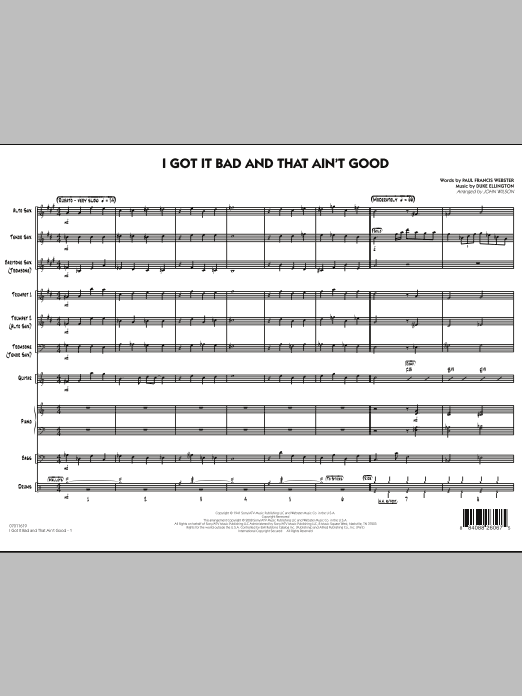

I Got It Bad and That Ain't Good: Jazz Ensemble Conductor Score & Parts
By Duke Ellington / By Paul Francis Webster / Arranged by John Wilson
Grade: 4
Item: 35-PK00118420
$45.00
Pickup currently not available
Buy Extra Parts (Digital PDF Download)
Parts Added to Cart!
Description
Here's a classic Duke Ellington ballad cast for small band and featuring tenor sax. Wonderful reharmonizations and skilled scoring.


I Got It Bad and That Ain't Good: Jazz Ensemble Conductor Score & Parts isn't in MakeMusic Cloud just yet...but it could be. Let us know you'd like to see it, and you'll help shape what comes next. In the meantime, start a free trial and dive into thousands of interactive titles your students can play along with today.
Request This Title
Tell us you want it.
Start Your Free Trial
Explore everything that's ready to play right now.
Sample Audio
No sample audio found.
Sample Video
No sample videos found.
Additional Details
Publisher:
Hal Leonard
SKU:
35-PK00118420
More about this title
About the Composer: Duke Ellington
Duke Ellington revolutionized jazz composition by treating the ensemble itself as an instrument, crafting works of symphonic ambition within the idiom. His innovations in harmony, orchestration, and form elevated jazz from dance music to concert art while maintaining its essential swing and soul. For educators, Ellington's output offers students a masterclass in how to write idiomatically for specific musicians while achieving musical sophistication that transcends genre boundaries.
Why we love this
John Wilson's reharmonization honors Ellington's compositional genius while making this ballad accessible to Grade 4 ensembles without sacrificing musical substance. The tenor sax feature gives your soloists a chance to inhabit a deeply soulful melody, and the scoring clarity means your section players can focus on the phrasing and dynamics that make this ballad breathe.
What to expect
Listening to this arrangement is like sitting in a smoky club at three in the morning, when the band has settled into a groove and the melody is being told with complete vulnerability. The reharmonizations shimmer around the tune, suggesting rather than stating, creating an atmosphere where the tenor sax voice becomes almost conversational.
Who it's for
Jazz ensembles at the intermediate level who have solid fundamentals in place and are ready to tackle ensemble swing and ballad interpretation. Conductors seeking repertoire that teaches students how to honor a standard while exploring sophisticated harmonic language will find this indispensable.
How to get the most out of it
- Shape the melody with legit rubato in the ballad sections; this isn't a strict rhythm tune, so let your tenor saxophonist breathe with the phrasing rather than fighting the pulse.
- Balance the reharmonizations so they support rather than obscure the original tune; clarity of voicing in the ensemble parts prevents the arrangement from getting muddy underneath the solo.
- Work the dynamics from the ground up; the accompaniment needs a soft touch to let the melody float, especially in passages where you're hearing just a few supporting voices.
How to use it
Pair this with uptempo swing tunes to show the full emotional range of your ensemble in a single concert. It also serves as an excellent slow feature that lets your best tenor saxophonist shine without requiring the technical pyrotechnics of a faster piece.
Skills your students will build
- Ballad phrasing and lyrical expression in a jazz context
- Reading and executing sophisticated reharmonizations
- Accompanying a featured soloist with dynamic restraint
- Swing feel and rhythmic flexibility in a lyrical setting
- Blend and balance in small ensemble voicings