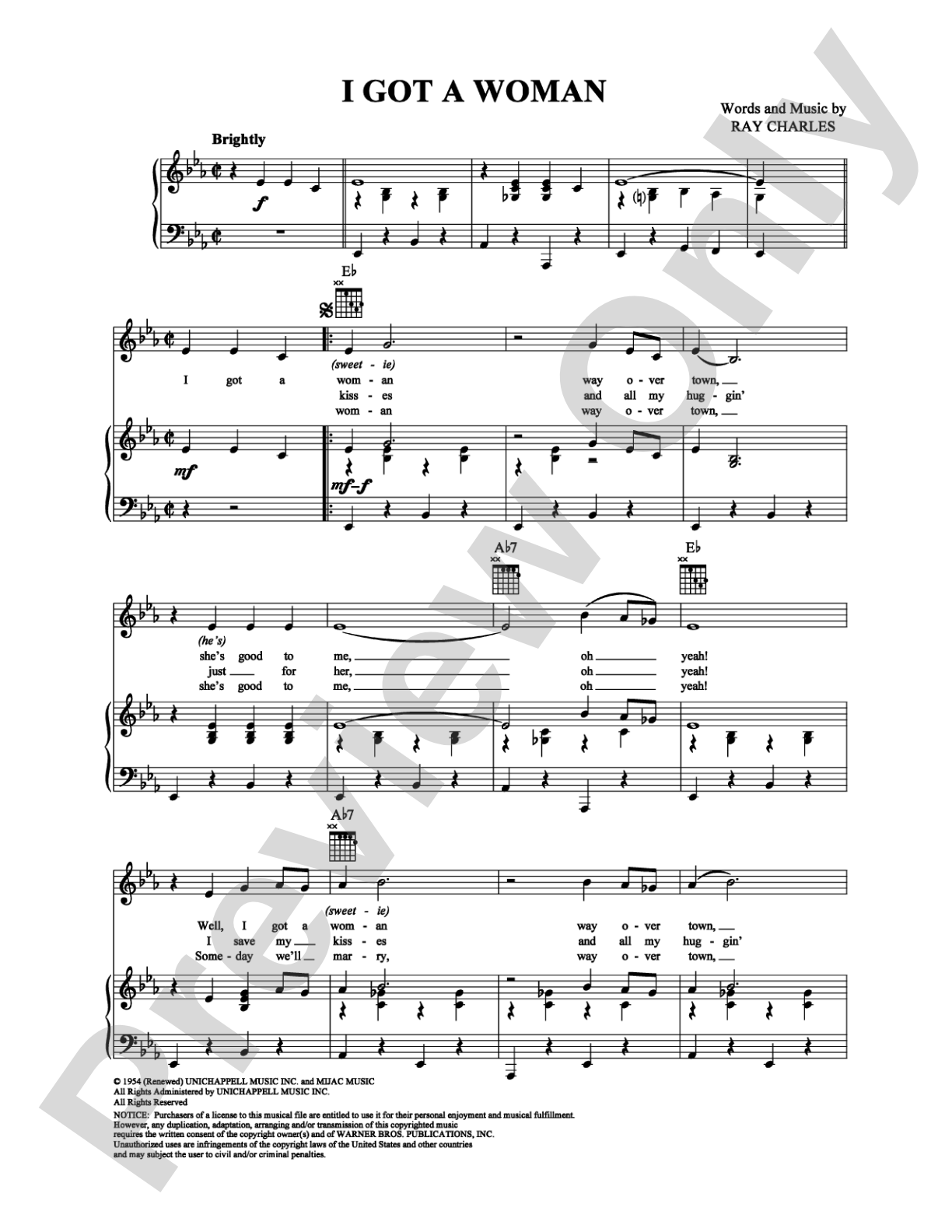
I Got a Woman: Piano/Vocal/Chords Digital Sheet Music

I Got a Woman: Piano/Vocal/Chords Digital Sheet Music

Ray Charles, Ricky Nelson, Jimmy McGriff

Item: 00-PS-0007772

Digital Download
$3.99
Description

I Got a Woman: Piano/Vocal/Chords Digital Sheet Music isn't in MakeMusic Cloud just yet...but it could be. Let us know you'd like to see it, and you'll help shape what comes next. In the meantime, start a free trial and dive into thousands of interactive titles your students can play along with today.

Sample Audio
No sample audio found.
Sample Video
Additional Details
SKU: 00-PS-0007772

More about this title

About the Artist: Ray Charles

Ray Charles (1930-2004) was a pianist, singer, and composer who fundamentally changed American music by blending jazz, blues, gospel, country, and R&B into a deeply personal artistic voice. Blind from childhood, he became one of the most influential musicians of the 20th century, known for his ability to inhabit any genre with authenticity and emotional depth. His work remains essential listening for musicians studying how to build expressive interpretation across multiple styles.

Why we love this

Ray Charles's 'I Got a Woman' is a masterclass in how to swing a simple harmonic progression and inject genuine soul into a popular song. The piano part sits comfortably in the middle register, making it accessible for intermediate pianists while the vocal melody gives singers room to add their own phrasing and character. This is the kind of standard that works equally well in a jazz ensemble, a pop band, or a cabaret setting, and students who learn it gain insight into how great musicians approach repertoire with flexibility and personality.

What to expect

Warm, confident, and groovy. The song has a relaxed swagger that invites performers to settle in and enjoy the moment rather than rush through it. Whether you're playing it straight or layering in jazz sophistication, there's an inherent joy in the music that comes through in every chord and lyric.

Who it's for

Pianists and singers at the intermediate level who want to tackle a song with real history and flexibility in how it can be approached. This works for music theater students, jazz musicians exploring popular standards, pop and rock performers looking to deepen their interpretive skills, and any ensemble director seeking a crossover piece that appeals to multiple styles and audiences.

How to get the most out of it

  • Anchor the groove in the left hand. The pocket of this song lives in steady, syncopated comping rather than elaborate voicings; lock in with a solid bassist or rhythm section if performing with others.
  • Let the vocal melody breathe. Ray Charles's original is relaxed and conversational, not rushed. Singers should resist the urge to fill every space and instead lean into the laid-back swing of the phrasing.
  • Voice the chord extensions to match the era and style you're leaning into. The chart gives you the foundation; experiment with jazz voicings if you're performing in a jazz context or simpler triads if you want a more direct pop approach.
  • Balance the piano comping with the vocal line. The piano should support and respond to the singer, not compete for attention.

How to use it

This works wonderfully as a solo feature for a pianist or vocalist with some interpretive maturity, or as a bridge piece between sets if you're programming a concert that mixes styles. It's also an excellent teaching tool for understanding how to arrange a standard for different ensembles, since the core melody and changes translate beautifully to small combos, full bands, or singer-piano pairs.

Skills your students will build

  • Swing feel and rhythmic phrasing in pop and jazz contexts
  • Comping and chord voicing flexibility
  • Balancing melody and accompaniment in duo performance
  • Stylistic interpretation across multiple genres
  • Blues and soul inflection in singing

You May Also Like