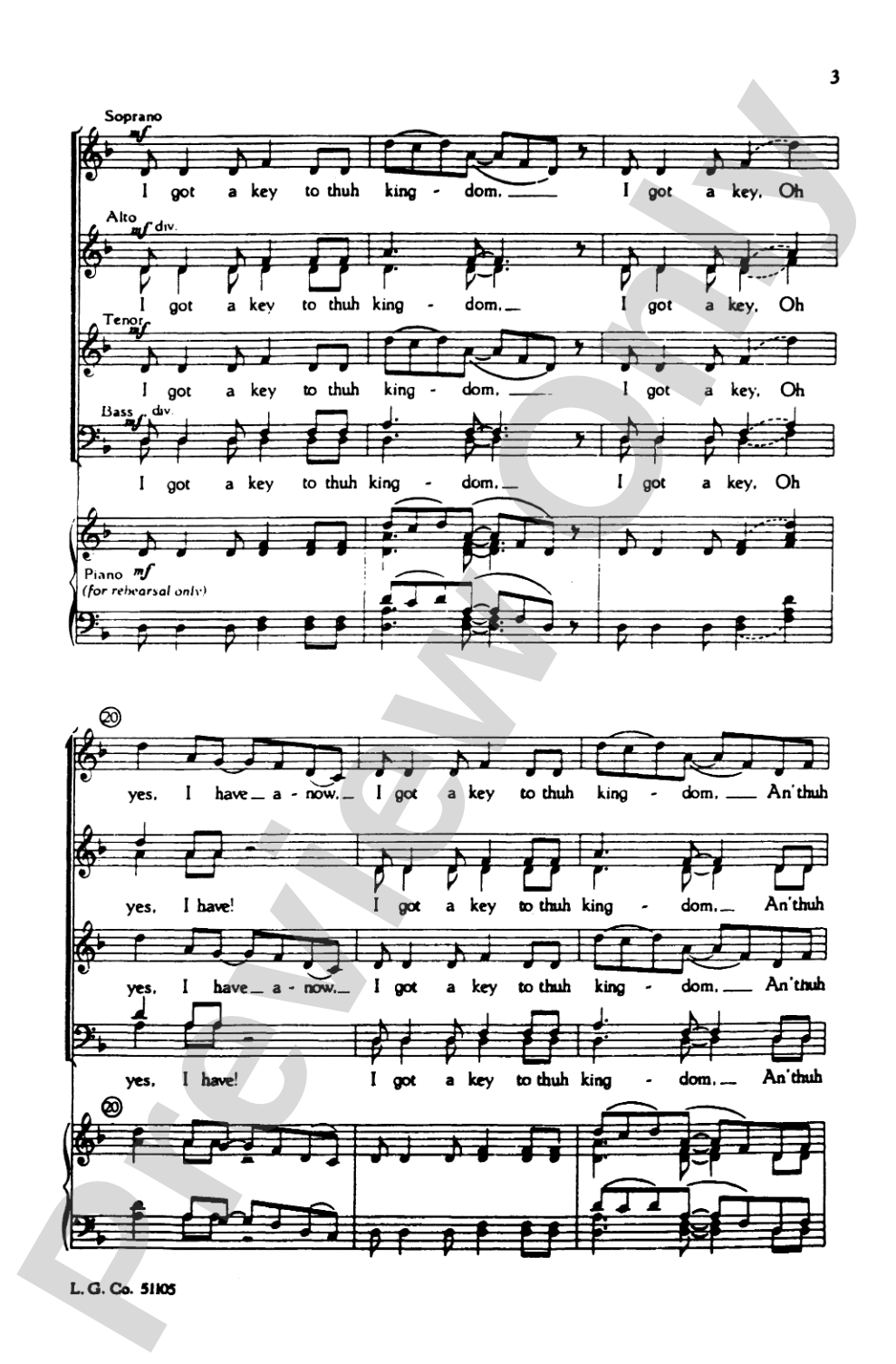
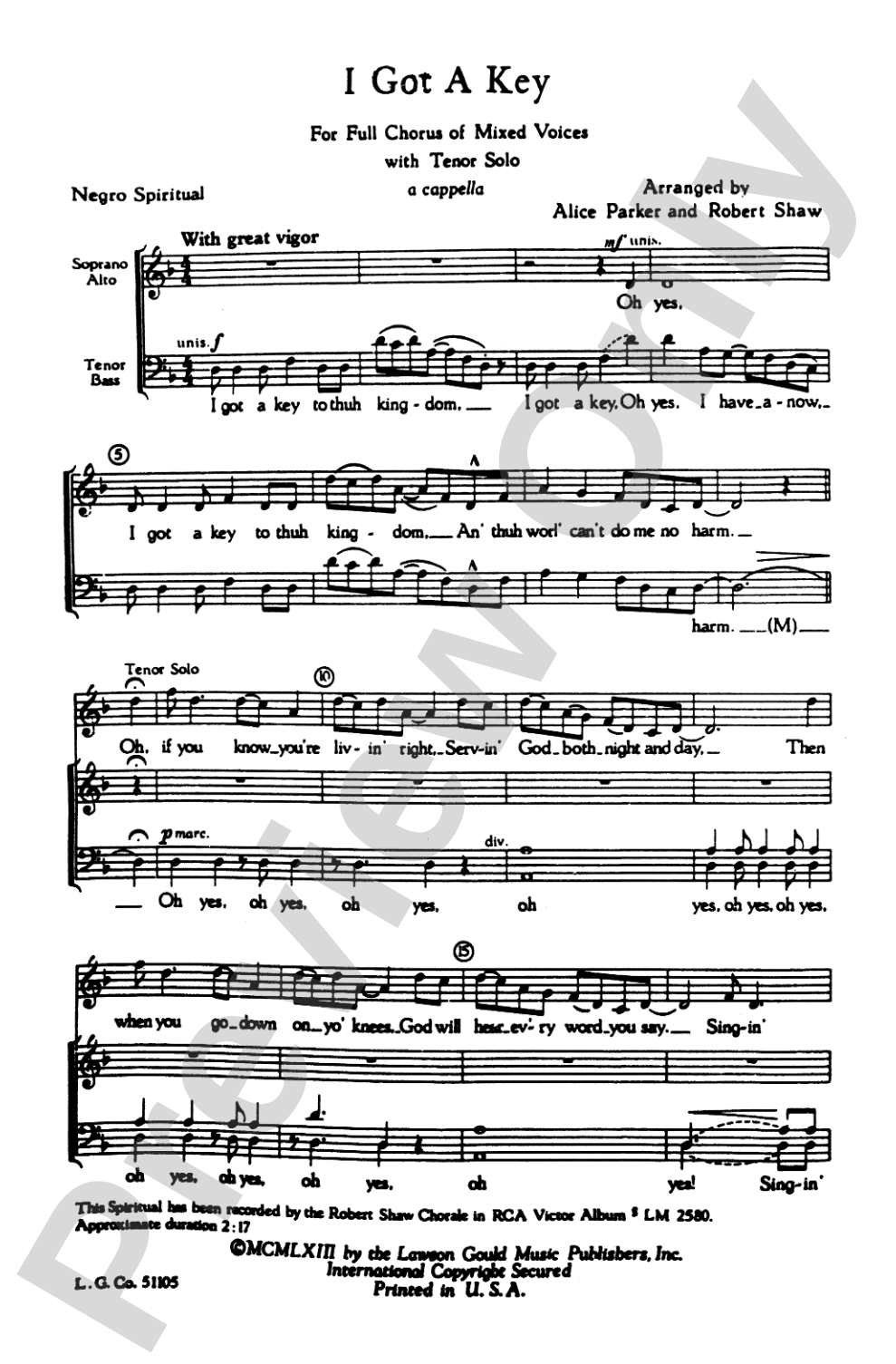
I Got a Key Sheet Music Preview

I Got a Key: SATB Choral Octavo

Arr. Robert Shaw and Alice Parker

Item: 00-PO-0002649

Digital Download
$2.25

Minimum order quantity: 20 copies

Description

I Got a Key: SATB Choral Octavo isn't in MakeMusic Cloud just yet...but it could be. Let us know you'd like to see it, and you'll help shape what comes next. In the meantime, start a free trial and dive into thousands of interactive titles your students can play along with today.

Sample Audio
No sample audio found.
Sample Video
Additional Details
Series: Alfred Archive Edition: Lawson-Gould Music Publishers
Publisher: Alfred Music
Page Count: 12
SKU: 00-PO-0002649

More about this title

About the Arranger: Robert Shaw

Robert Shaw (1916-1999) was a conductor, arranger, and educator whose work shaped American choral music for more than half a century. He founded the Robert Shaw Chorale in 1948 and became known for his meticulous attention to vocal blend, diction, and interpretive depth. Shaw's arrangements of spirituals and folk songs are distinguished by their harmonic sophistication and respect for source material; he never sentimentalized these traditions but instead elevated them through careful voice leading and thoughtful orchestration choices that made them accessible to choirs of varying abilities.

Shaw's legacy in music education extends far beyond his own performances. His arrangements and conducting philosophy influenced generations of choral directors through his published works, many of them still standard repertoire in American high schools and collegiate choirs. He demonstrated that accessible arrangement and artistic integrity are not opposing forces.

Why we love this

Shaw's gift for uncovering the emotional architecture of a spiritual shines throughout this setting. The a cappella writing sits comfortably in the voice parts while maintaining the harmonic richness that made Shaw's arrangements enduring—your singers will sound fuller and more resonant than the page might initially suggest, and the piece rewards careful attention to blend without demanding perfection beyond a solid SATB ensemble's grasp.

What to expect

The spiritual unfolds with quiet confidence, its melody supported by harmonies that are thoughtful without being overly complex. There is warmth in the writing, an invitation to find both the lyrical grace and the underlying strength of the text; the a cappella setting creates an intimate acoustic that draws the listener into the emotional core of the song.

Who it's for

This octavo suits high school, collegiate, and community choirs with secure music-reading skills and experience with a cappella singing. It works equally well for choirs preparing for festival or contest settings and for those seeking concert repertoire that carries both spiritual substance and musical integrity.

How to get the most out of it

  • Shape the inner voices with as much care as the melody. Shaw's harmonies depend on each line singing with independence and tone; neglecting the altos and tenors flattens the vertical sonority he built into this arrangement.
  • Establish a clear vowel strategy before rehearsing the text. Spiritual text often benefits from a warm, resonant vowel foundation; decide early whether your vowels will be uniform across the choir or vary slightly by part for blend.
  • Let the a cappella texture breathe. Without instrumental support, each phrase needs space to land and reset; avoid rushing between sections, and give your singers permission to breathe where the phrase naturally suggests it.
  • Listen for balance across the parts before focusing on dynamics. Once your SATB voices occupy equal harmonic weight, dynamic shaping will emerge more naturally and feel less imposed.

How to use it

Program this as part of a sacred or spirituals concert block, where its a cappella writing will contrast effectively with accompanied works. It also serves as an excellent festival or contest piece for intermediate to advanced choirs seeking repertoire that balances accessibility with artistic depth.

Skills your students will build

  • Balancing SATB parts in a cappella texture
  • Sustaining pitch without instrumental reference
  • Shaping phrasing in spiritual arrangements while maintaining historical authenticity
  • Blending vowels across four voice parts
  • Interpreting text with emotional nuance in a cappella setting

You May Also Like