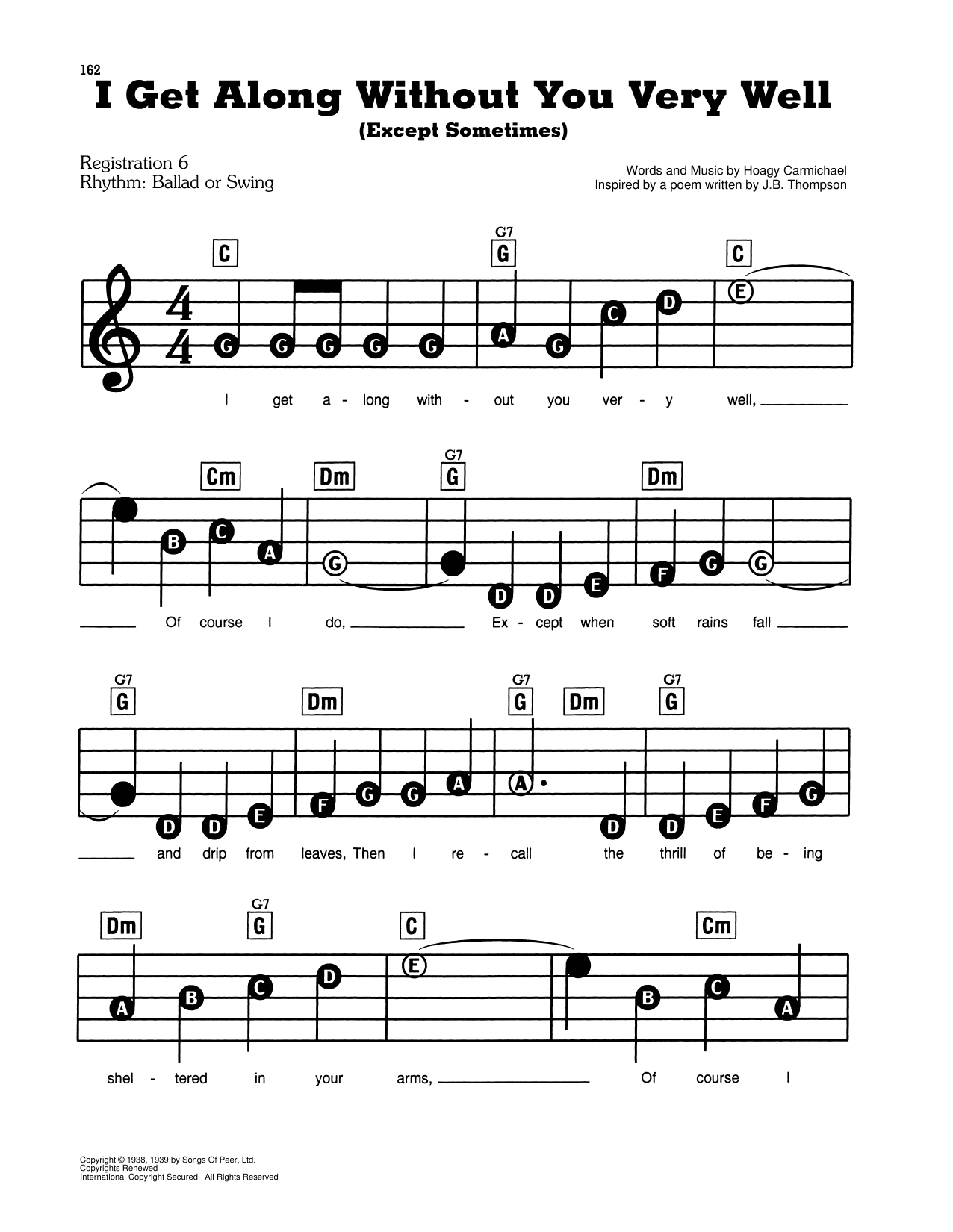
I Get Along Without You Very Well (Except Sometimes) Sheet Music Preview

I Get Along Without You Very Well (Except Sometimes): E-Z Play Today

As performed by Hoagy Carmichael

Item: 35-DS00460010

Digital Download
$4.99
Description

I Get Along Without You Very Well (Except Sometimes): E-Z Play Today isn't in MakeMusic Cloud just yet...but it could be. Let us know you'd like to see it, and you'll help shape what comes next. In the meantime, start a free trial and dive into thousands of interactive titles your students can play along with today.

Sample Audio
No sample audio found.
Sample Video
Additional Details
Publisher: Hal Leonard
Page Count: 4
SKU: 35-DS00460010

More about this title

About the Artist: Hoagy Carmichael

Hoagy Carmichael (1899-1981) was an American composer and pianist whose sophisticated melodies and jazz-inflected harmonies defined the American songbook. His gift for writing memorable tunes paired with subtle harmonic movement made him one of the most recorded composers of the 20th century, with "Stardust," "Georgia on My Mind," and "Heart and Soul" among his enduring standards.

For music educators, Carmichael's work offers a masterclass in melody writing. His songs sit naturally on instruments, balance repetition with surprise, and demonstrate how strong harmonic progressions support simple, singable themes. Teaching his compositions helps students understand the craft of the great American songwriters.

Why we love this

This arrangement captures the gentle wit and harmonic sophistication Carmichael packed into what sounds like a simple tune. The E-Z Play format makes it accessible without sacrificing the understated charm that makes this standard worth revisiting in recitals or casual performance contexts.

What to expect

A conversation with yourself on a quiet evening. The melody is direct and approachable, yet the harmony carries undertones of longing and acceptance. It feels bittersweet in the best way: honest about loss while celebrating resilience.

Who it's for

Pianists comfortable reading lead sheets and comfortable with jazz chord symbols. Students exploring American songbook standards and looking for material that teaches melodic phrasing and jazz voicing on a manageable scale.

How to get the most out of it

  • Allow the melody to breathe in the opening statement. Resist the urge to fill every space; let the harmony support the line rather than compete with it.
  • Attend to the rubato that the lyric suggests. The conversational tone of the text invites natural phrasing that bends slightly against a steady pulse.
  • Keep the accompaniment transparent so the song's emotional complexity shines through. This is a piece about mixed feelings, not technical display.

How to use it

Pair this with other introspective standards for a recital set focused on emotional storytelling rather than technical fireworks. It works equally well as a solo feature or as an opener that sets an intimate tone for the program.

Skills your students will build

  • Reading jazz chord symbols and realizing harmonies from lead sheets
  • Shaping melody with rubato while maintaining harmonic integrity
  • Accompanying a vocal line with transparent, supportive voicings
  • Understanding harmonic movement that goes beyond diatonic patterns

You May Also Like