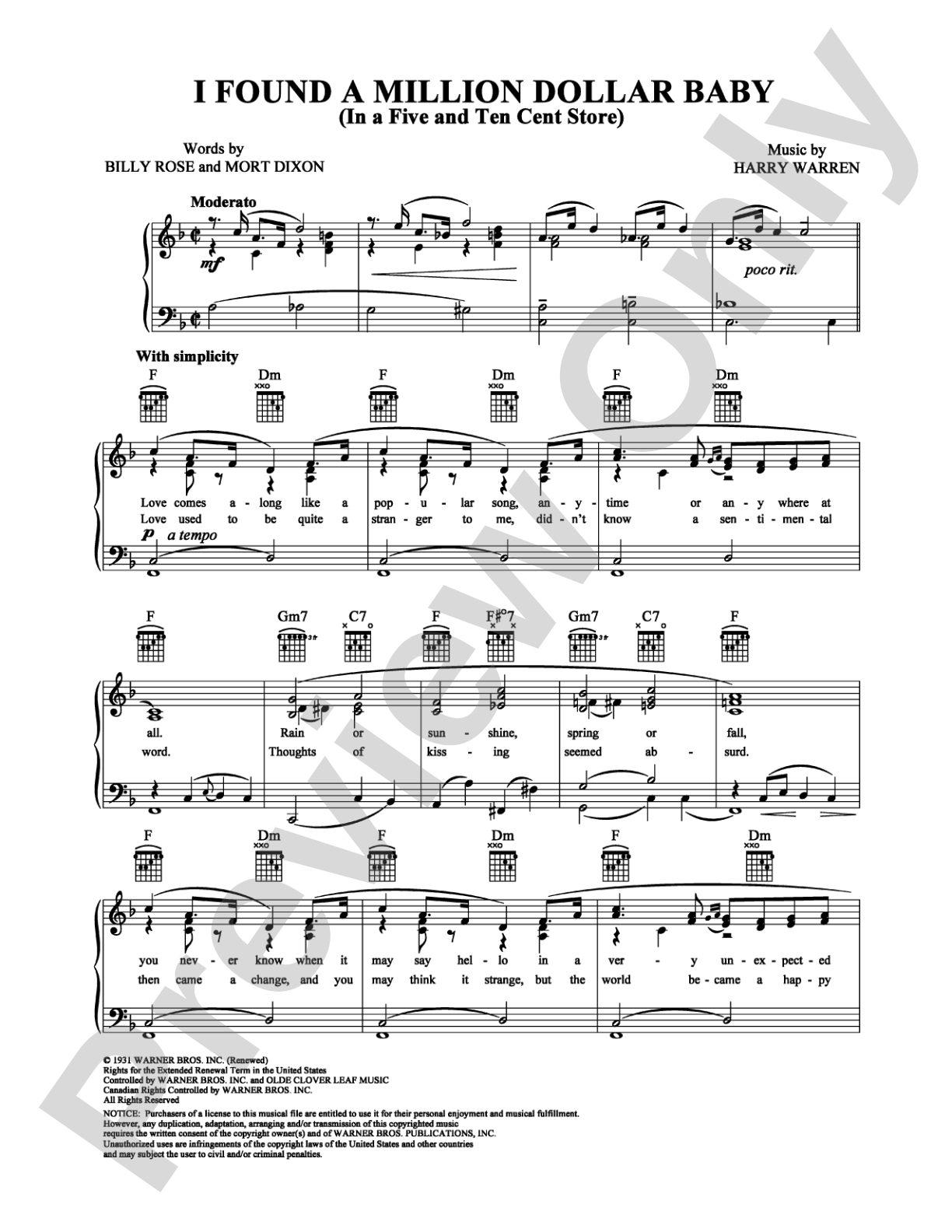
I Found a Million Dollar Baby (In a Five and Ten Cent Store): Piano/Vocal/Chords Digital Sheet Music

I Found a Million Dollar Baby (In a Five and Ten Cent Store): Piano/Vocal/Chords Digital Sheet Music

Harry Warren, Bing Crosby

Item: 00-PS-0005320

Digital Download
$3.99
Description

I Found a Million Dollar Baby (In a Five and Ten Cent Store): Piano/Vocal/Chords Digital Sheet Music isn't in MakeMusic Cloud just yet...but it could be. Let us know you'd like to see it, and you'll help shape what comes next. In the meantime, start a free trial and dive into thousands of interactive titles your students can play along with today.

Sample Audio
No sample audio found.
Sample Video
Additional Details
SKU: 00-PS-0005320

More about this title

About the Artist: Bing Crosby

Bing Crosby (1903-1977) was an American singer and actor whose warm baritone and relaxed phrasing defined popular music from the 1930s through the 1950s. His influence on vocal style—particularly his ability to communicate lyric meaning while maintaining impeccable musicality—made him a model for generations of jazz and popular singers.

Crosby's recordings remain central to American vocal pedagogy. Teachers use his interpretations to demonstrate phrasing, breath control, and the art of accompanying oneself or working with an ensemble. His approach to melody and time, rooted in both classical training and jazz sensibility, offers singers concrete examples of how to balance technical precision with emotional authenticity.

Why we love this

This standard has endured because it pairs an irresistible melody with clever, conversational lyrics that singers genuinely enjoy performing. The piano/vocal/chords arrangement gives you the flexibility to work with a pianist at the lesson or performance level, and the harmonic movement provides enough substance to keep accompanists engaged while remaining accessible.

What to expect

Wry and charming. The lyric's casual humor pairs with a melody that sits comfortably in the voice and avoids melodrama. There's a lightness here, though the harmonic sophistication keeps it grounded and satisfying.

Who it's for

Singers preparing recital material from the American Songbook, whether in private lessons, voice classes, or performance contexts. This works equally well for adult learners discovering standards and younger singers developing jazz or popular music technique.

How to get the most out of it

  • Shape the melody phrase by phrase rather than measure by measure. The conversational quality of the lyric pulls the music forward naturally; let that dictate your phrasing arc.
  • Work with your accompanist on the rhythmic relationship between vocal line and piano figure. Crosby's recordings often sit slightly behind the beat in a relaxed way; clarity between you two matters more than strict alignment.
  • The bridge invites a slight dynamic lift without pushing into belting. This is where restraint and control read as confidence.
  • Listen to at least two Crosby recordings of this tune if you can. Each one shows different interpretive choices around tempo and articulation; compare what you hear to your instincts about the lyric.

How to use it

Include this on a recital devoted to standards or American Songbook repertoire, particularly if you're building a program around singers who excel with lyric-driven material. It pairs well with other mid-century popular songs and works as a palate cleanser between more introspective ballads.

Skills your students will build

  • Interpretive phrasing based on lyric text rather than melodic contour alone
  • Jazz-influenced interpretation of a standard melody
  • Collaborative listening and communication with an accompanist
  • Swing articulation and rhythmic flexibility in popular vocal music

You May Also Like