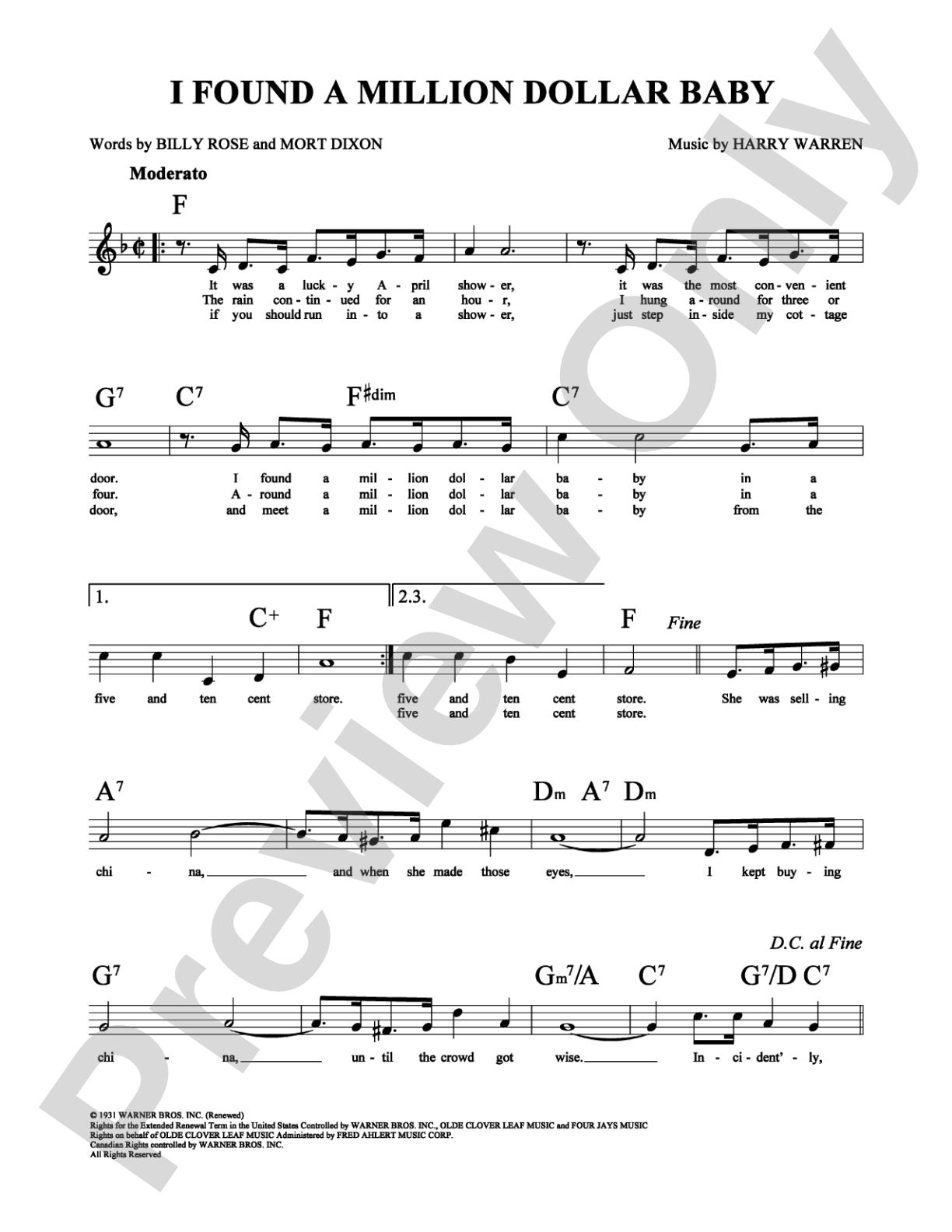
I Found a Million Dollar Baby: Lead Sheet Digital Sheet Music

I Found a Million Dollar Baby: Lead Sheet Digital Sheet Music

Harry Warren, Bing Crosby

Item: 00-PS-0002053

Digital Download
$1.99
Description

I Found a Million Dollar Baby: Lead Sheet Digital Sheet Music isn't in MakeMusic Cloud just yet...but it could be. Let us know you'd like to see it, and you'll help shape what comes next. In the meantime, start a free trial and dive into thousands of interactive titles your students can play along with today.

Sample Audio
No sample audio found.
Sample Video
Additional Details
SKU: 00-PS-0002053

More about this title

About the Artist: Bing Crosby

Bing Crosby (1903-1977) was an American singer and actor whose warm baritone and relaxed phrasing defined the sound of American popular music from the 1930s through the 1950s. His recording of "I Found a Million Dollar Baby" became a standard, and his interpretive approach to melody and lyric remains a masterclass in vocal storytelling for singers of all levels.

Crosby's influence on jazz and popular singing extends far beyond his era. His technique of intimate, conversational delivery pioneered the crooning style and set a standard for how to accompany oneself or a band with musicianship and restraint. Teachers and students return to his recordings as models of phrasing, breath control, and rhythmic flexibility within a song's harmonic structure.

Why we love this

This lead sheet captures one of the great American standards in its most singable form. The melody sits naturally in the voice, the harmonic progressions are straightforward enough to learn quickly yet sophisticated enough to reward deeper harmonic exploration, and the lyrical content gives singers of different ages something genuine to interpret.

What to expect

Bright, optimistic, and anchored in the rhythmic ease of 1930s swing. The melody is conversational and approachable, with a warmth that reflects the song's lyrical celebration of unexpected good fortune. It feels like a song that invites conversation and connection rather than demanding technical display.

Who it's for

Vocalists studying jazz standards, pop singers building a classic repertoire, and musicians preparing for jazz combo or ensemble performance. This lead sheet works equally well for casual performers learning the tune and serious jazz singers deepening their interpretation of American songbook material.

How to get the most out of it

  • Shape the melody with your own phrasing choices rather than locking into a single interpretation. The lead sheet format invites you to discover where your natural breath points fall and where you want to linger or press forward.
  • Pay attention to the harmonic rhythm as you work through chord changes. This standard uses a mix of diatonic and chromatic movement that becomes clearer when you sing the changes rather than simply reading the melody.
  • Experiment with rhythmic flexibility, especially on longer note values. Crosby's vocal style thrived on subtle rubato and syncopation; the lead sheet gives you room to find those moments.

How to use it

Include this in a jazz or standards-focused concert alongside other American songbook classics from the same era. It also works as a vocalist feature in a big band or small jazz ensemble setting, where a pianist or guitarist can realize the lead sheet while other instruments provide texture and response.

Skills your students will build

  • Reading lead sheet notation and chord symbols
  • Melodic phrasing and breath placement in popular song
  • Harmonic awareness through chord-melody relationship
  • Interpreting jazz and swing rhythm notation
  • Vocal flexibility and stylistic adaptation

You May Also Like