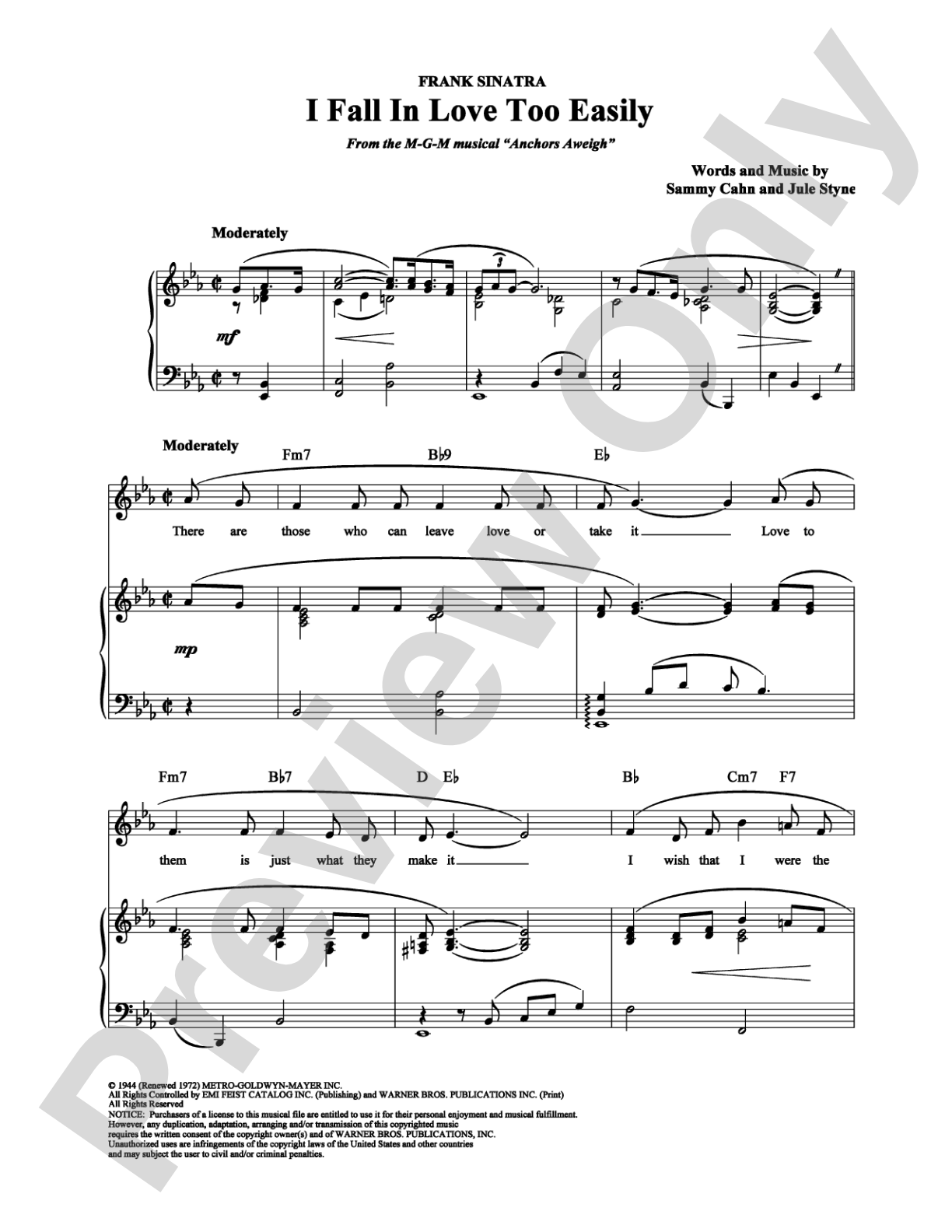
I Fall In Love Too Easily: Piano/Vocal/Chords Digital Sheet Music

I Fall In Love Too Easily: Piano/Vocal/Chords Digital Sheet Music

Jule Styne, Frank Sinatra, Mel Tormé

Item: 00-PS-0007076

Digital Download
$3.99
Description

I Fall In Love Too Easily: Piano/Vocal/Chords Digital Sheet Music isn't in MakeMusic Cloud just yet...but it could be. Let us know you'd like to see it, and you'll help shape what comes next. In the meantime, start a free trial and dive into thousands of interactive titles your students can play along with today.

Sample Audio
No sample audio found.
Sample Video
Additional Details
SKU: 00-PS-0007076

More about this title

About the Artist: Frank Sinatra

Frank Sinatra (1915, 1998) remains the gold standard for American vocal phrasing and interpretive depth. His approach to a lyric, the way he shaped melody around text, controlled breath, and manipulated time, fundamentally changed what singers could accomplish within the popular song tradition. For students and teachers, Sinatra's recordings offer a masterclass in how technical mastery and emotional intelligence work together.

Beyond his fame, Sinatra's influence on music education is concrete: his interpretations of standards have shaped how we teach rubato, dynamics, and character singing across genres. His recordings demonstrate that popular music can demand the same rigor and artistry as classical repertoire.

Why we love this

This standard sits in the sweet spot between approachable and sophisticated. The harmonic language is warm without being overly complex, and the melody has real singability, it lives well in the voice rather than feeling stranded on the page. Students get to explore how a skilled lyricist pairs internal rhymes and phrasing with a composer's melodic contour, all while working with chord changes that reward both accurate reading and genuine interpretation.

What to expect

A gentle, introspective ballad that captures the vulnerability of sudden romantic attraction. The melody floats over warm, sophisticated harmonies, creating a sense of quiet longing that invites intimate interpretation rather than theatrical display.

Who it's for

Vocalists building their standards repertoire will benefit from having this iconic tune in accessible form, whether they're preparing for jazz choir, vocal recital, or private lesson study. Pianists accompanying singers, or working through jazz standards independently, gain insight into a melody that appears constantly in real jazz and cabaret contexts.

How to get the most out of it

  • Treat the melody as a conversation with the piano rather than a display of lung power. Sinatra's genius was knowing when to push forward and when to pull back, letting silence do as much work as sound.
  • Study the chord progression carefully before performing, even if you're not improvising. Understanding the harmonic movement underneath the melody gives you freedom in how you shape the phrasing.
  • Pay attention to the lyrical content and let it inform your dynamics and tempo choices. The emotional arc of the text should guide your interpretation, not the other way around.

How to use it

Position this alongside other standards from the same era to create a set exploring how great American composers wrote for the voice, or use it in a vocal jazz or cabaret-style recital where storytelling and restraint take priority over spectacle. It works equally well as a study piece for understanding voice-leading in jazz harmony.

Skills your students will build

  • Phrasing across jazz chord changes
  • Reading piano/vocal scores and chord symbols
  • Vocal flexibility within a legit ballad style
  • Understanding harmonic progression through performance
  • Interpreting lyrical subtext in classic standards

You May Also Like