
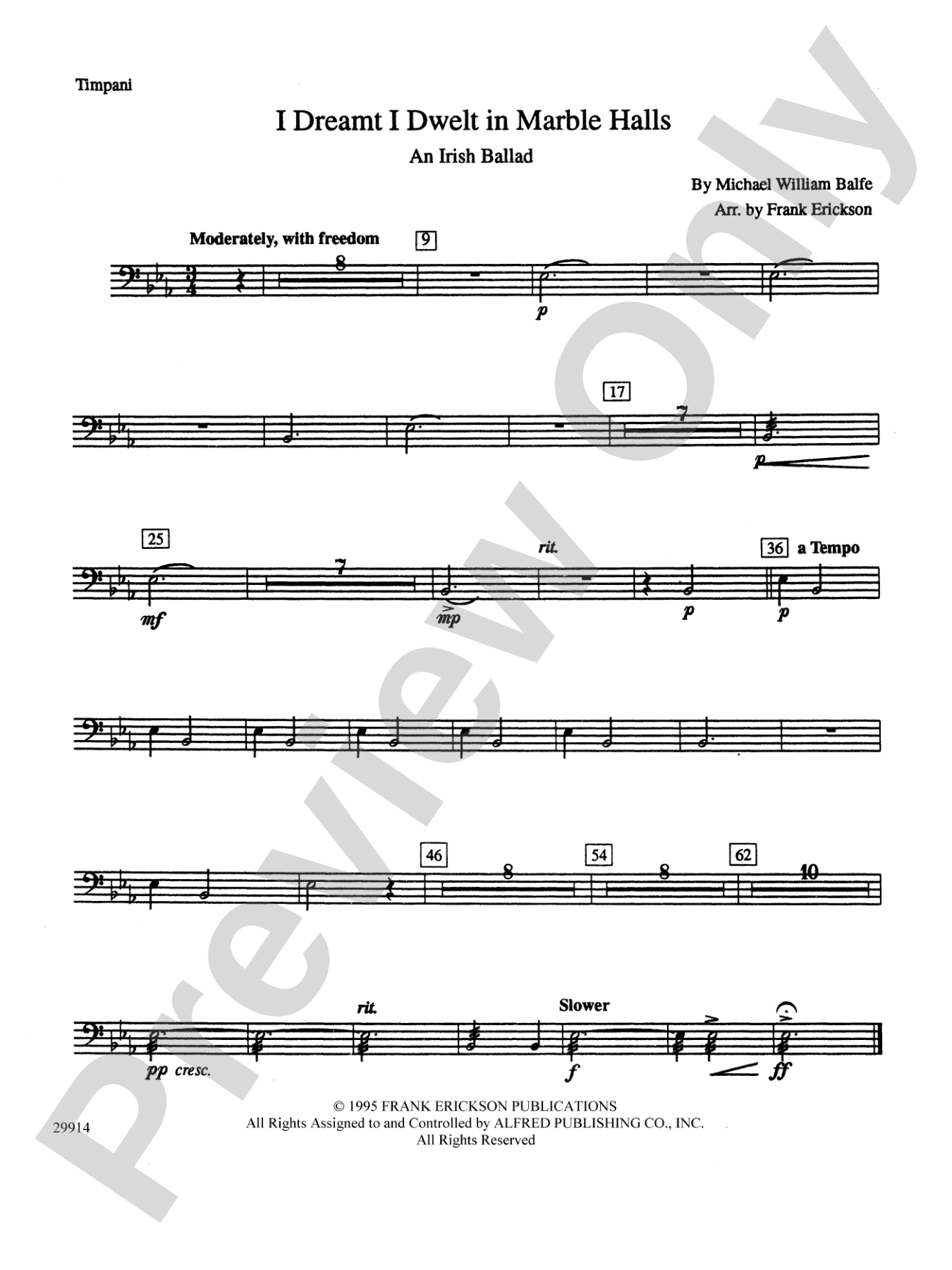

I Dreamt I Dwelt in Marble Halls: Timpani
An Irish Ballad
By Michael William Balfe / arr. Frank Erickson
Grade: 2 (Easy)
Item: 00-PC-0001637_TMP
$3.00
Pickup currently not available
Description
Although not widely known, the ballad I Dreamt I Dwelt in Marble Halls, from Michael Balfe's opera The Bohemian Girl, has found its way into some recent recordings by Irish folk singers. The melody and harmonies are quite simple in style: this, in addition to Balfe's heritage, could account for its Irish folk-song quality.


Don't just read it, hear it, play along with it, and watch your students grow with it. In MakeMusic Cloud, I Dreamt I Dwelt in Marble Halls: Timpani comes alive with professional accompaniment, adjustable tempo, and built-in practice tools that turn solo practice into real progress.
Open in the Player
Jump straight in and assign it today.
Start Your Free Trial
Open this title and explore the full library in minutes.
Sample Audio
No sample audio found.
Sample Video
No sample videos found.
Additional Details
Series:
Frank Erickson Publications
Publisher:
Alfred Music
Page Count:
134
SKU:
00-PC-0001637_TMP
More about this title
About the Composer: Michael William Balfe
Michael William Balfe (1808-1870) was an Irish composer and conductor whose operatic works gained considerable popularity across Europe during the 19th century. He spent much of his career in London and continental Europe, where his gift for memorable melody and skillful orchestration earned him a prominent place in the romantic opera repertoire. The Bohemian Girl, from which this ballad is drawn, remains his most frequently performed work and showcases the lyrical sensibility that defined his compositional voice.
Balfe's background as both a violinist and conductor informed his approach to writing singable, emotionally direct music. His melodies often reflect the folk traditions of his native Ireland, a quality that has allowed his work to endure in both operatic and popular music contexts. Educators value his compositions for their accessibility and their capacity to engage students with genuine 19th-century operatic material.
Why we love this
This arrangement by Frank Erickson opens up a genuine operatic melody to developing concert bands without sacrificing musicality or charm. The Grade 2 scoring makes it accessible while the source material carries real artistic weight, giving your ensemble something substantive to sink their teeth into rather than a simplified exercise. It's the kind of piece that reminds students they're making real music, not just reading dots on a page.
What to expect
Warm and nostalgic, with the unhurried lyricism of a well-crafted song. The piece invites players to think about melody as story, carrying a gentle 19th-century romanticism that feels both period-appropriate and timeless. There's a quietness to it, a kind of wistful beauty that rewards patient, thoughtful playing.
Who it's for
Band directors seeking Grade 2 repertoire that combines accessibility with genuine musical substance will find this especially useful. It works well for developing ensembles that need to build confidence while engaging with recognizable, emotionally coherent material. Student musicians benefit from experiencing an actual operatic melody in concert band dress, connecting them to a broader musical tradition.
How to get the most out of it
- Shape the melody with gentle dynamic swells that follow the natural phrasing of the vocal line; resist the urge to play it straight or mechanically. The Irish folk-song quality depends on expressive breathing.
- Balance is essential when the main theme passes between instruments. Keep the melody voice slightly prominent while ensuring inner parts support rather than compete.
- Allow the simpler harmonic structure to breathe. This is not dense counterpoint; clarity and warmth matter more than complexity.
- Attend to articulation choices in woodwind passages to match the legit operatic character. Clean, purposeful tonguing will prevent the piece from sounding precious.
How to use it
Program this early in a concert or as a transition between heavier works; its straightforward charm offers relief and clarity. It pairs naturally with other folk-influenced or light operatic material, or stands beautifully as a contrasting moment in a mixed program. Consider it for spring concerts, pops programs, or any context where you want to feature ensemble musicianship without technical complexity getting in the way.
Skills your students will build
- Playing long melodic phrases with consistent tone and intentional phrasing
- Balancing ensemble voices to support rather than compete with the primary melody
- Responding to expressive dynamic shapes within a simple harmonic framework
- Reading straightforward band arrangements of vocal music and understanding how operatic lines translate to instruments