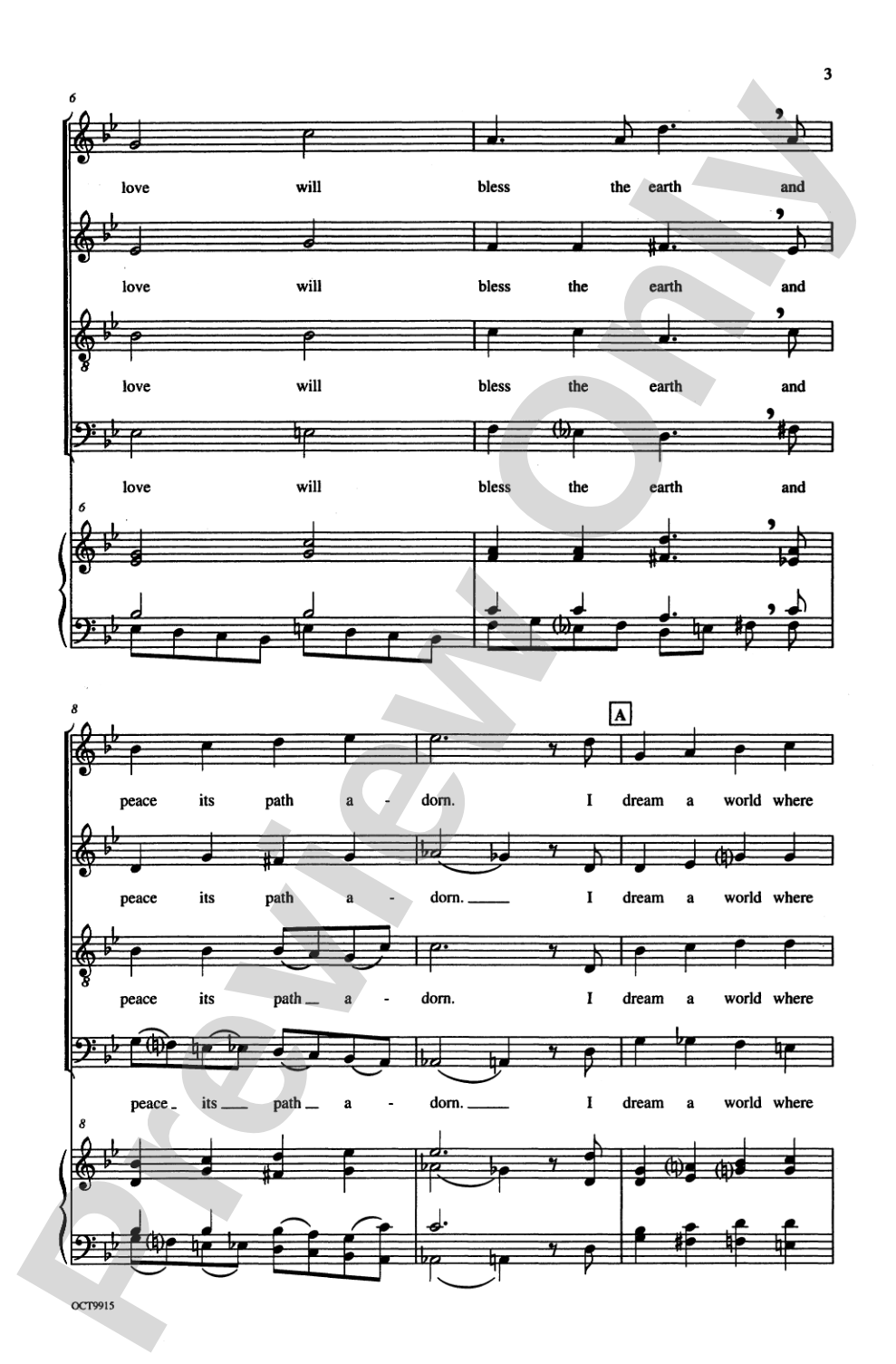
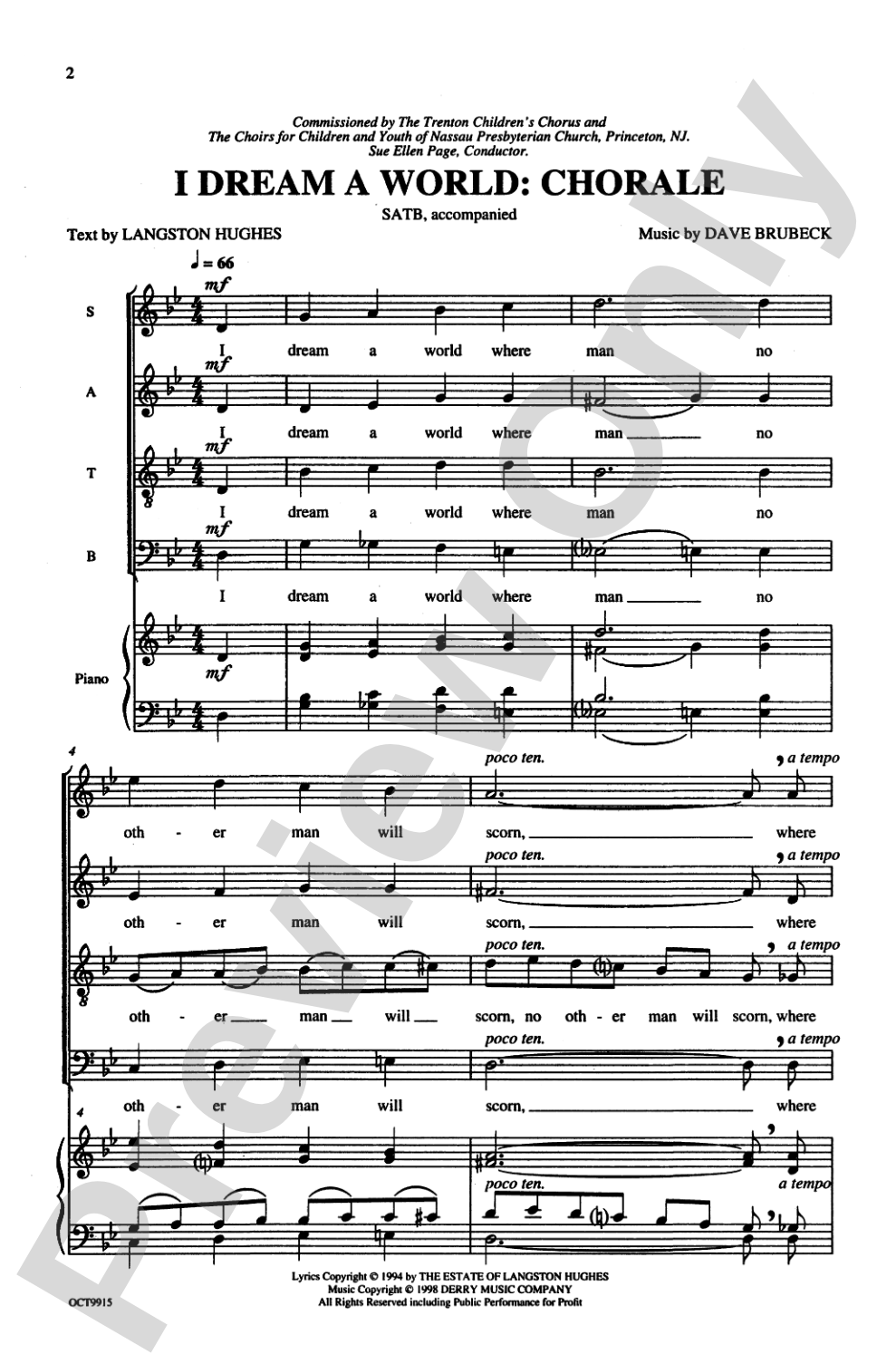
I Dream a World (Chorale) Sheet Music Preview

I Dream a World (Chorale): SATB Choral Octavo

By Dave Brubeck

Item: 00-PO-0005160

Digital Download
$2.25

Minimum order quantity: 20 copies

Description
This wonderful piece by Dave Brubeck is part of a series of titles taken from his larger work, "I Dream a World." Brubeck, in his world-famous musical style, has brought to life the powerful poetic text by Langston Hughes. In the world today, where we dream of a world of peace and harmony, the pieces are a joy to every soul that hears them. Although this work is a bit challenging, Brubeck does a wonderful job of making contemporary music accessible to choirs.

I Dream a World (Chorale): SATB Choral Octavo isn't in MakeMusic Cloud just yet...but it could be. Let us know you'd like to see it, and you'll help shape what comes next. In the meantime, start a free trial and dive into thousands of interactive titles your students can play along with today.

Sample Audio
No sample audio found.
Sample Video
Additional Details
Series: Alfred Archive Edition: Lawson-Gould Music Publishers
Publisher: Alfred Music
Page Count: 8
SKU: 00-PO-0005160

More about this title

About the Composer: Dave Brubeck

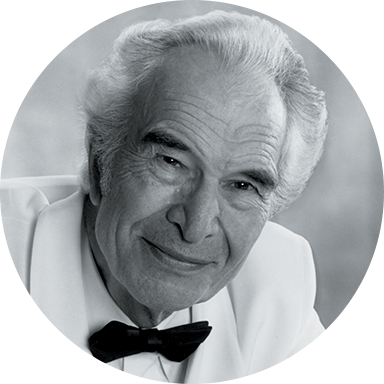
Dave Brubeck

Dave Brubeck forged a remarkable dual career as both a virtuoso jazz pianist and a serious classical composer. His improvisational mastery on the bandstand informed a prolific output that spans choral works, orchestral pieces, chamber music, and large-scale compositions for chorus and orchestra. He studied with Darius Milhaud at Mills College following World War II, an experience that shaped his lifelong commitment to blending jazz language with classical forms.

Brubeck's cultural impact extended far beyond the concert hall. The album "Time Out" became the first jazz recording to sell over a million copies, and his composition "Take Five" remains iconic. Beyond his groundbreaking artistry, he was instrumental in challenging racial barriers in mid-20th-century American music. His sacred works, including the mass "To Hope!" and oratorios such as "The Voice of the Holy Spirit" and "Beloved Son," have been performed and recorded internationally by major orchestras and choirs. Brubeck received the Grammy Lifetime Achievement Award, the Presidential Medal of the Arts, and was elected to the American Classical Music Hall of Fame in 2003.

Why we love this

Brubeck's setting of Hughes's visionary text manages to be both musically sophisticated and genuinely accessible to singers at the upper high school and collegiate level. The piece carries the unmistakable DNA of his jazz background (rhythmic vitality, harmonic color) while remaining thoroughly grounded in choral tradition, making it a standout choice for ensembles seeking contemporary sacred repertoire with real artistic substance.

What to expect

The piece radiates hope without sentimentality. Brubeck's harmonic language creates moments of lush color alongside passages of clarity and directness, reflecting Hughes's visionary but grounded text. There's an undercurrent of rhythmic vitality that keeps the music from ever feeling static, even in slower sections.

Who it's for

This octavo works well for treble-heavy or mixed choirs in high schools, community groups, and colleges who have some experience reading contemporary harmony. Singers need adequate sightreading skills and comfort with syncopation, making it suitable for ensembles beyond their first year of study.

How to get the most out of it

  • Study the harmonic progressions as a choir before diving into parts; Brubeck's jazz-influenced voicings will feel more idiomatic once singers understand their function rather than treating them as simply difficult intervals.
  • Shape the text with the same attention you'd give poetry in a literature class. Hughes's language carries weight, and the music should amplify that meaning rather than rush past it.
  • Balance the soprano and alto lines carefully in sections where they carry the primary melodic interest; contemporary scoring can obscure traditional voice hierarchy, and clarity serves the text.

How to use it

Program this as a anchor piece for a concert centered on justice, peace, or hope. Its contemporary idiom pairs naturally with spirituals or with other 20th-century choral works that tackle social themes. It also stands effectively as a solo choral feature in a mixed concert.

Skills your students will build

  • Reading jazz-influenced harmonies and voice leading
  • Rhythmic flexibility and syncopation in choral context
  • Text expression and poetic interpretation
  • Blend and balance in contemporary SATB voicings
  • Sustained legit tone within rhythmically active passages

You May Also Like