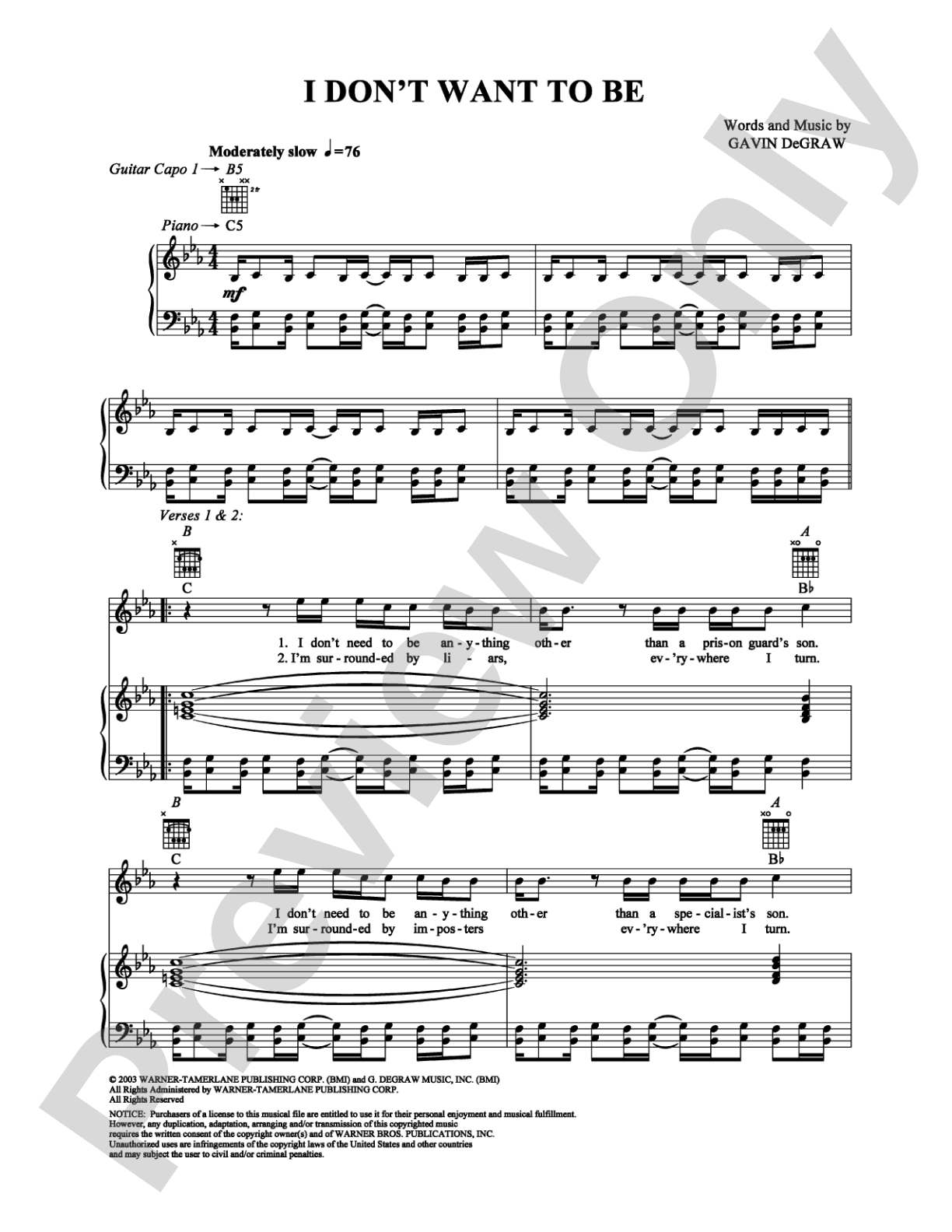
I Don't Want To Be: Piano/Vocal/Chords Digital Sheet Music

I Don't Want To Be: Piano/Vocal/Chords Digital Sheet Music

Gavin DeGraw

Item: 00-PS-0003660

Digital Download
$3.99
Description

I Don't Want To Be: Piano/Vocal/Chords Digital Sheet Music isn't in MakeMusic Cloud just yet...but it could be. Let us know you'd like to see it, and you'll help shape what comes next. In the meantime, start a free trial and dive into thousands of interactive titles your students can play along with today.

Sample Audio
No sample audio found.
Sample Video
Additional Details
SKU: 00-PS-0003660

More about this title

About the Artist: Gavin DeGraw

Gavin DeGraw is a singer-songwriter and pianist whose catalog spans pop rock, soul, and contemporary ballad writing. His work has earned Grammy nominations and widespread recognition for emotionally direct songwriting paired with strong melodic sensibility. In music education settings, his songs serve as accessible entry points for students learning to interpret contemporary material with vocal nuance and harmonic sophistication.

Why we love this

This song sits at the intersection of contemporary pop rock and genuine emotional vulnerability, making it compelling for students who want to work with material that feels current and honest. The vocal melody carries enough character to demand real interpretation, while the harmonic structure rewards thoughtful piano playing without becoming overly complex. Singers and pianists both find something substantial here rather than formulaic pop.

What to expect

Confident and raw at once, with a sense of someone standing their ground emotionally. The melody has a conversational quality that invites genuine vocal expression, supported by piano writing that feels purposeful without overwhelming the voice.

Who it's for

This piece works well for intermediate to advanced high school singers and pianists, as well as adult students exploring contemporary material. It appeals to anyone drawn to songs with emotional weight and clear melodic storytelling rather than technical display.

How to get the most out of it

  • Anchor the vocal phrasing to the piano's rhythmic foundation rather than pushing against it; the song's power comes from that unified sense of conviction
  • Pay attention to dynamic contrast between verses and the more driven moments; resist the urge to sing at full volume throughout
  • Let silence and space breathe in the arrangement; don't fill every moment with sound
  • Work the chord symbols to understand the harmonic shape, then decide where to voice fuller chords versus sparse ones depending on your arrangement choices

How to use it

Program this in a recital or concert highlighting contemporary singer-songwriter repertoire, or use it as a bridge piece between classical vocal literature and modern songwriting. It works equally well in a student recital or as part of a themed program exploring songs about identity and authenticity.

Skills your students will build

  • Interpreting contemporary vocal phrasing and emotional subtext
  • Balancing accompaniment and melody in a pop rock idiom
  • Reading chord symbols and making arrangement choices
  • Sustaining a clear harmonic center while maintaining rhythmic freedom

You May Also Like