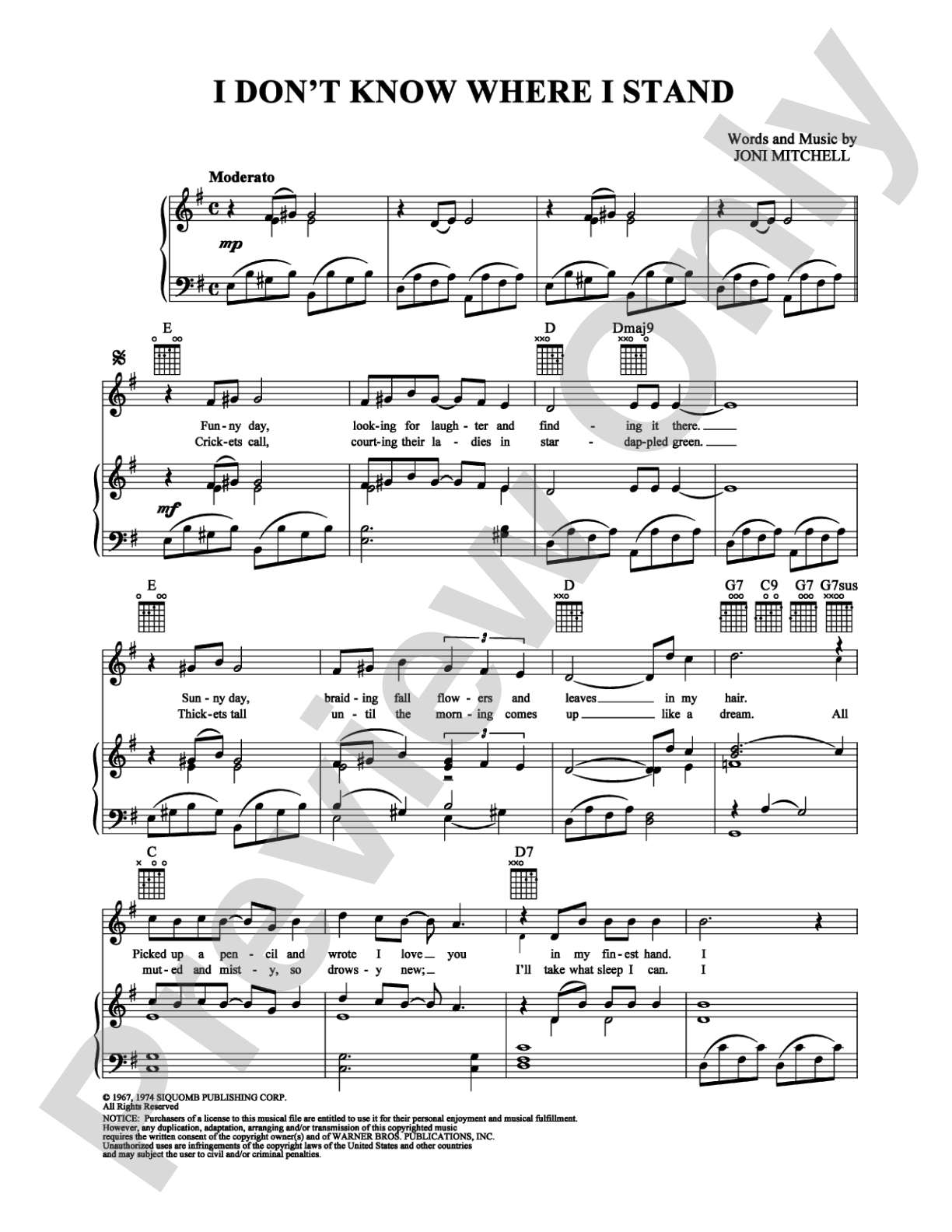
I Don't Know Where I Stand: Piano/Vocal/Chords Digital Sheet Music

I Don't Know Where I Stand: Piano/Vocal/Chords Digital Sheet Music

Joni Mitchell

Item: 00-PS-0009023

Digital Download
$3.99
Description

I Don't Know Where I Stand: Piano/Vocal/Chords Digital Sheet Music isn't in MakeMusic Cloud just yet...but it could be. Let us know you'd like to see it, and you'll help shape what comes next. In the meantime, start a free trial and dive into thousands of interactive titles your students can play along with today.

Sample Audio
No sample audio found.
Sample Video
Additional Details
SKU: 00-PS-0009023

More about this title

About the Artist: Joni Mitchell

Joni Mitchell stands among the most influential singer-songwriters of the late twentieth century, known for her distinctive alto voice, innovative guitar tunings, and lyrics that examine love, identity, and social consciousness with unflinching honesty. Her work spans folk, pop, rock, and jazz idioms, and her harmonic sophistication and poetic depth have shaped generations of musicians across genres.

Why we love this

Mitchell's songs reward close study of her lyrical precision and harmonic choices. This piano/vocal/chords arrangement opens her work to pianists and singers who want to engage with her compositional voice at the keyboard, making her sophisticated songwriting accessible across different musical entry points.

What to expect

Introspective and emotionally direct, the song draws you into a moment of personal reckoning. The music creates space for uncertainty and complexity rather than resolving into easy answers, mirroring the title's admission of standing at a crossroads.

Who it's for

This arrangement suits pianists with intermediate to advanced chord-reading skills who want to perform Mitchell's repertoire, as well as singers preparing for recital or studio work who need a flexible, notated foundation. It works for music students exploring how jazz-inflected harmony functions in popular songwriting.

How to get the most out of it

  • Attend to Mitchell's conversational phrasing; let the natural speech rhythms of the lyrics guide your tempo rather than locking into a metronomic beat.
  • Explore the chord voicings carefully. Mitchell's harmonic language often moves through unexpected sonorities, and how you voice these chords will shape the emotional arc.
  • Balance vocal vulnerability with instrumental presence. The piano should support rather than overshadow the lyrical storytelling.

How to use it

Include this in a contemporary art song recital or a program exploring female songwriters of the 1960s-70s. It pairs naturally with other introspective pop or singer-songwriter material and offers a bridge between classical song traditions and modern popular music.

Skills your students will build

  • Interpreting jazz-influenced chord symbols and chord extensions
  • Balancing vocal melody with piano accompaniment texture
  • Phrasing lyrics naturally across irregular metric patterns
  • Understanding harmonic language in contemporary songwriting

You May Also Like