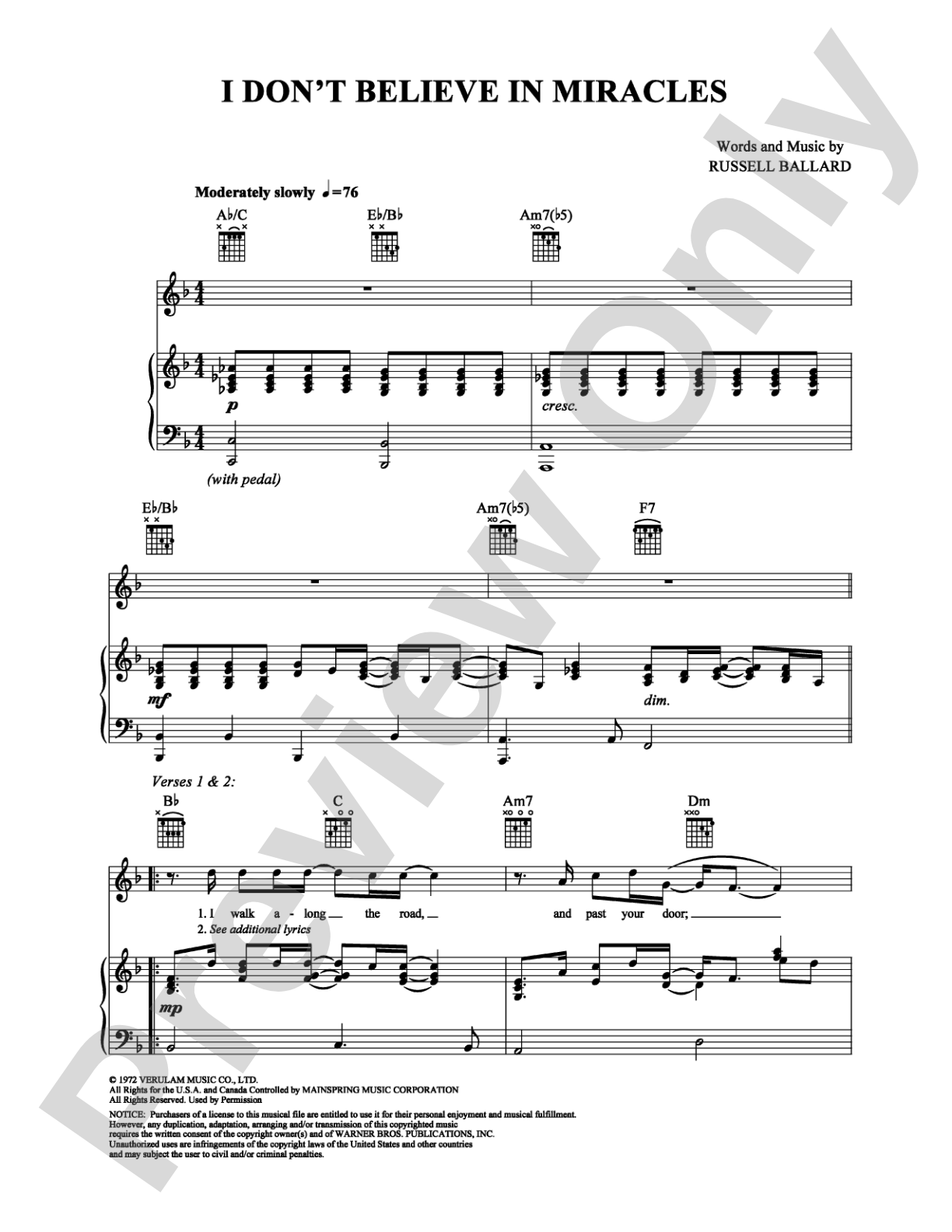
I Don't Believe in Miracles: Piano/Vocal/Chords Digital Sheet Music

I Don't Believe in Miracles: Piano/Vocal/Chords Digital Sheet Music

The Zombies, Russel Ballard

Item: 00-PS-0005017

Digital Download
$3.99
Description

I Don't Believe in Miracles: Piano/Vocal/Chords Digital Sheet Music isn't in MakeMusic Cloud just yet...but it could be. Let us know you'd like to see it, and you'll help shape what comes next. In the meantime, start a free trial and dive into thousands of interactive titles your students can play along with today.

Sample Audio
No sample audio found.
Sample Video
Additional Details
SKU: 00-PS-0005017

More about this title

About the Artist: The Zombies

The Zombies emerged from the British Invasion with a distinctly sophisticated sound, blending rock instrumentation with pop sensibility and jazz-inflected harmonies. Formed in 1961 in Hertfordshire, England, the band achieved international success with hits like "Time of the Season" and "She's Not There," showcasing their ability to craft melodically rich songs anchored by Colin Blunstone's distinctive vocals and Rod Argent's keyboard artistry.

Why we love this

This song captures what made The Zombies enduring: sophisticated pop-rock songwriting with genuine harmonic interest beneath an instantly singable melody. It's ideal for students who need to explore how rock repertoire can include jazz-influenced changes and countermelody lines without sacrificing accessibility.

What to expect

Wistful and introspective, with a narrator caught between hope and doubt. The harmonic language suggests something deeper than surface-level pop, with unexpected chord movements that mirror the emotional tension beneath the lyric.

Who it's for

Pianists and vocalists preparing pop-rock repertoire with harmonic sophistication, or students exploring how British Invasion songwriting blends vocal melody, keyboard support, and jazz-influenced chords. This works well for recital preparation, ensemble collaboration, or classroom study of rock-era composition.

How to get the most out of it

  • Balance the vocal line against the piano accompaniment so lyrics remain clear; the chords provide harmonic texture, not the primary voice.
  • Pay attention to the harmonic rhythm in the chord progression; some changes may feel quicker than expected in the verse, requiring precise rhythmic coordination between vocalist and pianist.
  • Shape the melody with attention to phrasing across the bar lines rather than stopping at each measure, allowing the song's arc to build naturally.
  • Use the chord chart to explore voicing options; richer, fuller voicings will suit the song's sophisticated harmonic palette better than sparse ones.

How to use it

Feature this in a recital exploring 1960s songwriting craft, pairing it with similar era material that values melodic and harmonic invention. It also works as a performance piece for piano-voice duet recitals or in vocal jazz contexts where students study arrangement and harmonic reharmonization.

Skills your students will build

  • Reading and interpreting chord symbols over a lead sheet
  • Coordinating vocal phrasing with piano accompaniment
  • Understanding harmonic movement in pop-rock contexts
  • Balancing lyrical clarity with musical accompaniment

You May Also Like