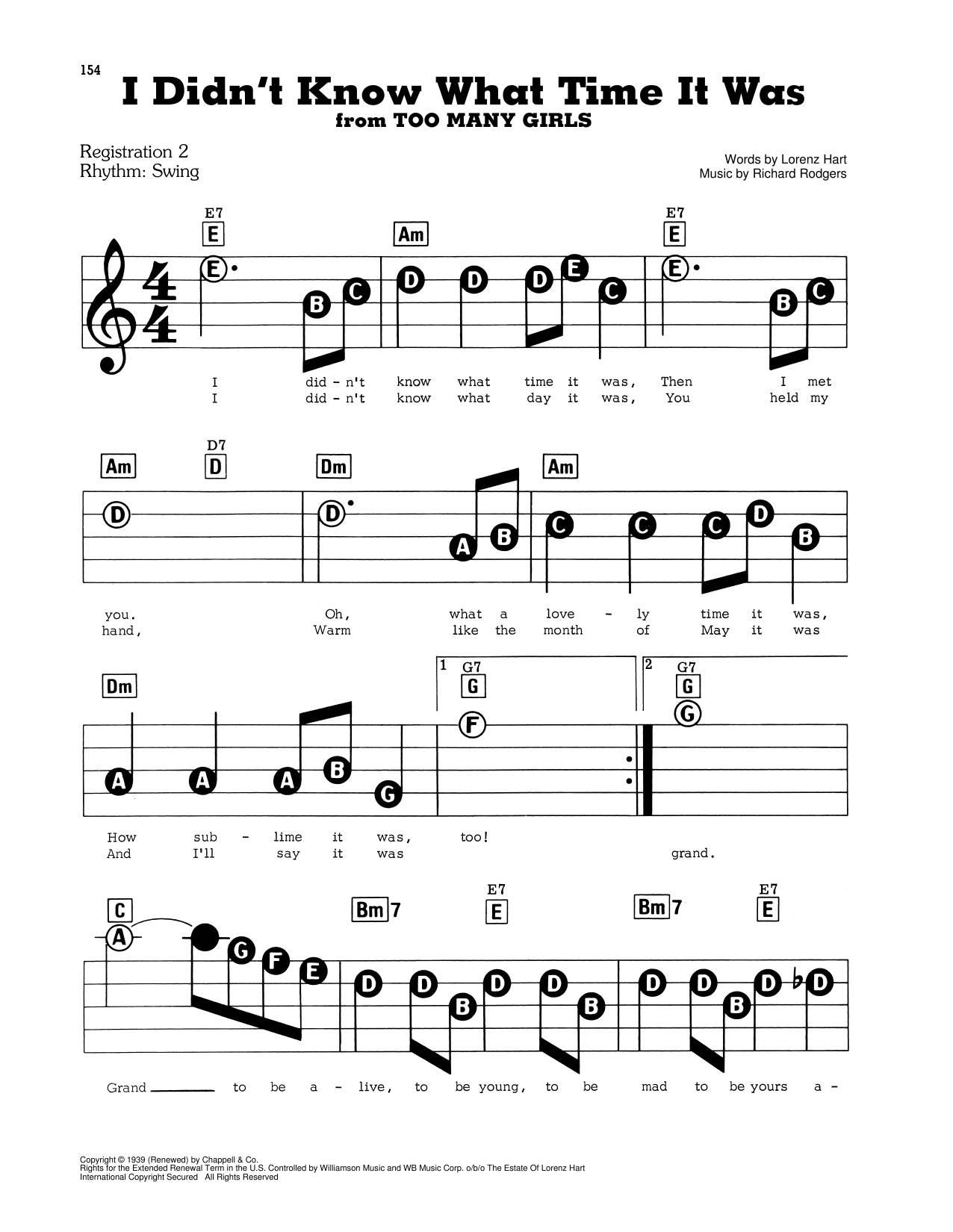
I Didn't Know What Time It Was (from Too Many Girls) Sheet Music Preview

I Didn't Know What Time It Was (from Too Many Girls): E-Z Play Today

Item: 35-DS00460083

Digital Download
$4.99
Description

I Didn't Know What Time It Was (from Too Many Girls): E-Z Play Today isn't in MakeMusic Cloud just yet...but it could be. Let us know you'd like to see it, and you'll help shape what comes next. In the meantime, start a free trial and dive into thousands of interactive titles your students can play along with today.

Sample Audio
No sample audio found.
Sample Video
Additional Details
Publisher: Hal Leonard
Page Count: 2
SKU: 35-DS00460083

More about this title

About the Creator

Rodgers and Hart defined the American songbook through their extraordinary partnership in the 1930s and 1940s. Richard Rodgers composed melodies of unforgettable sophistication while Lorenz Hart supplied lyrics of uncommon wit and emotional depth. Their work for Broadway musicals like Too Many Girls established standards that jazz musicians, pop singers, and classical pianists have treasured for generations.

Hart's ability to craft lyrics that matched the contour and surprise of Rodgers' harmonic language made their songs endlessly singable yet harmonically rich. Piano arrangements of their material remain essential for any musician exploring the Great American Songbook, offering both accessibility and depth.

Why we love this

This tune sits at a sweet spot between approachability and harmonic interest. The E-Z Play format makes it genuinely playable for intermediate pianists while preserving the sophisticated chord changes that made Hart and Rodgers legendary, so your students get real musicianship without the transcription struggle.

What to expect

Nostalgic and intimate, like overhearing a jazz pianist in a quiet room late at night. The song unfolds with genuine emotional directness, moving through its harmonic landscape with the kind of conversational ease that makes you want to linger on every phrase.

Who it's for

Intermediate pianists ready to dig into jazz standards without needing a music theory PhD to find their way through the changes. It works equally well for students who read lead sheets or those who prefer traditional notation with embedded harmony.

How to get the most out of it

  • Let the melody breathe on the first statement. Resist oversustaining the held notes; they'll land better with natural weight rather than artificial emphasis.
  • Treat the accompanying figures as conversational rather than mechanical. A slight pulse variation in the left hand mirrors how a jazz pianist responds to their own melody.
  • The harmonic movement is the real story here. Mark chord changes that move by chromatic steps so you hear and feel their voice leading rather than playing changes as abstract symbols.

How to use it

Pair this with other Rodgers and Hart standards to build a concert set that celebrates American songwriting, or use it as an interlude piece between larger ensemble works. It also serves beautifully as a solo feature if you're looking for something that doesn't require accompaniment.

Skills your students will build

  • Reading and interpreting lead sheet notation with jazz chord symbols
  • Voice leading through chromatic and diatonic harmonic progressions
  • Balancing melody with accompanying figures at the intermediate level
  • Stylistic phrasing appropriate to jazz and popular song repertoire

You May Also Like